When a persistent manufacturing challenge meets cutting-edge technology and collaborative spirit, the results can be transformative. This was precisely the scenario that unfolded when K-Rain, a prominent manufacturer of irrigation products, joined forces with Zero Tolerance LLC, Xact Metal, and Reaction Plastics Solutions. Their collective endeavor aimed to resolve a critical cooling inefficiency within one of K-Rain’s molds, ultimately leading to significant improvements in cycle time, part quality, and process repeatability. The innovation at the heart of this success story lies in the application of 3D-printed conformal cooling inserts, a testament to the evolving landscape of modern moldmaking and additive manufacturing.
The impetus for this collaboration originated from a common demand in the manufacturing sector: the relentless pursuit of faster production cycles. K-Rain approached Steve Michon, the founder of Zero Tolerance LLC, with a specific request to develop conformal-cooled inserts. The existing mold design utilized traditional thermal pins, which, due to their localized placement, created an area of inefficient and uneven cooling. "Everywhere else in the mold was fine, but this section wasn’t cooling efficiently," Michon explained, highlighting the bottleneck that was impacting K-Rain’s productivity. This uneven cooling led to longer cycle times, a higher incidence of part warpage, and surface defects, all of which compromised the quality and consistency of K-Rain’s irrigation components.
From Traditional Pins to Advanced Cooling: A Design Evolution

The limitations of traditional cooling methods became apparent as the team delved deeper into the problem. The critical area in question was a thin cross-section near the core tip of the mold. The confined space in this region severely restricted the effective placement and number of conventional thermal pins. While these pins were adequate for other parts of the mold, they failed to adequately dissipate heat from this specific hot spot, creating a persistent performance issue. This challenge presented an ideal opportunity to explore alternative, more sophisticated cooling solutions.
Steve Michon, with his keen interest in advanced manufacturing technologies, recognized the potential of 3D-printed conformal cooling. He had been exploring metal additive manufacturing for some time, finding the capabilities compelling but the initial investment in machinery prohibitive for his business. The emergence of compact metal 3D printers, such as those offered by Xact Metal, presented a timely and accessible solution. This technological advancement allowed Zero Tolerance to bring the metal printing process in-house, empowering them to undertake innovative projects like the one for K-Rain.
The Xact Metal Advantage: Bringing Innovation In-House
The decision to invest in Xact Metal’s technology was strategic. Scott Kraemer, senior sales manager at Xact Metal, played a pivotal role in advising Michon and his team. "This project with K-Rain was unique because we started without knowing for sure that conformal cooling would make a difference," Michon admitted. "But based on past experience and the experience of Scott Kraemer… we decided to go for it." This calculated risk, underpinned by industry expertise and faith in emerging technology, set the stage for a successful outcome.

The collaborative design process involved close coordination between Zero Tolerance and Xact Metal. The goal was to engineer conformal cooling channels that precisely followed the contours of the mold cavity, ensuring uniform heat extraction. This approach deviates significantly from traditional cooling, where straight-line channels or pins are employed, often leading to localized temperature variations. The design focused on replacing the problematic core cap with a 3D-printed insert featuring these intricate, custom-designed cooling channels. This allowed for optimal heat management within the limited spatial constraints of the critical zone, without compromising the structural integrity of the mold steel.
Material Selection: Corrax for Durability and Performance
A crucial aspect of the project was the selection of the appropriate material for the 3D-printed inserts. Given that K-Rain’s facility is located in the Dominican Republic, a region known for its humid and salty air, material resilience and durability were paramount. The team opted for Uddeholm’s Corrax stainless steel. This material was chosen for its exceptional properties, including its ability to be hardened, polished, and welded, while also offering excellent resistance to corrosion. These characteristics made Corrax an ideal choice for the demanding environmental conditions and the need for high-performance tooling.
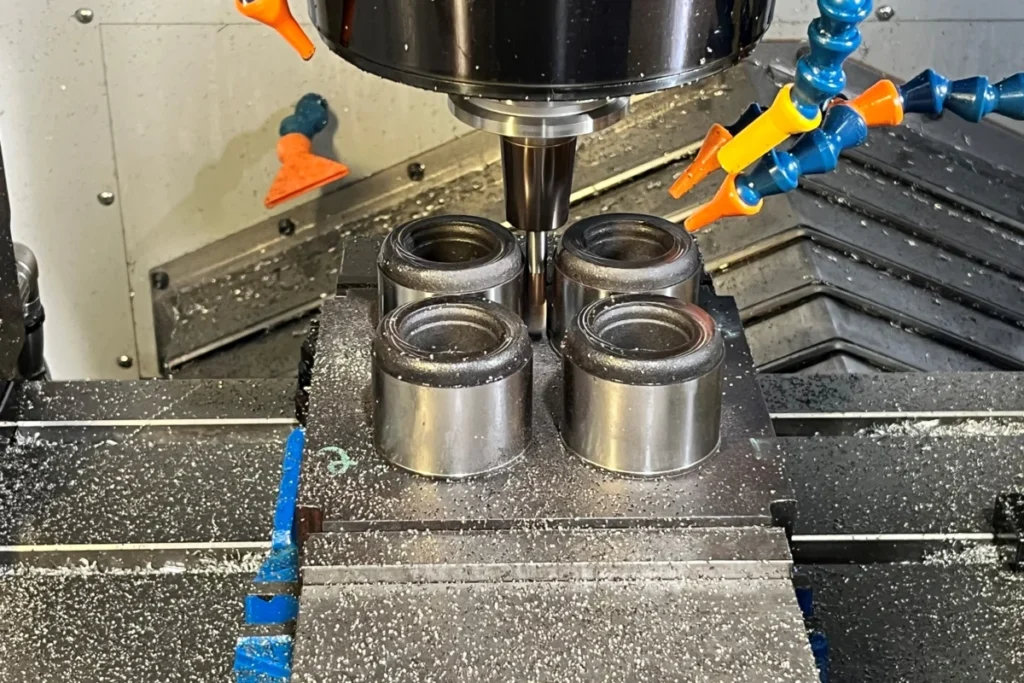
The manufacturing process for the conformal-cooled inserts was streamlined and executed entirely in-house by Zero Tolerance. The inserts were printed directly on the additive manufacturing build plate, minimizing post-processing requirements. Following the printing, they underwent machining and electrical discharge machining (EDM) to achieve the precise dimensions and surface finish required. The final polish to an A2 standard met K-Rain’s stringent quality specifications, ensuring the inserts integrated seamlessly into the existing mold.

Simulation Meets Reality: Validating the Design
A particularly insightful aspect of this project was the timing of the simulation. Typically, simulations are conducted prior to manufacturing to validate a design. In this case, however, the simulation by Reaction Plastics Solutions, led by Richard Evans, was performed after the conformal-cooled tool had already been manufactured and put into operation. This provided a unique opportunity to compare virtual predictions with real-world performance data.
The simulation results aligned remarkably well with the observed improvements, underscoring the accuracy of modern simulation software. Evans noted, "The two lined up remarkably well, demonstrating how accurate modern simulation has become." The simulation revealed a stark contrast in temperature distribution between the original design and the conformal-cooled insert. In the original mold, temperature mapping indicated a significant hot spot developing within 31 seconds of the cycle. In contrast, the conformal cooling design exhibited a much more uniform temperature distribution, with heat dissipating more rapidly and efficiently.
This more even temperature profile directly translated into a host of tangible benefits for K-Rain. The consistent cooling of the molded parts led to reduced shrinkage variations, effectively eliminating warpage and sink marks that had previously plagued the top sections of the components. Furthermore, the simulation validated the performance of the cooling circuit itself. It indicated favorable Reynolds numbers, suggesting efficient fluid flow, and a manageable pressure drop of approximately 40 PSI. These factors are critical for ensuring optimal performance, especially in multi-cavity tooling applications where consistent cooling across all cavities is essential.

Evans emphasized the value of simulation in the moldmaking process: "Of course, running a project like this without simulation is risky. A simulation might cost a few thousand dollars, while redesigning and re-machining tooling can run far more expensive if things don’t work out." This statement highlights how simulation acts as a crucial risk mitigation tool, preventing costly errors and rework by providing predictive insights into the performance of a mold design before significant capital is invested in its physical realization.
Quantifiable Results: A 20% Improvement in Cycle Time
The impact of the 3D-printed conformal cooling inserts on K-Rain’s production process was substantial and measurable. Following the implementation of the new inserts, the mold’s cycle time saw a dramatic reduction. Steve Michon reported, "K-Rain’s new tool ran 10 seconds faster per cycle, dropping from 54 seconds to around 44, an 18-20% improvement." While acknowledging that a servo motor upgrade also contributed approximately two seconds to this gain, the majority of the improvement was directly attributable to the enhanced cooling efficiency provided by the conformal channels.
This significant reduction in cycle time translates directly into increased throughput and a lower cost per part. For a high-volume manufacturer like K-Rain, even a modest percentage improvement can have a substantial impact on overall profitability and competitiveness. Beyond the speed enhancement, the elimination of warpage and sink marks led to a marked improvement in part quality and consistency, reducing scrap rates and enhancing customer satisfaction. The successful implementation also established a repeatable and reliable process that K-Rain is now considering for integration into new mold designs.

Broader Implications and Lessons Learned
This collaborative project between K-Rain, Zero Tolerance LLC, Xact Metal, and Reaction Plastics Solutions serves as a compelling case study for the broader manufacturing industry. It demonstrates the power of interdisciplinary collaboration, where expertise in moldmaking, additive manufacturing, material science, and simulation converge to solve complex engineering challenges. The success of the conformal cooling inserts in improving efficiency and quality highlights the growing importance of advanced manufacturing techniques in maintaining a competitive edge.
For companies exploring metal additive manufacturing, the project offers several valuable takeaways:
- Strategic Investment in Accessible Technology: The adoption of Xact Metal’s compact printer showcases how advanced capabilities can be integrated into smaller to medium-sized businesses without requiring exorbitant capital expenditure. This democratizes access to cutting-edge manufacturing technologies.
- The Importance of Material Expertise: The careful selection of Corrax stainless steel, considering both its technical performance and environmental resilience, proved critical to the long-term success of the solution. Understanding material properties is paramount when leveraging additive manufacturing for critical tooling.
- The Power of In-House Capabilities: Zero Tolerance’s ability to print, machine, and finish the inserts in-house provided them with greater control over the process, reduced lead times, and allowed for rapid iteration if needed. This vertical integration is a key advantage for innovation.
- Bridging the Simulation-Design Gap: The project underscored the synergy between simulation and practical application. While simulation can predict performance, real-world testing and data collection are invaluable for validating and refining designs. The fact that the simulation confirmed the observed improvements after the fact reinforces its predictive power and its role in de-risking future projects.
- Focus on Specific Challenges: Instead of attempting to overhaul the entire mold at once, the team focused on addressing the most critical cooling bottleneck. This targeted approach allowed for a more efficient and cost-effective solution, demonstrating that even incremental improvements can yield significant results.
The story of K-Rain’s mold optimization is more than just a tale of faster production cycles. It’s a narrative of how embracing new technologies, fostering collaboration, and applying rigorous engineering principles can lead to measurable advancements in manufacturing. What began as a trial to resolve a specific cooling issue has evolved into a powerful demonstration of the potential of additive manufacturing and advanced cooling strategies to revolutionize mold design and production, setting a new benchmark for efficiency and quality in the industry. The measured success of this project serves as a potent reminder that when the right technology is combined with the right expertise and a spirit of innovation, progress is not merely achievable, but demonstrably impactful.