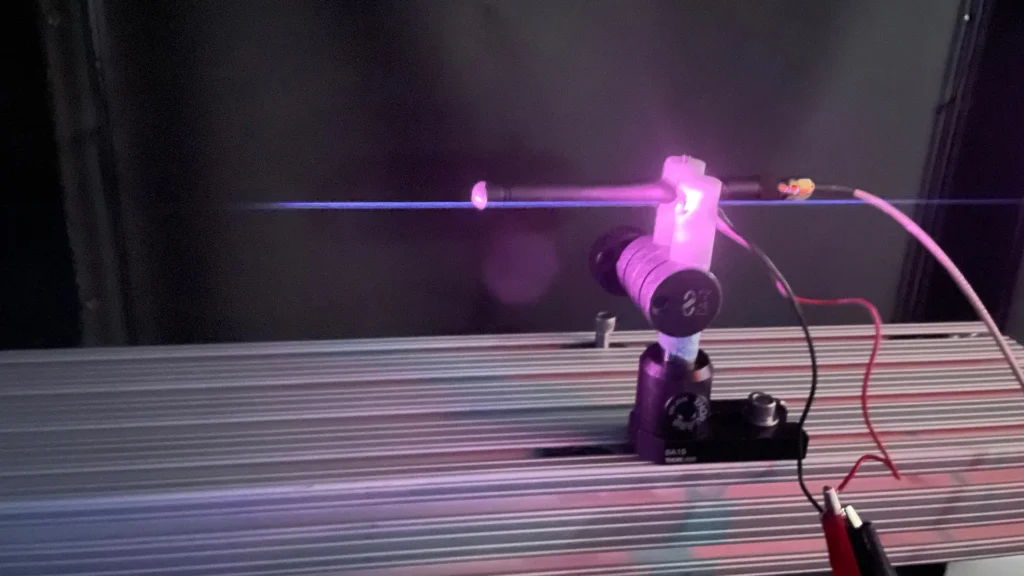
In a significant departure from more than a century of radio frequency engineering, researchers at North Carolina State University have successfully demonstrated a functioning radio antenna composed not of solid metal, but of a laser-generated plasma filament. This breakthrough, which visually mimics the glowing blade of a "lightsaber," represents a paradigm shift in how electromagnetic waves can be transmitted. By utilizing a high-intensity laser to ionize the air and create a conductive channel, the team has proven that traditional physical structures—long the bottleneck in agile communications—can be replaced by ephemeral, tunable, and highly adaptable beams of energy.
The research, recently published in the IEEE Journal of Microwaves, details a system where a laser beam is used to strip electrons from air molecules, creating a narrow column of plasma. Because plasma contains a high density of free-moving electrons, it exhibits electrical conductivity similar to that of copper or aluminum. This conductive "filament" then acts as the radiating element for radio signals. The implications for this technology are vast, ranging from ultra-lightweight satellite communications to radar systems that can reconfigure their frequency and direction in a fraction of a second without the need for mechanical motors or complex phased arrays.
The Mechanics of Laser-Induced Ionization
To understand the magnitude of this achievement, one must first look at the physics of the plasma filament. Plasma is frequently referred to as the fourth state of matter. It occurs when a gas is energized to the point that its constituent atoms lose their electrons, resulting in a soup of positively charged ions and free electrons. In the NC State experiment, the researchers employed a laser to achieve this state within a localized region of the atmosphere.
By precisely controlling the laser’s power and beam diameter, the team created what is known as a "plasma filament." Unlike a standard spark or a wide-area discharge, a filament is a highly concentrated, needle-like channel of ionized gas. This channel serves as the physical medium through which radio frequency (RF) energy can travel.
"The plasma beam antenna looks like a lightsaber and is tunable, meaning we should be able to transmit across a broad range of frequencies," explained Prya Darshni, a Ph.D. student at North Carolina State University and the corresponding author of the study. While the current demonstration focused on transmission, Darshni noted that the underlying physics suggests the device should be equally capable of functioning as a receiver, capturing incoming radio waves and converting them back into electrical signals.
Overcoming the Connection Challenge: The Contactless Feed
One of the primary hurdles in developing a plasma-based antenna is the "feed" mechanism. In a traditional radio, a wire connects the transmitter to the metal antenna. However, connecting a physical wire to a high-energy plasma beam created by a laser presents significant engineering difficulties, including potential interference with the laser path and the degradation of the wire under high temperatures.
The NC State team, led by Darshni and Paul Franzon, the Cirrus Logic Distinguished Professor of Electrical and Computer Engineering, solved this by designing a contactless antenna feed. This system utilizes a metal ring that acts as a capacitor. As the laser passes through the center of this ring, it generates the plasma filament. When a radio signal is pumped into the capacitor ring, it generates an electromagnetic field that couples with the plasma filament passing through its center.
This inductive coupling allows energy to be transferred from the transmitter to the plasma beam without any physical contact. In their experimental setup, the researchers were able to successfully transmit a signal at 30 megahertz (MHz), which falls within the Very High Frequency (VHF) band. This frequency range is traditionally used for FM radio broadcasting, television stations, and two-way land mobile radio systems.
Historical Context and the Evolution of Antenna Design
The concept of a plasma antenna is not entirely new; researchers have explored the use of ionized gas for radio communication for several decades. However, previous iterations typically relied on "plasma tubes"—glass vessels filled with noble gases like neon or argon that were ionized via electrodes. While effective, these systems were still bound by the physical dimensions of the glass tubes, limiting their flexibility.
The move toward laser-induced plasma represents the "holy grail" of this field. By removing the glass enclosure, the antenna becomes truly virtual. The length of the antenna is no longer determined by a factory-manufactured tube or a telescoping metal rod, but by the focal length and power of the laser beam.
In traditional antenna theory, the physical length of the antenna is intrinsically linked to the wavelength of the signal it is designed to carry (often a half or quarter-wavelength of the target frequency). To change frequencies significantly, one usually needs to change the antenna’s size. In space or military applications, this requires complex mechanical deployment systems that are prone to failure. The laser-induced plasma filament removes this mechanical dependency, allowing the "length" of the antenna to be adjusted electronically by simply recalibrating the laser.
Implications for Space Exploration and Satellite Technology
Perhaps the most immediate application for this technology lies in the aerospace sector. Spacecraft and satellites are governed by strict "Size, Weight, and Power" (SWaP) constraints. Every gram of weight added to a satellite increases the cost of launch, and every moving part represents a potential point of failure in the harsh environment of space.
Current satellite designs often feature large, deployable mesh antennas or long booms that must be folded into a fairing during launch and unfolded once in orbit. These mechanical deployments are among the most high-risk moments of a satellite’s mission. A laser-based system could theoretically eliminate these mechanisms.
"In low Earth orbit, there is sufficient air to form a plasma," noted Professor Paul Franzon. While the atmosphere is thin, it provides enough medium for a laser to create the necessary ionization for short-range or specialized communications. Furthermore, the ability to "steer" the beam—changing the antenna’s direction by simply moving a mirror—allows for high-speed tracking of ground stations or other satellites without rotating the entire spacecraft.
Analysis of Strategic and Industrial Impact
The flexibility of a "lightsaber" antenna offers significant advantages in electronic warfare and signal intelligence. In a military context, a metal antenna is a permanent fixture that can be detected by radar or visual surveillance. A plasma antenna, however, can be "turned on" for a millisecond to transmit a burst of data and then "disappeared" instantly as the laser is powered down. This provides a level of stealth and operational security that traditional hardware cannot match.
Furthermore, the ability to sweep across a broad range of frequencies—known as frequency agility—is critical for modern communications. As the electromagnetic spectrum becomes increasingly crowded, the ability for a single device to jump between bands to find clear channels is invaluable.
From a commercial perspective, this could lead to a new generation of "smart" base stations. While the current experiment used 30 MHz, future iterations could target the higher frequencies used in 5G and 6G telecommunications. If a base station could project its antenna beam exactly where it is needed, it could reduce interference and increase the efficiency of data transmission in dense urban environments.
Technical Challenges and Future Research Directions
Despite the successful proof of concept, the transition from a laboratory "lightsaber" to a field-ready communication system faces several hurdles.
- Power Consumption: Generating a laser beam powerful enough to ionize the air requires significant energy. For portable or satellite applications, the efficiency of the laser-to-plasma conversion will be a critical metric.
- Atmospheric Conditions: The stability of a plasma filament can be affected by wind, humidity, and air pressure. While the NC State team demonstrated success in a controlled environment, real-world atmospheric turbulence could cause the "antenna" to flicker or distort, leading to signal noise.
- Signal Reception: As mentioned by Prya Darshni, the team has yet to formally demonstrate the system’s efficacy as a receiver. Receiving signals requires the plasma to be sensitive to very weak incoming electromagnetic waves, which may require different plasma densities than those used for transmission.
- Frequency Scaling: Moving from the 30 MHz VHF band to the gigahertz (GHz) range used by modern smartphones and satellite internet will require even finer control over the plasma filament’s properties.
Conclusion: A Big Step Toward Virtual Infrastructure
The work conducted by Darshni, Franzon, and their collaborator Arthur Dogariu (of Texas A&M and Princeton University) represents the first time a plasma-filament antenna has been proven to work in a transmission capacity. It marks the beginning of an era where communication hardware is no longer "hard," but rather a dynamic manifestation of energy.
The support from the NC State Instrument Shop, specifically the contributions of Chris Hewett, Byron Goode, and Joe McElveen, underscores the interdisciplinary nature of this project, blending high-level physics with precision mechanical engineering to create the contactless feed system.
As the team moves forward, their focus will likely shift toward refining the stability of the filament and testing the system across a wider spectrum of frequencies. While the "lightsaber" antenna may seem like a concept from science fiction, its successful demonstration at 30 MHz suggests that the future of wireless communication may not be made of metal, but of light and ionized air. "This is the first step, but it is a big step," Darshni concluded. "Now that we’ve shown it is possible, we can begin improving its performance."