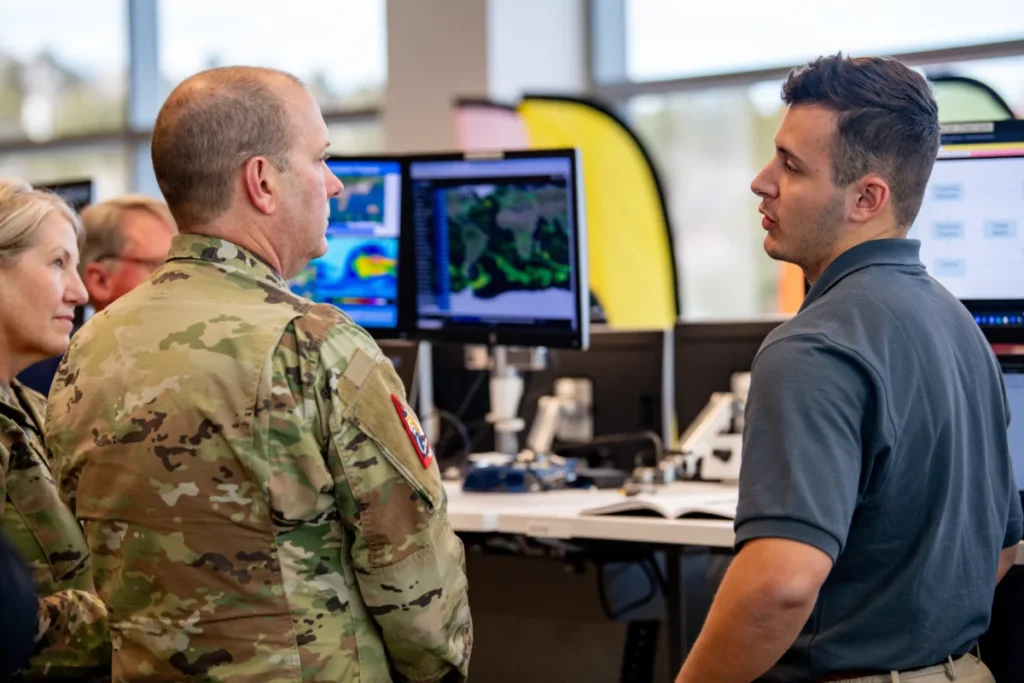
The U.S. Space Force’s commercial software laboratory has recently emerged from a comprehensive renovation, poised to welcome its inaugural cohort of participants under a significantly revamped operational model. This strategic overhaul, marked by a new name, extended program timelines, and dynamic focus areas, is meticulously designed to establish a more robust and efficient pathway for integrating cutting-edge software solutions into the Space Force’s operational arsenal. The initiative represents a crucial step in the Space Force’s ongoing effort to modernize its digital infrastructure and enhance its capabilities in an increasingly complex and contested space domain.
From SDA TAP Lab to BMC3I TAP Lab: A New Paradigm for Software Integration
The facility, previously known as the Space Domain Awareness Tools, Applications and Processing (SDA TAP) Lab, faced challenges in consistently transitioning promising technologies into official programs of record. Lieutenant Colonel Collin Greiser, a program leader within System Delta 85 and a key figure in the lab’s transformation, acknowledged these past limitations. "Where the SDA TAP Lab wasn’t quite as effective is transitioning the technology to programs of record," Greiser stated. While the lab had achieved some successes, he characterized them as "an exception rather than a norm."
The newly christened Battle Management, Command, Control, Communications, and Space Intelligence (BMC3I) TAP Lab is intended to directly address these shortcomings. "We’re trying to solve all that with how the BMC3I TAP Lab was rearchitected," Greiser emphasized. This rebranding signifies a broader strategic scope, moving beyond the specific focus on Space Domain Awareness to encompass a wider spectrum of critical space operations.
A Structured Pathway for Innovation: From Pitch to Program of Record
Under the previous SDA TAP Lab model, companies participated in intensive three-month programs. During this period, they were tasked with developing products, concepts, and research to tackle specific software challenges identified by the Space Force. The last cohort under this old structure concluded its work in March, marking the end of an era for the lab.
The revamped BMC3I TAP Lab, first announced in July, adopts a more expansive vision. Its primary objective is to identify and foster innovative software solutions that bolster the Space Force’s capabilities in battle management, command and control, communications, and space intelligence. This mission aligns directly with the goals of the Space Force’s Kronos program, which shares the same focus areas and is also spearheaded by Lt. Col. Greiser.
The new model introduces a "staged approach" for participants, with each engagement anticipated to last approximately one year. While the duration is significantly extended, the lab aims to accommodate up to three cohorts annually, thereby increasing the overall throughput of innovative solutions.
The participant journey begins with teams applying and presenting their technological concepts for one of the lab’s designated focus areas. These focus areas are not static; they are designed to rotate over time, reflecting evolving operational needs and emerging technological trends. Once selected, teams undergo an initial six-week phase focused on integration with the lab’s environment and demonstrating their coding capabilities. This foundational stage ensures that the proposed solutions are technically sound and can be readily integrated into existing or future Space Force systems.
Following this initial demonstration, participants enter subsequent stages that are conceptually similar to Phases II and III of the Small Business Innovative Research (SBIR) program. During these phases, companies have the opportunity to secure work and further develop their solutions. The BMC3I TAP Lab itself does not directly provide funding to participants. Instead, funding is channeled through SpaceWERX, the Space Force’s dedicated innovation arm. Greiser explained that the lab’s processes are tightly integrated with SpaceWERX’s calls for SBIR contract awards. "When I let a focus area, I’ve already precoordinated with SpaceWERX," he noted, ensuring a seamless transition from lab participation to potential government contracts.
As teams progress through the lab, they are expected to refine their software, enhance their cybersecurity posture, and successfully navigate a series of rigorous tests. This iterative process culminates in the "proving ground," serving as the lab’s exit point. "When you ‘graduate’ that model and that proving ground, you have a high chance of getting a contract with the government," Greiser stated. The Kronos program, with its commercial solutions opening, provides a direct avenue for lab graduates to pursue more substantial contracts, although successful acquisition is not guaranteed.
Initial Focus Areas: Addressing Critical Operational Needs
The BMC3I TAP Lab has announced its initial focus areas for the first cohort, reflecting direct input from Space Force operators. These include:
- Battle Damage Indications/Assessment: This area aims to foster innovative solutions for fusing data to accurately assess battle damage in space. Such capabilities are critical for understanding the impact of adversary actions and for post-conflict restoration efforts.
- Crimson Forge: This focus area seeks to build upon previous advancements in space domain awareness, likely enhancing the ability to detect, track, and identify objects and activities in space.
The selection of these topics underscores the Space Force’s immediate priorities in maintaining situational awareness and responding effectively to threats in the space domain. Greiser indicated that the first cohort was nearing an announcement in mid-September, signaling the imminent launch of this new operational paradigm.
The Broader Strategic Context: Modernizing Space Operations
The establishment and restructuring of the BMC3I TAP Lab are part of a larger, ongoing effort by the U.S. Space Force to modernize its operational capabilities and foster a more agile and responsive acquisition process. The traditional defense procurement cycle has often been criticized for its slow pace, which can hinder the integration of rapidly evolving commercial technologies. Initiatives like the BMC3I TAP Lab are designed to bridge this gap by creating a more direct and efficient channel between commercial innovators and the military’s operational needs.
The Space Force, as the newest branch of the U.S. armed forces, faces unique challenges in developing and deploying advanced capabilities in a domain that is rapidly transforming. The increasing reliance on space-based assets for communication, navigation, intelligence, and surveillance necessitates a robust and resilient space architecture. Furthermore, the growing threat of adversaries developing capabilities to disrupt or deny access to space assets adds a layer of urgency to these modernization efforts.
Supporting Data and Industry Trends
The push for faster software integration is not unique to the Space Force. Across the Department of Defense, there is a recognized need to accelerate the adoption of commercial off-the-shelf (COTS) software and to embrace agile development methodologies. The U.S. Department of Defense’s annual budget consistently allocates significant resources to research, development, test, and evaluation (RDT&E), with a growing portion dedicated to software-intensive systems. While specific figures for the BMC3I TAP Lab are not publicly detailed, the overall investment in space technology R&D by the U.S. government has been on an upward trajectory, driven by both national security imperatives and commercial sector growth.
The commercial space industry has experienced a boom in recent years, with a proliferation of startups and established companies developing innovative solutions in areas such as satellite technology, data analytics, cybersecurity, and artificial intelligence. The BMC3I TAP Lab aims to tap into this vibrant ecosystem, leveraging the agility and innovation of the private sector to meet the Space Force’s specific requirements. The SBIR program, which plays a central role in the lab’s model, has historically been a critical funding mechanism for small businesses engaged in R&D, leading to numerous technological advancements and commercial spin-offs.
Implications and Future Outlook
The success of the BMC3I TAP Lab could have significant implications for the Space Force’s ability to maintain its technological edge. By providing a structured and supportive environment for commercial companies, the lab can help de-risk the adoption of new technologies and reduce the time it takes to bring them into operational service. This could lead to more responsive force-tailoring and a greater ability to adapt to evolving threats and operational requirements.
The extended timelines and staged approach are designed to ensure that the software developed is not only innovative but also robust, secure, and ready for integration into complex military systems. The emphasis on cybersecurity and rigorous testing is crucial, given the high-stakes nature of space operations.
The rotating focus areas will allow the lab to remain agile and responsive to emerging needs, ensuring that it continues to address the most pressing challenges facing the Space Force. This dynamic approach is a departure from the more static requirements that have sometimes characterized traditional defense acquisition.
Lt. Col. Greiser’s concluding remarks highlight the deliberate and structured nature of the new model: "We’re trying to make it [the BMC3I TAP Lab] deliberate and structured, so that at the end we have the highest chance of transition and integration." This commitment to a systematic process, combined with the focus on collaboration with industry and the leveraging of existing funding mechanisms like SBIR, positions the BMC3I TAP Lab as a potentially transformative element in the Space Force’s pursuit of advanced space capabilities. The performance of its first cohort will be closely watched as an indicator of its long-term effectiveness in accelerating the integration of vital software solutions into operational use.