Astronomers revisiting decades-old observations from NASA’s Hubble Space Telescope have uncovered a compelling clue in a long-standing celestial mystery. A study published on October 5th in the journal Nature Astronomy details an unusual chemical signature within the white dwarf star designated HS 0209+0832, suggesting the compelling possibility of a second-generation planet forming around this stellar remnant. This groundbreaking discovery challenges conventional understanding of planetary formation and evolution, pointing to a potentially dynamic afterlife for stellar systems.
Unveiling a Stellar Enigma: The Nature of White Dwarfs
White dwarfs represent the final evolutionary stage for stars like our Sun, after they have exhausted their nuclear fuel and shed their outer layers of gas and dust. These stellar cores are incredibly dense, packing the mass of a star into a volume roughly the size of Earth. Unlike the first-generation planets that form alongside young stars from primordial nebulae, second-generation planets are theorized to coalesce from material ejected by a dying star. This process implies that planetary systems are not static entities, but can undergo significant transformations and even spawn new worlds long after their initial formation.
Dr. Jamie Williams, a doctoral candidate at the University of Warwick in the United Kingdom and the lead author of the study, articulated the profound implications of this finding. "Rather than the white dwarf stage being a kind of epilogue to the story of a star and its planets, this research points to the systems we are familiar with only being the first chapter of a potentially much longer tale, with some new characters showing up. That’s a really exciting prospect to pursue," Dr. Williams stated. Earth and its planetary companions are prime examples of first-generation planets, having coalesced from the remnants of our Sun’s birth approximately 4.6 billion years ago.
The Curious Case of Niobium: A Hubble Revelation
The key to this intriguing discovery lies in the spectral analysis of HS 0209+0832, observed by the Hubble Space Telescope in 1999. At the time, scientists encountered approximately 100 unidentified chemical features within the data, a puzzle that remained largely unsolved for over two decades. Dr. Williams, by returning to these archival observations and employing an updated chemical database, made a remarkable identification: a significantly high abundance of the element niobium. "What Hubble is showing us in this white dwarf system is something we haven’t seen before: a high abundance of the element niobium, the signature of which I was unfamiliar with when I first found it in the archival data," Dr. Williams explained.
Niobium, a transition metal, is known to exist within our own solar system and finds applications on Earth in various high-tech fields, including jewelry and medical imaging devices due to its strength and resistance to corrosion. However, the exceptionally high concentration of niobium detected in the HS 0209+0832 system points towards a unique and potent origin, distinct from the typical material present during a star’s formation.
Stellar Death Throes and the Genesis of New Worlds
The unusual abundance of niobium strongly suggests its origin lies not in the initial star-forming nebula, but rather in the violent processes associated with the star’s demise. Dr. Nicholas Stone, a theoretical astrophysicist at the University of Wisconsin-Madison and a member of the research team, elaborated on the significance of this element. "Niobium and other elements heavier than iron are astronomically special because, unlike many common elements, they are not formed in the cores of stars by thermonuclear fusion," Dr. Stone explained. "Instead, these heavy elements can only be synthesized in the exotic conditions that briefly emerge inside dying stars. The presence of niobium is a signpost of these ‘death’ throes, and the expulsion of the dying star’s innards into space."
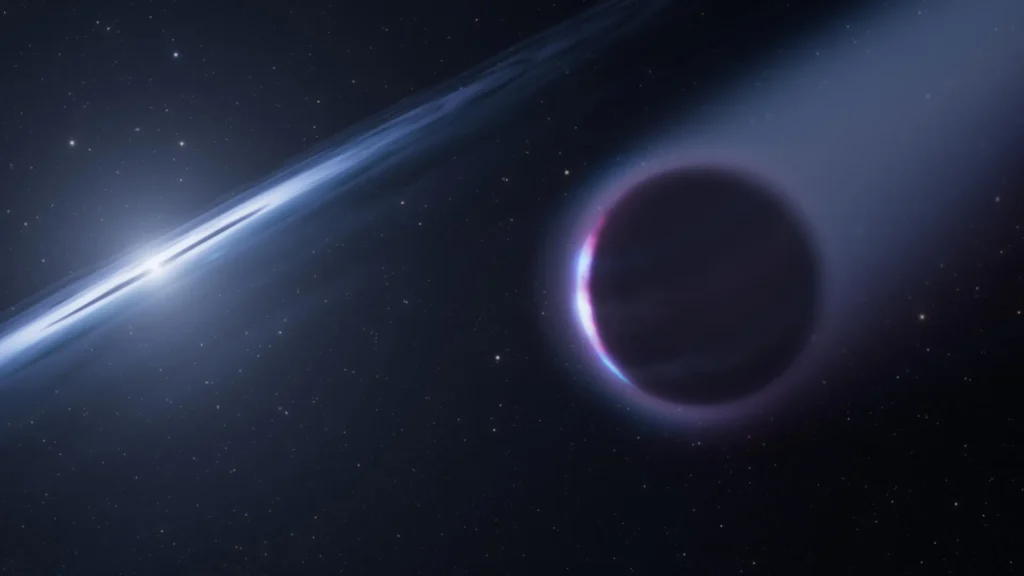
The prevailing hypothesis among the researchers is that after HS 0209+0832 expelled this chemically enriched material, a portion of it coalesced under its own gravity, eventually forming a gas giant planet. The majority of the ejected matter would have dispersed into the vastness of space over time, leaving the newly formed planet in orbit around its stellar remnant.
The astonishment of the research team was palpable. "When Jamie asked me about niobium in relation to this study, I was truly gobsmacked, as that element had not been reported in any other white dwarf analyzed to date. Once we realized it was there, everything fell into place," remarked Dr. Boris Gaensicke, an astronomer and co-author of the study, also affiliated with the University of Warwick. This collective moment of realization underscores the serendipitous nature of scientific discovery, often born from collaborative inquiry and the pursuit of unexplained phenomena.
Cross-Mission Confirmation: Supporting Evidence from NASA
The compelling findings from Hubble were further corroborated by observations from other NASA missions, strengthening the case for a second-generation planet. The retired Far Ultraviolet Spectroscopic Explorer (FUSE) mission, which operated from 2001 to 2007, also provided data revealing strong niobium signatures in the HS 0209+0832 system, lending significant weight to the initial Hubble discovery.
Adding another crucial piece to the puzzle, NASA’s Transiting Exoplanet Survey Satellite (TESS) played a pivotal role in detecting potential evidence of a planet. TESS monitored the white dwarf for a four-month period, capturing recurring variations in its brightness. These periodic dips in luminosity are a hallmark of a transiting exoplanet, an object passing in front of its host star from our perspective. Based on TESS data, researchers estimate that this candidate world orbits HS 0209+0832 at an exceptionally close distance of approximately 3.7 million miles (6 million kilometers), significantly nearer to its star than Mercury is to our Sun.
A Gas Giant Under Siege: Atmospheric Erosion and Survival
The researchers have posited that this orbiting body is a gas giant, comparable in size to Jupiter. However, its proximity to the intensely hot white dwarf has led to rapid atmospheric loss. The extreme energy radiating from the stellar remnant is likely stripping away the planet’s outer atmospheric layers. This escaping gas could be forming a comet-like tail, with some of the material potentially creating a disk around the white dwarf before accreting onto its surface. This accretion process could provide a plausible explanation for the high niobium detection by Hubble, as material from the planet’s atmosphere, enriched by the star’s death throes, falls onto the white dwarf.
Despite this ongoing atmospheric erosion, Dr. Williams expressed optimism regarding the planet’s long-term survival. "If the second-generation planet is there, I think it is likely to survive. Eventually the white dwarf will cool and then maintain a consistent temperature, with the planet in its stable habitable zone for millions of years," he projected. As the white dwarf cools over eons, the intense radiation that is currently stripping the planet’s atmosphere will diminish, potentially leading to a more stable environment.
The Frontier of Planet Formation: Unanswered Questions
This discovery opens a new vista in our understanding of planetary system evolution and raises a multitude of questions that astronomers are eager to explore. Key among these are the precise mechanisms by which second-generation planets form, their prevalence in the universe – are they exceptionally rare cosmic occurrences or a common phenomenon – and how they adapt and evolve while orbiting a "dead" star.
Dr. Williams intends to leverage the capabilities of the Hubble Space Telescope for several more years to meticulously investigate these unanswered questions. By accumulating a substantial body of observations, the aim is to establish meaningful statistical data on this unusual class of celestial objects. This will be crucial in moving from a single compelling case study to a broader understanding of second-generation planetary systems.
Dr. Gaensicke emphasized the iterative and often non-linear nature of scientific progress. "I think this research is an important example of the fact that scientific discovery is not a straight path," he remarked. "It often needs that magical moment when people discuss big questions on their minds and realize that together they can find unexpected answers." This sentiment highlights the collaborative and often serendipitous spirit that drives astronomical research, where persistent inquiry and open dialogue can unlock the universe’s most profound secrets. The ongoing study of HS 0209+0832 and its potential second-generation companion promises to rewrite chapters in astrophysics textbooks and redefine our perception of cosmic lifecycles.