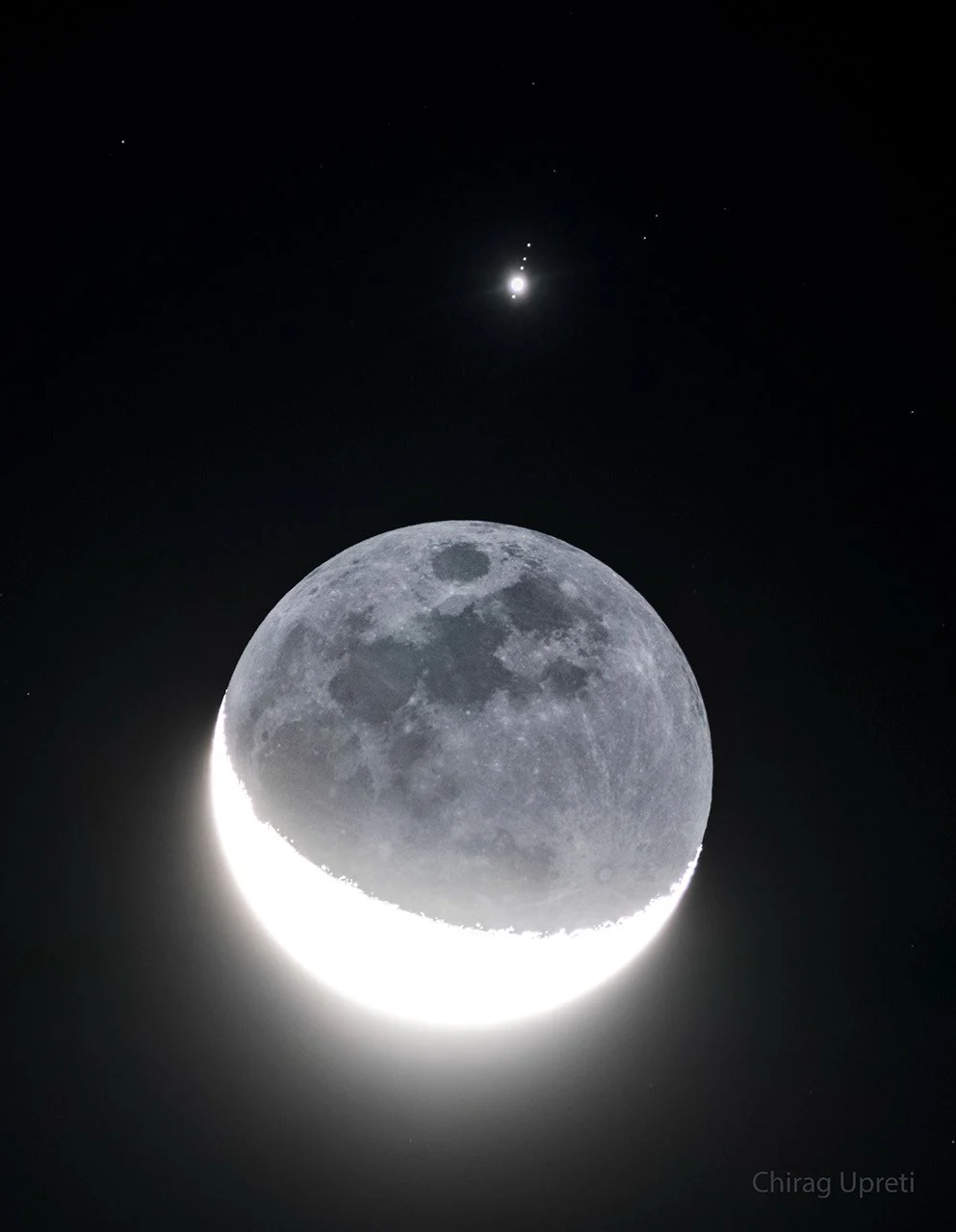
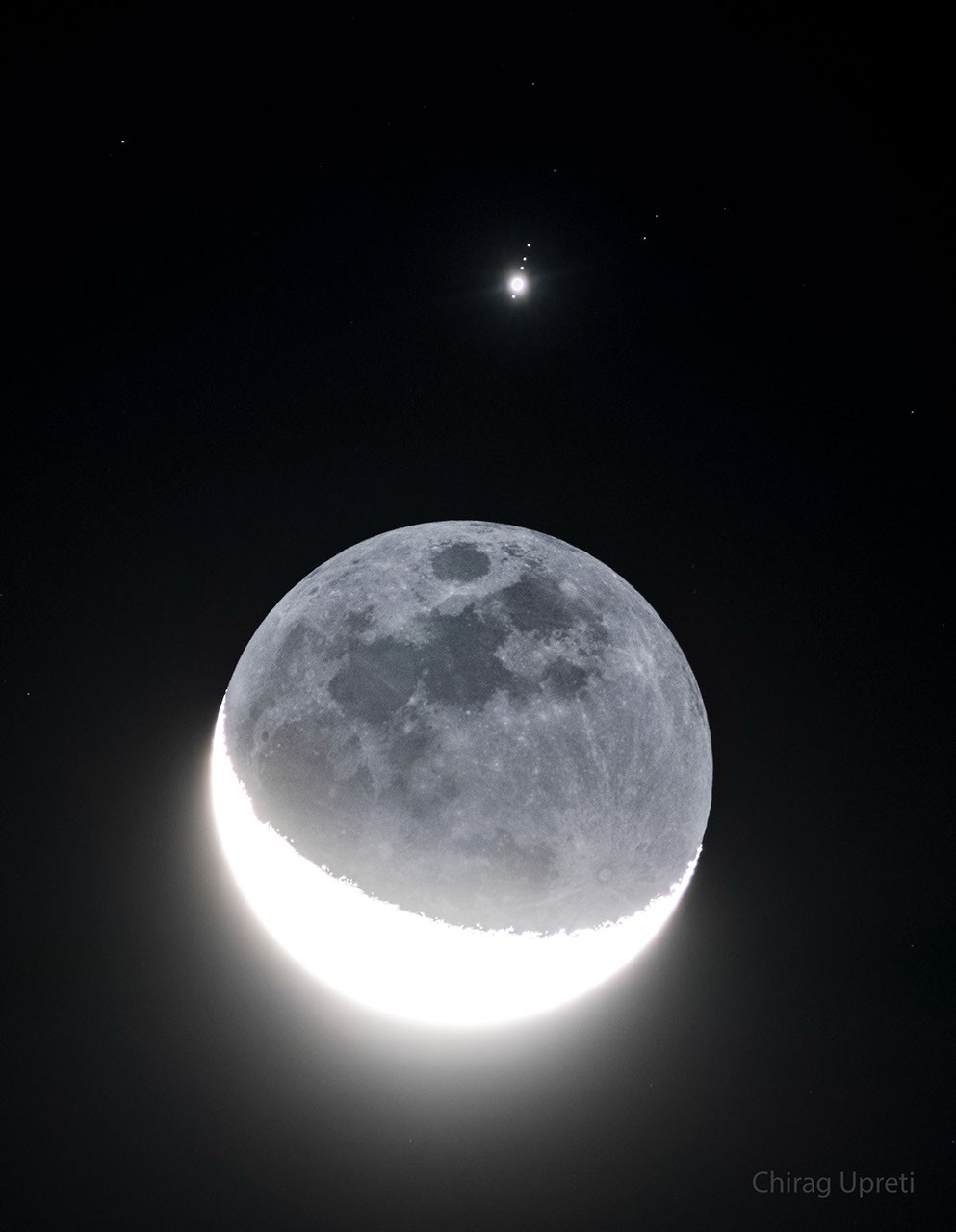
A remarkable celestial alignment, where Earth’s Moon passed directly in front of Jupiter, has provided astronomers and skywatchers with an extraordinary opportunity to witness five moons simultaneously in a single frame. This rare event, captured in a stunning image from Westchester, New York, showcases our familiar Luna alongside four of Jupiter’s most prominent moons: Ganymede, Io, Callisto, and Europa. The photograph, a composite of multiple exposures, meticulously captures the subtle interplay of light and shadow across these celestial bodies.
A Rare Conjunction: Unveiling the Celestial Dance
The phenomenon occurred when Earth’s Moon, in its orbital path around our planet, transited across the face of Jupiter, the colossal gas giant of our solar system. This astronomical event, while predictable, requires precise timing and favorable viewing conditions to be observed and documented effectively. The image featured is a testament to the dedication of amateur astronomers and the increasing accessibility of high-quality astrophotography.
The photograph, taken in Westchester, New York, USA, highlights the brilliant, sunlit crescent of Earth’s Moon. This portion appears overexposed due to its direct illumination, a common characteristic in such close-up captures. However, the ingenuity of the photographer lies in capturing the fainter, night side of the Moon, which is subtly illuminated by Earthshine – the reflection of sunlight off Earth’s surface onto its moon. This ethereal glow allows the shadowed hemisphere of Luna to become visible, adding depth and detail to the image.
Positioned nearly vertically above Earth’s Moon, and arranged from bottom to top, are Jupiter’s four Galilean satellites. These moons, discovered by Galileo Galilei in 1610, are among the largest in our solar system and hold significant scientific interest. Their apparent alignment in the captured image is a direct consequence of the Moon’s transit across Jupiter’s disk.
The Galilean Giants: A Closer Look
The four Galilean moons are not merely points of light; they are worlds in their own right, each with unique characteristics.
-
Ganymede: The largest moon in the solar system, Ganymede is even larger than the planet Mercury. It possesses its own magnetic field, a unique feature among moons, which creates auroras around its poles. Its surface is a mix of older, heavily cratered terrain and younger, grooved regions, suggesting complex geological history. NASA’s Juno spacecraft, currently orbiting Jupiter, has made close passes near Ganymede, providing invaluable data.
-
Io: Renowned for its extreme volcanic activity, Io is the most geologically active body in the solar system. Hundreds of volcanoes erupt continuously, spewing sulfurous plumes high into space, painting its surface in vibrant hues of yellow, red, and orange. This intense activity is driven by tidal heating, caused by the gravitational tug-of-war between Jupiter and the other large Galilean moons.
-
Callisto: This ancient, heavily cratered moon is thought to be one of the oldest surfaces in the solar system. Unlike its siblings, Callisto appears to have a less active interior, and its surface is scarred by countless impact craters. Despite its seemingly inert nature, recent evidence suggests the possibility of a subsurface ocean, making it a potential candidate for harboring life.
-
Europa: Europa is a prime target in the search for extraterrestrial life, primarily due to strong evidence suggesting the presence of a vast liquid water ocean beneath its icy crust. The surface of Europa is remarkably smooth and crisscrossed with reddish-brown lines, believed to be fractures in the ice shell. The potential for this subsurface ocean to harbor microbial life has fueled numerous scientific proposals for future exploration missions.
The Significance of the Alignment
Such alignments, where Earth’s Moon passes in front of Jupiter, are relatively infrequent. The precise geometry required for the Moon to occult, or cover, Jupiter depends on the orbital planes of both bodies. While the Moon’s orbit is tilted by about 5.1 degrees with respect to the ecliptic (Earth’s orbital plane around the Sun), and Jupiter’s orbit is inclined by about 1.3 degrees to the ecliptic, these slight differences combine to create specific windows for such events.
The apparent size of the Moon in the sky is also crucial. When the Moon is closer to Earth in its elliptical orbit, it appears larger and is more likely to occult celestial objects like Jupiter. Conversely, when it is farther away, it may only graze the planet or pass by without a significant visual overlap.
A Chronicle of Celestial Observation
The history of observing Jupiter’s moons is deeply intertwined with the dawn of telescopic astronomy. Galileo Galilei’s groundbreaking observations in 1610, using one of the earliest telescopes, revealed the four largest moons orbiting Jupiter. This discovery was revolutionary, challenging the long-held geocentric model of the universe and providing strong evidence for the heliocentric model, where celestial bodies orbit the Sun.
Galileo’s findings were meticulously documented, and his discovery of these moons laid the foundation for our understanding of planetary systems beyond our own. Today, with advanced telescopes and spacecraft, our knowledge of Jupiter and its extensive moon system has expanded exponentially.
Supporting Data and Scientific Context
Jupiter boasts an astonishing collection of moons, with its current count exceeding 90 confirmed satellites. The Galilean moons, however, remain the most significant due to their size and scientific implications.
-
Orbital Periods: The Galilean moons have distinct orbital periods around Jupiter. Io orbits in approximately 1.77 Earth days, Europa in 3.55 days, Ganymede in 7.15 days, and Callisto in 16.69 days. These varying speeds contribute to their dynamic configurations around the giant planet.
-
Sizes: Ganymede (radius ~2,634 km) and Callisto (radius ~2,410 km) are larger than Mercury (radius ~2,440 km). Io (radius ~1,821 km) and Europa (radius ~1,561 km) are also substantial moons, with Europa being only slightly smaller than Earth’s Moon (radius ~1,737 km).
-
Atmospheric Conditions: Jupiter itself is a gas giant, primarily composed of hydrogen and helium. Its immense gravity influences the orbits of its moons and plays a role in the tidal forces that shape their geology.
Official Responses and Astronomical Community Engagement
While this particular event was captured by an amateur astronomer, such alignments often garner attention from professional astronomical institutions. NASA and other space agencies frequently highlight significant celestial events through their public outreach programs, such as the Astronomy Picture of the Day (APOD) initiative. The APOD feature of this image underscores its scientific and visual merit, serving to educate and inspire the public.
Leading up to and following such an event, astronomers often engage in discussions and analysis. The precise prediction of these transits requires sophisticated orbital mechanics calculations. The data gathered from these observations, even those made by amateurs, can contribute to refining our understanding of celestial mechanics and the long-term evolution of planetary systems.
Broader Impact and Implications
The visual impact of such an alignment serves as a powerful reminder of the vastness and complexity of our universe. It ignites curiosity about space exploration and the potential for discoveries beyond Earth.
-
Public Engagement: Events like this foster public interest in astronomy and science, encouraging people to look up at the night sky and learn more about the cosmos.
-
Scientific Inspiration: The image of multiple moons in conjunction can inspire the next generation of scientists and engineers to pursue careers in fields related to space exploration and astrophysics.
-
Technological Advancement: The development of advanced imaging techniques and observational equipment, used by both professionals and dedicated amateurs, is crucial for capturing and analyzing such celestial phenomena. This continuous push for technological improvement benefits the entire scientific community.
The capture of Earth’s Moon and four of Jupiter’s moons in a single frame is more than just a beautiful photograph; it is a moment of profound connection to the grand cosmic ballet that unfolds above us. It highlights the interconnectedness of celestial bodies and the ongoing scientific endeavor to unravel the mysteries of our universe. As NASA’s Juno mission continues its exploration of Jupiter, and future missions are planned for moons like Europa, our understanding of these distant worlds will undoubtedly continue to expand, fueled by both dedicated professional research and the enduring fascination of the human spirit with the cosmos.
Tomorrow’s picture: stairway to heaven