The search for life beyond Earth has traditionally been guided by the principle of "follow the water," focusing almost exclusively on planets with liquid oceans or temperate atmospheres similar to our own. However, a groundbreaking study from the Massachusetts Institute of Technology (MIT) has challenged this terrestrial-centric paradigm, revealing that the fundamental building blocks of life can not only survive but thrive in environments previously deemed far too hostile. Published in the Proceedings of the National Academy of Sciences (PNAS), the research demonstrates that short chains of amino acids, known as peptides, remain remarkably stable and maintain complex three-dimensional structures in highly concentrated sulfuric acid—the primary component of the cloud layers surrounding Venus.
The findings, led by MIT Professor of Chemistry Mei Hong and Professor of Planetary Sciences Sara Seager, suggest that the acidic droplets within the Venusian atmosphere could potentially serve as a solvent for biological processes. By proving that peptides can fold into specific shapes called "omega loops" within a 98 percent sulfuric acid solution, the team has provided a chemical foundation for the possibility of an aerial biosphere on Venus. This discovery significantly broadens the scope of astrobiology, urging scientists to consider "Venus archetypes" rather than just "Earth twins" in the quest to identify habitable exoplanets.
The Venusian Paradox: A Hostile Surface and a Temperate Sky
To understand the significance of the MIT study, one must look at the unique and contradictory environment of Venus. Often described as Earth’s "evil twin," Venus possesses a surface temperature of approximately 464 degrees Celsius (867 degrees Fahrenheit)—hot enough to melt lead—and an atmospheric pressure 92 times that of Earth. These conditions make the surface an impossible habitat for any known form of organic chemistry.
However, the environment changes drastically as one ascends. Between 48 and 60 kilometers (30 to 37 miles) above the surface, Venus hosts a cloud layer where temperatures and pressures are surprisingly Earth-like. In this temperate zone, temperatures range from 0 to 60 degrees Celsius. Despite these hospitable temperatures, the clouds are composed of concentrated sulfuric acid droplets, a substance that is famously corrosive and destructive to the biological molecules found on Earth, such as DNA, proteins, and lipids.
For decades, the presence of this acid was considered an absolute barrier to life. Conventional scientific wisdom held that any biological precursor entering these clouds would be instantly hydrolyzed—broken down by chemical reactions with the solvent. The new research from MIT suggests this assumption may have been premature, failing to account for the unique behavior of molecules in the near-absence of water.
The Chemistry of Survival: Stability Without Water
The core of the MIT study lies in the behavior of peptides—short chains of amino acids that serve as the structural and functional precursors to proteins. In an aqueous (water-based) environment, strong acids typically act as catalysts for hydrolysis, a process where water molecules break the peptide bonds that hold amino acids together.
However, at a concentration of 98 percent sulfuric acid, the environment is almost entirely devoid of water. The MIT team, including lead author Jia Yi Zhang and senior author Janusz Petkowski of Wroclaw University of Science and Technology, hypothesized that the lack of water molecules might actually prevent the very hydrolysis that scientists feared.
Using advanced nuclear magnetic resonance (NMR) spectroscopy at the MIT Department of Chemistry Instrumentation Facility, the researchers monitored the integrity of various peptides over several weeks. To their surprise, the molecules did not degrade. "Without water, an acid that you would consider a harsh solvent suddenly is not as menacing as one might think," explained Professor Mei Hong. The study found that because there are so few water molecules to participate in the chemical reaction, the peptide bonds remained intact, preserving the primary sequence of the molecules for extended periods.
The Formation of Omega Loops: Structure Dictates Function
In biology, the shape of a molecule is as important as its composition. For a peptide or protein to perform a biological function—such as acting as an enzyme or a signaling molecule—it must fold into a specific three-dimensional structure. A primary concern for the researchers was whether peptides in sulfuric acid would simply exist as "random coils"—loose, disorganized strings with no functional potential.
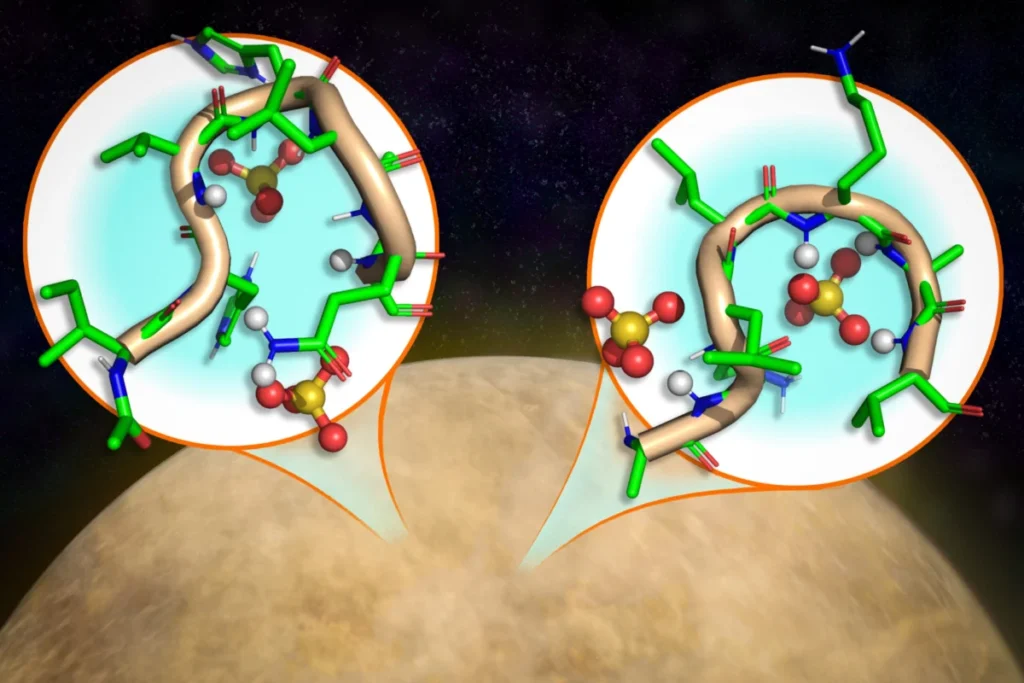
The NMR analysis revealed a startling secondary discovery: the peptides folded into well-defined shapes known as "omega loops." Specifically, the team analyzed a synthetic seven-amino-acid peptide called HHQ, a longer variation called HHQ13, and a peptide named K7. In water, these molecules typically form flat beta-sheets that aggregate into fibrils. In concentrated sulfuric acid, however, they adopted the Greek-letter omega shape.
The researchers believe that the sulfuric acid molecules themselves act as a chemical scaffold. The acid molecules appear to slide into the center of the peptide loops, providing a stabilizing framework that holds the shape in place. This finding is critical because omega loops are known in terrestrial biology to play roles in molecular recognition and protein folding. The fact that these structures can exist in such an extreme solvent suggests that complex, functional molecular machinery could theoretically operate within the Venusian clouds.
A Chronology of Discovery: From Phosphine to Peptides
The current study is part of a broader, multi-year research initiative led by Sara Seager to investigate the habitability of Venus. The timeline of this investigation has seen several key milestones:
- 2020: An international team announced the detection of phosphine gas in the Venusian atmosphere. On Earth, phosphine is primarily produced by anaerobic biological processes, sparking a global debate about potential life on Venus.
- 2021-2022: Seager’s lab began systematic testing of organic molecules in sulfuric acid. Initial experiments demonstrated that nucleic acid bases (the components of DNA and RNA) could remain stable in the acid.
- 2023: Further research showed that lipids (fats) and certain amino acids could also withstand concentrated sulfuric acid without decomposing.
- 2024: The current study confirms that not only are peptides stable, but they also possess the structural complexity required for biological function.
This progression of data has systematically dismantled the argument that the chemistry of Venus is inherently "anti-life." While it does not prove that life exists, it confirms that the "hardware" of life is compatible with the environment.
Expert Reactions and Scientific Implications
The results have garnered significant attention from the broader scientific community. Adriaan Bax, chief of the Section on Biophysical NMR at the National Institute of Diabetes and Digestive and Kidney Diseases, characterized the findings as "important and unexpected." He noted that the observation of conformational order in such an environment supports the prospect of folded protein structures existing in atmospheric conditions radically different from those on Earth.
The implications for exoplanetary science are equally profound. To date, the search for life has been heavily biased toward finding planets with liquid water. Professor Seager argues that this bias may be causing scientists to overlook a vast number of potentially inhabited worlds. "We really don’t know the full extent of what planet archetypes are out there," Seager stated. "We’re seeking exoplanets that might be a true Earth twin, but what if they’re all Venuses?"
The study suggests that if sulfuric acid can serve as a solvent for complex organic chemistry, then the "habitable zone" around stars must be redefined to include planets with highly acidic atmospheres, provided they have temperate cloud layers.
Future Research and Missions to the Morning Star
The MIT team is already looking toward the next phase of their research. Professor Seager plans to investigate the stability of Peptide Nucleic Acid (PNA). PNA is a synthetic molecule where the sugar-phosphate backbone of DNA is replaced by a peptide-like backbone. Since the team has now proven that peptide backbones are stable in sulfuric acid, PNA represents a plausible candidate for a genetic material that could exist on Venus.
Furthermore, these laboratory findings are providing the scientific justification for upcoming space missions. Seager is currently leading the "Morning Star Missions to Venus," a series of privately funded missions designed to send a probe directly into the Venusian clouds to search for organic molecules and potentially even signs of life. These missions will complement planned government efforts, such as NASA’s DAVINCI and VERITAS missions and the European Space Agency’s EnVision, which seek to map the planet’s surface and atmosphere in unprecedented detail.
Conclusion: Redefining the Limits of Biology
The MIT study serves as a powerful reminder that life, as a chemical process, may be far more resilient and adaptable than previously imagined. By demonstrating that peptides can maintain their structural integrity and fold into functional shapes in 98 percent sulfuric acid, the researchers have removed one of the primary theoretical barriers to life on Venus.
As humanity continues to peer into the depths of the solar system and beyond, the findings emphasize the need for an open-minded approach to astrobiology. The clouds of Venus, once thought to be a corrosive wasteland, may instead be a laboratory for a form of life that operates on a chemical logic entirely foreign to our own. Whether or not Venus is currently inhabited, the discovery that the building blocks of life are "acid-proof" has forever changed our understanding of where, and how, life might exist in the cosmos.