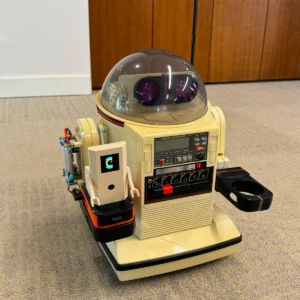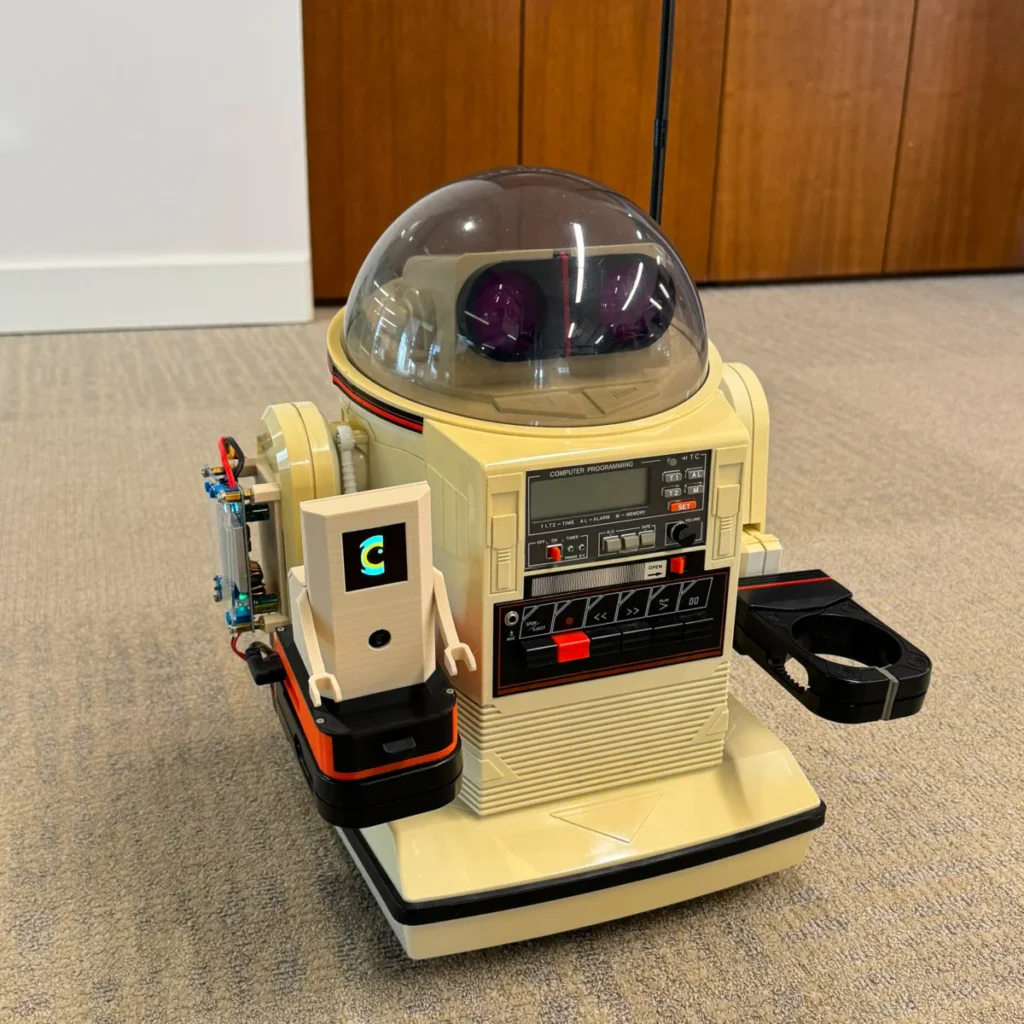
The intersection of vintage hardware and cutting-edge artificial intelligence has reached a new milestone at the Moonlighter FabLab in Miami, where a 1984 Tomy Omnibot has been successfully restored and augmented with a modern AI companion. This project, spearheaded by technologist Mario Cruz in collaboration with the design firm Placitech, represents a significant bridge between the early consumer robotics movement of the 1980s and the current era of computer vision and large language models (LLMs). The modified unit, which debuted at Maker Faire Miami 2026, demonstrates how legacy mechanical systems can be revitalized using low-cost, high-performance silicon to fulfill the original promises of 20th-century domestic robotics.
The Legacy of the 1984 Tomy Omnibot
When Tomy released the Omnibot in 1984, it was positioned as a high-end luxury toy that offered a glimpse into a future of domestic automation. Retailing for approximately $600—roughly equivalent to $1,800 in 2024 currency—the Omnibot featured a distinctive aesthetic: a smoked-plastic dome, tank-style drive wheels, and a built-in serving tray. Technically, it was an advanced piece of consumer electronics for its time, utilizing a cassette tape deck to record and play back sequences of movements and audio messages.
Despite its sophisticated appearance, the original Omnibot’s capabilities were limited by the era’s hardware. It relied on a frequency-encoded system where specific audio sine waves triggered internal relays to drive motors. Over the decades, most units fell into disrepair, plagued by leaking alkaline batteries that corroded circuit boards and the natural degradation of rubber components. The restoration of the unit at Moonlighter FabLab required extensive chemical cleaning with isopropyl alcohol and precision soldering to repair traces on the 40-year-old logic boards.

Chronology of the Restoration and Upgrade
The project evolved through three distinct phases, transitioning from a simple mechanical repair to a complex systems integration.
Phase I: Mechanical and Electrical Restoration
The initial effort focused on the "revival" of the base hardware. This included the replacement of disintegrated rubber wheels with modern 3D-printed alternatives and the cleaning of the main PCB. A critical discovery during this phase was the realization that the robot’s "language"—the audio frequencies recorded on tape—could be spoofed using modern digital signals. By identifying that 1614Hz commanded forward motion and 2208Hz commanded a left turn, the team realized the robot could be controlled via any modern audio output, including Bluetooth.
Phase II: The Integration of Ring-O
To provide the Omnibot with "sight" and "intelligence," the team developed a companion robot named Ring-O. Designed by Placitech, a Miami-based firm specializing in mechanical enclosures, Ring-O serves as the robot’s sensory head. It houses a Raspberry Pi 5 with 8GB of RAM, a Sony IMX500 AI camera, and a 128×128-pixel OLED display. This modular approach allowed the team to keep the vintage Omnibot chassis intact while offloading all computational tasks to the new hardware.
Phase III: Software Optimization and Public Debut
The final phase involved refining the interaction between the computer vision system and the motor controls. After initial failures using cloud-based AI for navigation, the team pivoted to localized, rule-based arithmetic for driving. This configuration was then stress-tested in a public environment at Maker Faire Miami 2026, where the robot interacted with thousands of attendees over a two-day period.

Technical Architecture: Vision and Decision-Making
The most significant technical achievement of the project is the implementation of an on-chip AI vision system. The Sony IMX500 camera utilized in the build features integrated AI processing, allowing it to run the YOLO11 (You Only Look Once) neural network directly on the sensor’s silicon.
Edge Computing vs. Cloud Reasoning
Initially, the developers attempted a modern "2026-style" architecture, where camera frames were sent to a cloud-hosted Large Language Model (LLM) via the Groq platform. The intent was for the LLM to reason about the scene and issue commands. However, this resulted in a 15-second latency per decision, which was insufficient for real-time movement. Furthermore, the LLM struggled with spatial reasoning, often defaulting to incorrect directional commands regardless of the target’s position.
To solve this, the project shifted to a localized rule-based system. The IMX500 identifies objects (e.g., "person," "shoe," "ball") and returns their X and Y coordinates. A Python script on the Raspberry Pi 5 then uses simple arithmetic to determine the robot’s course:
- Center of Frame (x: 224 to 416): Command "Forward"
- Left Side (x < 224): Command "Left"
- Right Side (x > 416): Command "Right"
This shift reduced decision latency from 15,000 milliseconds to near-zero, enabling the robot to track moving targets in real-time.

Overcoming Coordinate Discrepancies
A secondary challenge involved the "war of the bounding boxes." The team encountered issues where the AI’s detections did not align with the visual feed due to coordinate normalization errors and aspect ratio padding. The Sony IMX500 captures images at a 640×480 resolution, but the YOLO model processes a 640×640 square. This introduced 80 pixels of "letterboxing" padding at the top and bottom of the frame. Correcting this required a custom transformation function to map the AI’s internal logic to the actual screen pixels, ensuring that the visual "tracking box" accurately surrounded the detected objects.
Design for Human Interaction
A key finding of the project was that technical functionality alone does not create a successful social robot. The addition of the OLED "eye" on the Ring-O unit was a non-functional design choice that radically altered public perception. The eye was programmed to perform biological behaviors:
- Blinking: Occurs every three to seven seconds to simulate life.
- Tracking: The pupil moves in the direction of the robot’s turn.
- Recognition: The eye dilates or changes expression based on whether it detects a human, a dog, or a cat.
Observers at Maker Faire Miami reported that these animations transformed the machine from a "wheeled platform" into a "character." This psychological effect, often referred to as "perceived agency," allowed users to forgive minor mechanical stumbles and engaged children more effectively than a standard interface would have.
Reliability and Public Stress-Testing
Deploying a DIY robot in a high-traffic environment like Maker Faire Miami 2026 required a focus on "ruggedized" software. The development team implemented several fail-safes to ensure the robot could survive an eight-hour exhibition day:

- Systemd Services: The robot’s core processes were configured to restart automatically upon a crash.
- Health Endpoints: A local web server monitored the status of the camera, Bluetooth connection, and the OLED thread, providing a diagnostic dashboard for the operators.
- Command Serialization: To prevent system freezes from "button mashing" by children, the software was updated to process only one command at a time, returning a "busy" status to the UI during active movements.
Broader Impact and Implications
The success of the Omnibot/Ring-O project highlights several emerging trends in the field of robotics and maker culture.
The Democratization of AI Hardware
The project demonstrates that high-speed computer vision is no longer the exclusive domain of industrial laboratories. With a sub-$100 AI camera and a consumer-grade single-board computer, makers can now achieve inference speeds (approximately 17ms) that were impossible for hobbyists even five years ago.
Sustainable Innovation through Retrofitting
By using the original 1984 motor boards, the project makes a case for the longevity of mechanical systems. While digital logic becomes obsolete quickly, well-built mechanical frames and motors can remain functional for decades. Retrofitting legacy hardware with modern "brains" offers a sustainable alternative to the "planned obsolescence" prevalent in the modern toy industry.
Educational Value
The use of a web-based "Kids Dashboard" at Maker Faire Miami showcased how complex AI can be made accessible. By simplifying the interface to "Find Shoe" or "Dance," the project provided a hands-on introduction to neural networks for a younger generation, demystifying how robots "see" the world.

Conclusion
The Tomy Omnibot restoration stands as a testament to the enduring appeal of the "robot butler" dream. While the 1984 hardware could not meet the expectations of its era, the integration of 2026 technology has finally allowed the machine to fulfill its original purpose. By combining the charm of retro design with the efficiency of modern edge computing, Mario Cruz and the team at Placitech have created a blueprint for the future of hobbyist robotics—one where the past is not discarded, but updated. The full source code for the project remains open-source on GitHub, providing a foundation for other developers to revive the hundreds of thousands of Omnibots still sitting in attics and garages worldwide.