A groundbreaking new study, published by a team of researchers, presents compelling evidence suggesting that the universe may not be as uniform as previously assumed, challenging the bedrock principles of modern cosmology. The research indicates that the shape of the cosmos could be asymmetric or "lopsided," meaning its appearance and properties are not identical in every direction. This finding, which has significant implications for our understanding of the universe’s structure and evolution, directly confronts the long-standing assumption of isotropy – that the universe looks the same in all directions when averaged on large scales – upon which today’s standard cosmological model is built.
The Pillars of Modern Cosmology: Isotropy and Homogeneity
For decades, the "standard cosmological model," often referred to as the Lambda-CDM model, has served as the prevailing framework describing the dynamics and large-scale structure of the entire cosmos. This model is remarkably successful in explaining a vast array of astronomical observations, from the distribution of galaxies to the expansion rate of the universe. Its success, however, rests squarely on a fundamental set of assumptions derived from Albert Einstein’s theory of General Relativity. Chief among these are the principles of isotropy and homogeneity.
Isotropy posits that the universe looks the same in all directions from any given point. Homogeneity states that the universe is roughly the same everywhere, meaning matter and energy are uniformly distributed when averaged over sufficiently large volumes. These two assumptions simplify Einstein’s complex field equations, leading to the Friedmann-Lemaître-Robertson-Walker (FLRW) metric, which forms the mathematical backbone of the Lambda-CDM model. The FLRW description provides a "maximally symmetric" vision for spacetime, allowing cosmologists to model the universe as an expanding, smooth, and predictable entity. Without these simplifications, solving Einstein’s equations to describe the universe on cosmic scales would be virtually intractable.
The Lambda-CDM model itself incorporates a cosmological constant (Lambda, representing dark energy, responsible for accelerating expansion) and cold dark matter (CDM, an invisible substance interacting gravitationally but not electromagnetically). It has successfully predicted the cosmic microwave background’s (CMB) acoustic peaks, the large-scale structure of the universe, and the abundance of light elements, cementing its status as the leading theory.
The Cosmic Microwave Background: A Relic of Symmetry
Much of the initial confidence in the universe’s symmetry stemmed from observations of the cosmic microwave background (CMB). Discovered in 1964 by Arno Penzias and Robert Wilson, the CMB is the relic radiation left over from the Big Bang, representing the earliest light we can observe, emitted approximately 380,000 years after the universe’s birth. This ancient light permeates the entire sky, and its remarkable uniformity is one of the most compelling pieces of evidence for the Big Bang theory and the isotropic universe. To within one part in a hundred thousand, the CMB temperature is uniform across the sky, suggesting an incredibly smooth and featureless early universe. This extraordinary isotropy strongly supported the FLRW framework, reinforcing the idea of a universe that is, at its core, symmetrical.
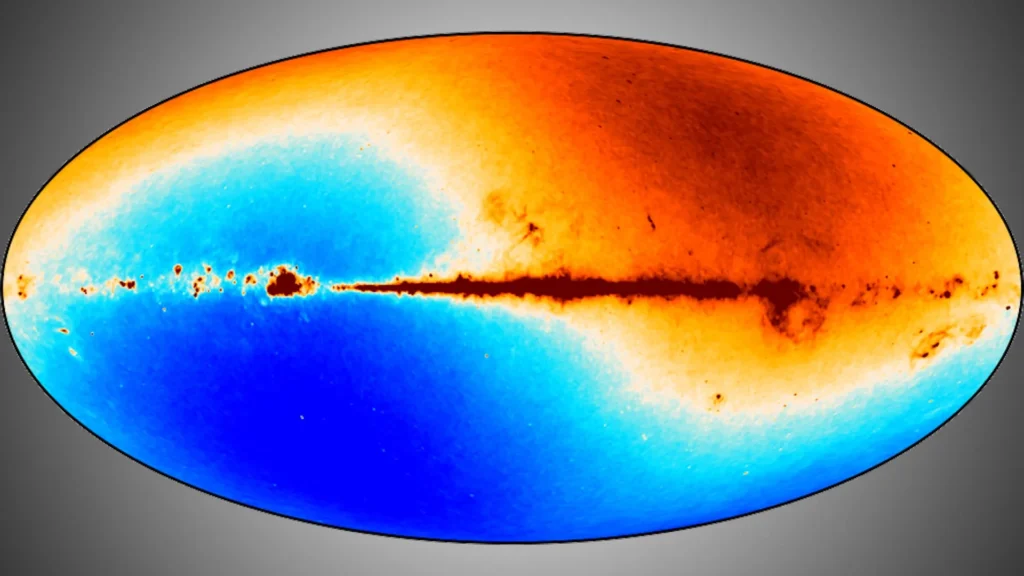
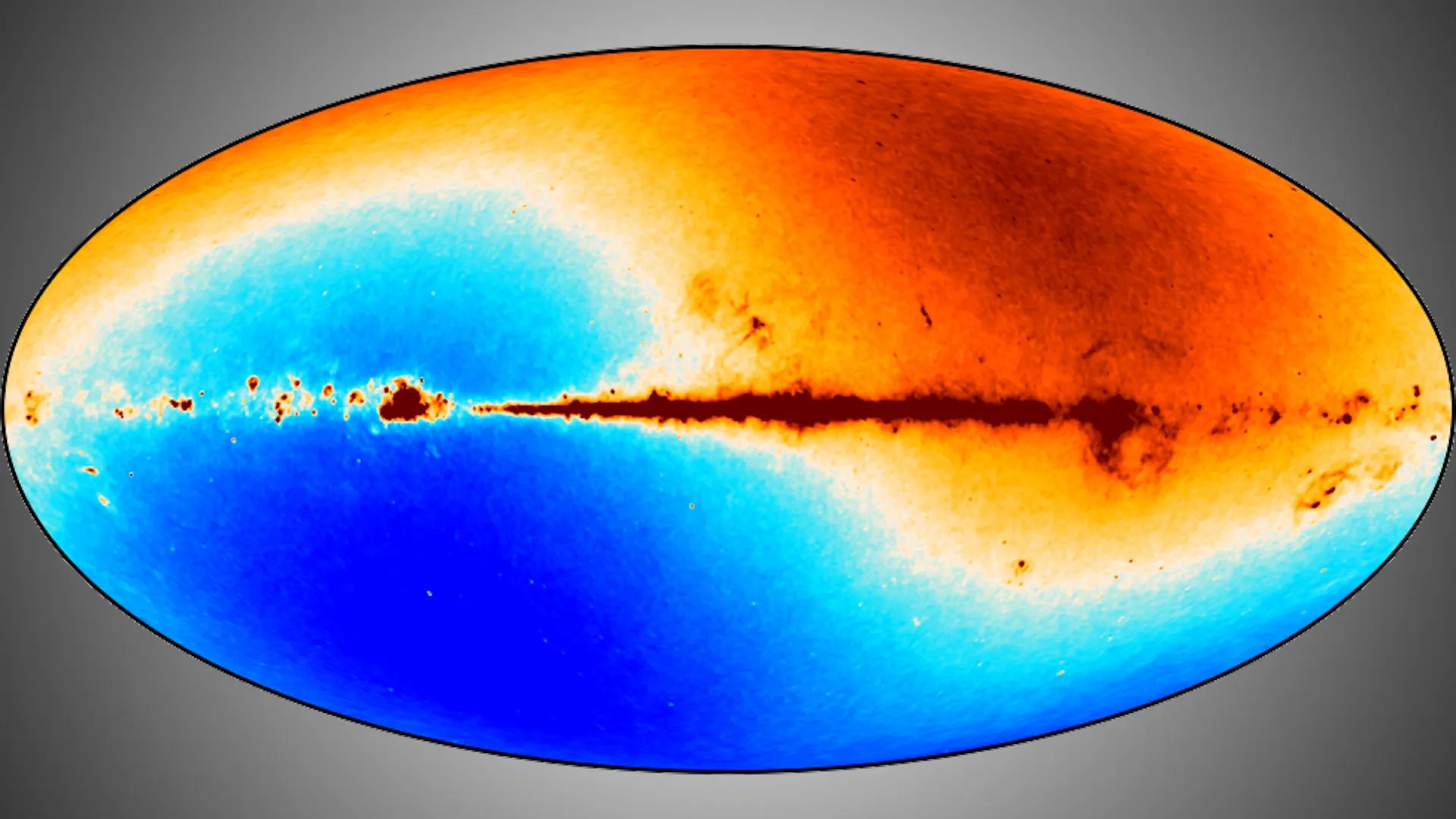
However, precise measurements by missions like NASA’s COBE, WMAP, and ESA’s Planck satellite have also revealed tiny temperature variations in the CMB. While these minute fluctuations are crucial for understanding the formation of galaxies and large-scale structures, one particular variation stands out: the CMB dipole anisotropy. This is the largest temperature difference observed in the CMB, manifesting as one side of the sky being slightly hotter and the opposite side cooler – by about one part in a thousand. Traditionally, this CMB dipole has been interpreted as a result of our own solar system’s motion through the universe, creating a Doppler shift effect. As the Earth and the Sun move towards a particular region of space, the CMB photons arriving from that direction are blueshifted (appear hotter), and those from the opposite direction are redshifted (appear cooler). Crucially, this interpretation does not challenge the Lambda-CDM model or the fundamental isotropy of the universe itself, as it’s considered a local kinematic effect rather than an intrinsic cosmic asymmetry.
Cracks in the Cosmic Consensus: Emerging Tensions
Despite the immense success of the Lambda-CDM model, several significant "tensions" or disagreements in astronomical data have emerged over recent decades, posing challenges to the idea of a perfectly uniform and predictable universe. One of the most widely debated is the "Hubble tension."
The Hubble tension is named after Edwin Hubble, who in 1929 made the revolutionary discovery that the universe is expanding. The tension itself refers to a significant discrepancy in the measured rate of this expansion. Measurements of the Hubble Constant (H₀), which quantifies the universe’s expansion rate, yield different values depending on the method used. One set of measurements, derived from observations of the early universe (e.g., the CMB by Planck), suggests a slower expansion rate. Another set, based on observations of the nearby, more recent universe (using "standard candles" like Type Ia supernovae and data from telescopes like the Hubble Space Telescope and satellites like Gaia), indicates a faster expansion rate. This persistent disagreement, exceeding standard statistical uncertainties, suggests either a fundamental flaw in our understanding of the universe’s evolution or errors in the measurements themselves. While the Hubble tension has garnered considerable attention and spurred numerous research efforts, the new study suggests that the cosmic dipole anomaly might be an even more fundamental challenge to our cosmological understanding.
Unveiling the Cosmic Dipole Anomaly: A More Fundamental Challenge
The cosmic dipole anomaly, though less frequently discussed than the Hubble tension, strikes at the very heart of the standard cosmological model’s foundational assumptions. While the CMB dipole is attributed to our local motion, the critical question raised by this anomaly is whether a similar dipole – an anisotropy in matter distribution – exists in the universe at very large scales, and crucially, whether it aligns with the CMB dipole.
The concept was first formally explored in 1984 by cosmologists George Ellis and John Baldwin. They proposed a test to determine if a similar "dipole anisotropy" could be detected in the sky distribution of distant astronomical sources, such as radio galaxies and quasars. Radio galaxies are active galactic nuclei that emit powerful jets of radio waves, often associated with supermassive black holes. Quasars are extremely luminous active galactic nuclei, powered by accretion disks around supermassive black holes, and are some of the most distant and brightest objects in the universe. Both serve as excellent tracers of matter distribution at cosmological distances.
Ellis and Baldwin recognized the importance of using very distant sources. Nearby sources could create a "clustering dipole" – an apparent anisotropy due to the uneven distribution of matter in our local cosmic neighborhood, which would not reflect a fundamental cosmic asymmetry. By looking at objects billions of light-years away, astronomers can probe the universe on scales where the assumptions of isotropy and homogeneity should firmly hold if the FLRW model is correct. The premise of their test was elegant: if the "symmetrical universe" described by the FLRW assumption is indeed correct, then any observed variation in the distribution of these distant astronomical sources should be directly determined by, and align perfectly with, the observed kinematic variation in the CMB. In simpler terms, if our motion causes the CMB to look lopsided, then the distribution of distant galaxies should also appear lopsided in the exact same way and direction, purely due to the same Doppler effect.
The Ellis-Baldwin Test: Methodology and Startling Results
The Ellis-Baldwin test requires exceptionally precise and comprehensive data catalogues of distant astronomical sources, something that has only recently become available thanks to advancements in observational astronomy. The methodology involves meticulously mapping the sky distribution of millions of distant galaxies and quasars and then analyzing whether their observed density varies in a dipole pattern. If such a pattern is found, its direction and magnitude are then compared against the direction and magnitude of the CMB dipole anisotropy.
The new paper details the performance of this crucial test, utilizing the latest available data from various observational platforms. The outcome is unequivocal and startling: the universe, as observed through the distribution of distant matter, fails the Ellis-Baldwin test. The variation in the distribution of matter does not match that in the CMB. Specifically, the direction or magnitude (or both) of the dipole observed in distant radio galaxies and quasars is significantly different from what would be expected if the CMB dipole were solely due to our local motion within an otherwise isotropic FLRW universe.
The robustness of this finding is further bolstered by the fact that the same result is obtained using different types of telescopes and observing at different wavelengths. Terrestrial radio telescopes, which observe at radio frequencies, and satellites observing at mid-infrared wavelengths, both independently confirm this discrepancy. This multi-messenger approach significantly reduces the likelihood that the anomaly is merely an artifact of a specific instrument, observational technique, or wavelength-dependent systematic error. The consistency across diverse datasets solidifies the cosmic dipole anomaly as a major and increasingly undeniable challenge to the standard cosmological model, and indeed, to the foundational FLRW description itself.
Implications: Rewriting the Cosmic Rulebook
The failure of the Ellis-Baldwin test presents a profound crisis for cosmology, far surpassing the implications of the Hubble tension. While the Hubble tension might be resolved by tweaking parameters within the Lambda-CDM model or introducing minor modifications to dark energy, the cosmic dipole anomaly directly undermines the most fundamental assumption of the model: the large-scale isotropy of the universe. If the universe is not isotropic, then the FLRW metric is no longer an accurate description of spacetime on cosmic scales. This would necessitate a complete overhaul of our theoretical framework, essentially requiring cosmologists to "go back to square one."
The scientific community has, to some extent, "chosen to largely ignore" this anomaly, as noted by the authors. This reluctance is understandable, given the monumental implications. Abandoning the FLRW description would mean:
- Revisiting General Relativity: The FLRW metric is a direct consequence of General Relativity applied to a homogeneous and isotropic universe. If these assumptions are incorrect, we might need to explore more complex solutions to Einstein’s equations, or even consider modifications to General Relativity itself on cosmic scales.
- Rethinking Dark Energy and Dark Matter: The properties and behaviors of dark energy and dark matter are inferred within the context of an FLRW universe. If the cosmic geometry is different, the interpretations of these mysterious components would also have to be re-evaluated.
- New Models of the Early Universe: The conditions of the very early universe, including inflation and baryogenesis, are typically modeled within an isotropic framework. An anisotropic universe would require entirely new models for the universe’s genesis and initial evolution.
- Impact on Structure Formation: The formation and evolution of galaxies and large-scale structures are understood through gravitational collapse in an expanding, largely uniform universe. An inherent cosmic anisotropy would introduce directional preferences, potentially altering our understanding of how cosmic structures grew.
The philosophical impact is equally significant. For centuries, humanity has sought to place itself within a grand, often symmetrical, cosmic order. The idea of a simple, elegant, and predictable universe, while mathematically convenient, may prove to be an oversimplification. The universe might be inherently more complex, with intrinsic directional preferences that hint at physics beyond our current understanding.
The Road Ahead: Data Deluge and New Paradigms
While the cosmic dipole anomaly presents an immense challenge, it also opens up exciting new avenues for discovery. The coming decade promises an unprecedented "avalanche of data" from a new generation of cutting-edge observatories. Missions like ESA’s Euclid space telescope, designed to map the dark universe, will provide exquisite detail on galaxy distribution and gravitational lensing across vast cosmic scales. NASA’s SPHEREx mission will conduct an all-sky survey in near-infrared light, providing spectral data for hundreds of millions of galaxies. Ground-based observatories such as the Vera C. Rubin Observatory, with its Legacy Survey of Space and Time (LSST), will map the Southern Hemisphere sky every few nights, detecting billions of astronomical objects and tracking their changes. Finally, the Square Kilometre Array (SKA), currently under construction, will be the world’s largest radio telescope, capable of surveying the universe with unparalleled sensitivity and resolution, providing crucial data on radio galaxies and quasars at the furthest reaches of the cosmos.
This wealth of new data will be instrumental in confirming or refuting the findings of the cosmic dipole anomaly with even greater precision. It is conceivable that these new observations, coupled with recent advances in artificial intelligence (AI), particularly machine learning, could provide bold new insights into how to construct a new cosmological model. Machine learning algorithms are exceptionally good at identifying subtle patterns and correlations in massive, complex datasets that might elude human analysis. This could accelerate the development of theoretical frameworks capable of describing an intrinsically anisotropic universe.
The impact of such a paradigm shift would be truly enormous, not just on fundamental physics and our understanding of gravity, dark energy, and dark matter, but on humanity’s place within a potentially more intricate and less symmetrical cosmos. The universe, it seems, might be ready to reveal a deeper, more complex truth about its fundamental nature.