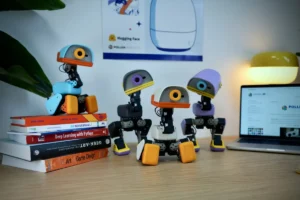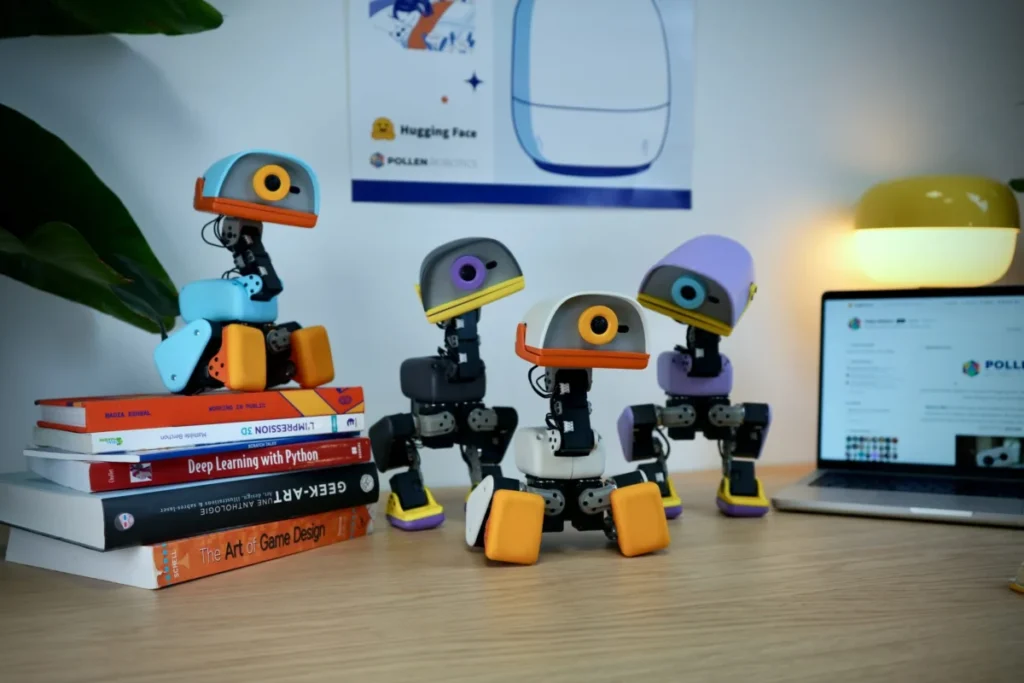
The world of robotics is witnessing a charming revolution, proving that often, the smallest innovations make the biggest impact. Following in the footsteps of advanced bipedal predecessors, a new contender has emerged to democratize access to cutting-edge artificial intelligence and robotics research: Microduck. This delightful, open-source, and trainable robot, priced at an accessible $400, is the brainchild of a collaborative effort between AI powerhouse Hugging Face and robotics innovator Pollen Robotics. Designed as an engaging platform for learning and experimenting with reinforcement learning, Microduck combines advanced technology with an undeniably endearing form factor, promising to inspire a new generation of roboticists and AI enthusiasts.
The Genesis of a Bipedal Bot: From Lab to Living Room
The journey to Microduck’s creation is a fascinating chronology of innovation, community engagement, and the relentless pursuit of making complex technology approachable. Its lineage can be traced back to the groundbreaking work of Disney Research, which captivated the robotics community with its BDX droid. Revealed in the mid-2020s, the BDX droid represented a significant leap in compact, highly dynamic bipedal locomotion. Disney’s approach focused on creating robots capable of nuanced, expressive movements, pushing the boundaries of what small, self-contained bipedal systems could achieve. The BDX droid was lauded for its ability to traverse uneven terrain, maintain balance, and perform complex maneuvers, showcasing the potential for small-scale, autonomous robots in various applications, from entertainment to research.
The public’s fascination with the BDX droid quickly spurred a vibrant community response. Recognizing the educational and developmental potential of such a platform, enthusiasts and developers rallied to create an open-source alternative. This collective effort culminated in the Open Duck Mini, a DIY-friendly version inspired by the BDX’s core principles but designed for broader accessibility. The Open Duck Mini project quickly gained traction, attracting the attention and sponsorship of key players in the tech world, notably Hugging Face, renowned for its contributions to open-source AI, and Pollen Robotics, a company dedicated to creating versatile, open-source robotic hardware. Their support provided the Open Duck Mini community with crucial resources, accelerating its development and refining its design.
The success and lessons learned from the Open Duck Mini paved the way for the next logical evolution: Microduck. Rather than solely relying on a DIY assembly, Microduck emerges as a refined, commercially available product that retains the core ethos of open-source development and community collaboration. This transition from a purely community-driven, build-it-yourself project to a professionally manufactured, yet fully open, robot signifies a maturation of the concept, aiming to lower the barrier to entry even further for individuals and institutions eager to delve into robotics and AI. Microduck is currently available for pre-order, with initial deliveries targeted before Christmas 2026, setting the stage for a festive season of robotic exploration.
Microduck’s Technical Specifications and Design Philosophy
At the heart of Microduck’s appeal lies a meticulously crafted design that balances technical capability with an engaging user experience. Physically, Microduck is characterized by its compact stature, making it easy to handle and deploy in various environments. Its movements are deliberately imbued with personality, featuring a distinctive "pigeon-toed walk" and "bowlegged skating" gait. These seemingly quirky attributes are not merely aesthetic choices; they are integral to Microduck’s role as a learning platform for reinforcement learning. By exhibiting movements that are less than perfectly optimized from the outset, Microduck provides a more realistic and challenging environment for training AI models, mirroring the complexities and imperfections of real-world scenarios. This design choice forces developers to confront and solve problems related to balance, locomotion, and adaptability, which are fundamental to robust robotic control.
Beyond its visual and kinetic charm, each Microduck possesses an "individual voice," a feature that adds another layer of personalization and engagement. While the technical specifics of this voice generation are not fully detailed, it likely involves unique sound profiles or modulated vocalizations that allow users to distinguish between individual robots in a swarm or simply deepen the emotional connection with their bot. This subtle yet powerful design element enhances the robot’s appeal, transforming it from a mere piece of hardware into a characterful companion.
The true power of Microduck, however, lies in its open-source software development kit (SDK) and the robust support infrastructure provided by its creators. The complete SDK is hosted on GitHub (github.com/pollen-robotics/microduck), offering unparalleled transparency and flexibility for developers. This includes access to low-level control APIs, sensor data streams, and examples for implementing various behaviors. For hardware, Microduck likely incorporates a suite of miniature servo motors for precise joint control, an onboard micro-controller (e.g., an ARM-based chip) for real-time processing, and various sensors such as accelerometers and gyroscopes for orientation and balance feedback. The open nature of the SDK means that users are not limited to pre-programmed functionalities but can deeply customize the robot’s behavior, integrate new sensors, or even experiment with alternative control architectures.

A primary application for Microduck is in the field of reinforcement learning (RL). Reinforcement learning is a paradigm of machine learning where an agent learns to make decisions by performing actions in an environment to maximize a cumulative reward. Unlike supervised learning, which relies on labeled datasets, RL agents learn through trial and error, receiving positive or negative feedback for their actions. Microduck provides an ideal physical sandbox for RL experiments. Its ability to physically interact with the environment, fall over, recover, and gradually improve its locomotion or task execution provides tangible, real-time feedback that is invaluable for understanding and developing RL algorithms. For instance, a student could program Microduck to learn to walk more efficiently, avoid obstacles, or even perform simple manipulation tasks by rewarding successful movements and penalizing failures. The inherent cuteness and robustness of Microduck make the inevitable "failures" during the learning process less frustrating and more engaging, turning setbacks into valuable learning opportunities.
While current iterations of Microduck do not feature onboard language processing capabilities, the developers are keenly aware of the community’s potential. As one representative from Pollen Robotics stated, "It’s technically feasible and could be a future development. Even if we’re not the ones doing it, I expect the community to build it in a matter of weeks after the first users get their robots." This statement underscores the profound belief in the power of the open-source community to drive innovation and extend the capabilities of the platform far beyond its initial release.
Hugging Face and Pollen Robotics: Driving Open-Source Innovation
The collaboration between Hugging Face and Pollen Robotics is a testament to the growing synergy between software AI development and physical robotics. Hugging Face has rapidly become a dominant force in the AI landscape, particularly known for its open-source contributions to natural language processing (NLP) and machine learning models. Their mission revolves around democratizing AI, making powerful tools and models accessible to researchers, developers, and hobbyists worldwide. Sponsoring and co-developing Microduck perfectly aligns with this vision, extending their reach from purely digital AI models to embodied AI, providing a physical platform for machine learning experimentation. Their involvement ensures that Microduck benefits from state-of-the-art AI integration and a robust, community-centric development philosophy.
Pollen Robotics, on the other hand, brings its deep expertise in creating innovative, open-source robotic hardware. They are known for their commitment to modularity, versatility, and empowering users to build and adapt robots for diverse applications. Their previous projects often emphasize user-friendliness and educational value, making them an ideal partner to translate the Open Duck Mini concept into a polished, production-ready robot. Pollen Robotics handles the intricate engineering, manufacturing, and supply chain logistics, ensuring that Microduck is not only technically sound but also reliable and widely available.
The combined strengths of these two companies create a formidable force. Hugging Face provides the AI brain and community infrastructure, while Pollen Robotics delivers the robust and accessible robotic body. This partnership is crucial for Microduck’s success, guaranteeing that it is both a powerful AI learning tool and a durable, well-supported piece of hardware. Their joint commitment to open source means that the entire ecosystem around Microduck—from its software to its potential hardware modifications—is designed to be transparent, extensible, and community-driven.
The Educational and Research Frontier: Why Microduck Matters
Microduck’s introduction marks a significant moment for both education and research in robotics and artificial intelligence. Its primary impact stems from its unprecedented accessibility. Priced at $400, Microduck drastically lowers the financial barrier to entry for acquiring a sophisticated, trainable bipedal robot. In contrast, many research-grade bipedal robots can cost tens of thousands of dollars, limiting their availability to well-funded university labs or large corporations. This affordability means that high schools, community colleges, small research groups, and individual hobbyists can now engage with advanced robotics concepts in a tangible way. This democratizing effect is vital for fostering interest and talent in STEM fields globally.
For educational institutions, Microduck offers an unparalleled pedagogical tool for teaching complex AI concepts, particularly reinforcement learning. Theoretical understanding of RL can be challenging; however, when students can implement an algorithm and observe its direct impact on a physical robot’s behavior—watching it learn to walk, balance, or perform a task through trial and error—the abstract concepts become concrete and intuitive. This hands-on, experiential learning is far more effective than purely simulation-based or theoretical approaches. Moreover, the charm of the Microduck ensures that the learning process remains engaging and fun, reducing the intimidation factor often associated with advanced robotics.
Beyond education, Microduck holds significant promise for the research community. Its open-source nature means researchers can adapt it for specific experiments, develop novel control algorithms, or even explore swarm robotics at a fraction of the cost previously possible. The community’s potential to integrate language processing, advanced computer vision, or other AI modules into Microduck suggests that the platform’s capabilities will continue to evolve rapidly. This collaborative development model can accelerate research outcomes by allowing researchers to build upon a shared, robust foundation. Imagine a future where numerous Microducks, each trained by different community members, contribute to a global knowledge base of robotic behaviors and AI models.

Furthermore, the emphasis on learning from "failure" in its design philosophy directly addresses a core challenge in robotics: robustness. By designing Microduck to be resilient to falls and imperfect movements, it encourages developers to build more robust and adaptive AI systems, preparing them for the unpredictable nature of real-world environments. This approach is crucial for advancing robotics beyond controlled laboratory settings.
The Expanding Landscape of Affordable Bipedal Robotics
Microduck enters an increasingly vibrant and competitive landscape of affordable, programmable robots. The past decade has seen a proliferation of educational robot kits, ranging from wheeled platforms to articulated arms, but truly dynamic, affordable bipedal robots have remained relatively scarce. While companies like Boston Dynamics have showcased incredibly advanced (and expensive) bipedal robots like Atlas, the market for accessible bipedal platforms capable of sophisticated AI integration has been largely underserved.
Microduck distinguishes itself in this market through its unique blend of features: its low price point, explicit focus on reinforcement learning, fully open-source hardware and software, and an engaging, charismatic design. Other platforms might offer open-source components or be affordable, but few combine all these elements with the backing of major AI and robotics entities like Hugging Face and Pollen Robotics. This positions Microduck not just as another robot toy, but as a serious educational and research tool.
The challenges inherent in bipedal locomotion—maintaining balance, navigating uneven terrain, and adapting to unexpected disturbances—make it an excellent problem domain for AI research. Microduck’s design embraces these challenges, providing a physical embodiment where these complex problems can be tackled incrementally. As the list of affordable walking robots gets longer, Microduck ensures that the list of excuses not to engage with this exciting field gets shorter.
Pre-order and Community Engagement
For those eager to get their hands on this pioneering robot, Microduck is available for pre-order now through the official Pollen Robotics website (pollen-robotics.com/microduck). The targeted delivery before Christmas 2026 allows enthusiasts and educators to plan their projects and curriculum well in advance. Beyond purchasing the pre-built unit, the open-source nature of Microduck means that individuals with a strong DIY spirit can also explore building their own versions from scratch, leveraging the publicly available designs and software.
The success of Microduck, much like its Open Duck Mini predecessor, will heavily rely on the strength and vibrancy of its community. Pollen Robotics and Hugging Face are actively fostering this community, encouraging users to connect, share their projects, and contribute to the platform’s evolution. Engaging with the community is made easy through platforms like the official Discord server, where users can discuss ideas, troubleshoot problems, and collaborate on new features. This emphasis on collective intelligence and shared development is a hallmark of the open-source movement and promises to make Microduck a dynamic and continually evolving platform.
In conclusion, Microduck represents more than just an adorable new robot; it embodies a significant step towards democratizing access to advanced artificial intelligence and robotics. By combining an engaging design, an accessible price point, and a fully open-source ecosystem, it empowers students, researchers, and hobbyists to explore the complex world of reinforcement learning and embodied AI. With the collaborative backing of Hugging Face and Pollen Robotics, Microduck is poised to waddle its way into classrooms, laboratories, and homes worldwide, inspiring the next generation of innovators to push the boundaries of what is possible with intelligent machines.