The fundamental behavior of water when restricted to spaces only a few molecules wide has remained one of the most persistent enigmas in physical chemistry, but a landmark study published in the journal Science Advances has finally provided a definitive explanation for the phenomenon. For over a decade, the scientific community has been divided by contradictory experimental results regarding the reactivity of water in nanoscale pores, biological channels, and membrane filters. By utilizing advanced machine learning simulations, a research team led by the University of Cambridge has demonstrated that the perceived changes in water’s chemical reactivity under confinement are not driven by the confinement itself, but rather by the extreme internal pressures generated within these tiny spaces and the specific chemical interactions of the surrounding surfaces.
This discovery provides a unifying framework that reconciles years of disparate data. Water is the most studied substance on Earth, yet its behavior at the interface of solids—where it exists in almost all biological and technological systems—has proven notoriously difficult to model. The research, spearheaded by Xavier R. Advincula and a team of experts from the Yusuf Hamied Department of Chemistry and the Cavendish Laboratory, suggests that once variables such as density, pressure, and chemical potential are accounted for, the "mystery" of nanoconfinement largely evaporates, revealing a predictable thermodynamic process.
A Decade of Scientific Discrepancy: The Context of the Study
The debate surrounding nanoconfined water centers on the process of auto-ionization, or "water splitting." In its liquid state, water molecules (H2O) occasionally dissociate into two charged particles: a hydronium ion (H3O+) and a hydroxide ion (OH-). This process is the foundation of the pH scale, which dictates whether a substance is acidic or alkaline. In the macroscopic "bulk" world, this process is well-understood. However, when water is forced into pores narrower than a billionth of a meter, previous studies suggested its chemistry changed radically.
Since approximately 2010, various laboratory experiments have produced wildly different results. Some researchers reported that confining water made it thousands of times more reactive, while others found negligible changes. These contradictions stalled progress in fields ranging from battery design to desalination technology. The Cambridge study identifies the source of this confusion: earlier researchers were often comparing systems at different effective pressures or densities without realizing that these factors, rather than the physical "walls" of the container, were the primary drivers of change.
The Role of Gigapascal Pressures in Nanofluidics
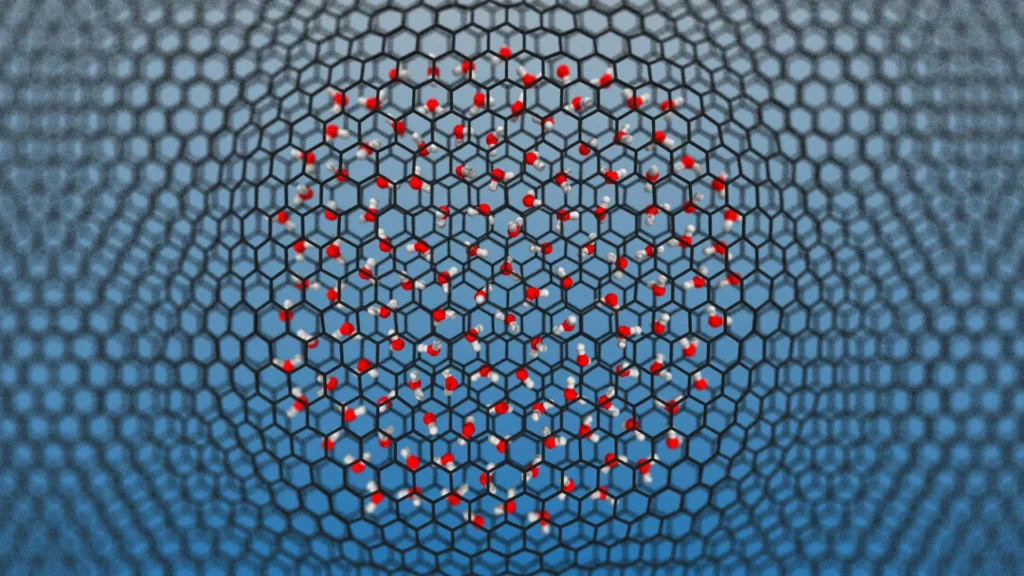
One of the most striking revelations of the new research is the sheer magnitude of the forces at play within nanoscale gaps. The team examined water trapped between two-dimensional sheets of graphene and hexagonal boron nitride (hBN). Despite these materials being only a single atom thick, they exert a massive influence on the liquid trapped between them.
The simulations revealed that water droplets confined between these 2D layers experience internal pressures reaching several gigapascals (GPa). To put this in perspective, one gigapascal is approximately 10,000 times the atmospheric pressure at sea level, comparable to the crushing forces found deep within the Earth’s mantle or at the core of gas giant planets.
Crucially, these pressures are generated naturally without the application of any external force. The phenomenon is driven by van der Waals attraction—the relatively weak electromagnetic forces that exist between neutral atoms and molecules. While these forces are negligible in everyday life, they become incredibly powerful when applied across the high surface area of two-dimensional materials. The sheets of graphene or hBN are pulled together so forcefully that they compress the water molecules between them into a high-density state, which in turn facilitates the splitting of H2O into ions.
Machine Learning as a Tool for Quantum Accuracy
To reach these conclusions, the researchers had to overcome a significant computational hurdle. Traditional computer simulations of water usually fall into two categories: classical molecular dynamics, which are fast but lack the precision to model chemical reactions, and quantum mechanical simulations, which are highly accurate but computationally expensive and limited to very small systems for short periods.
The Cambridge team bridged this gap using machine learning. They developed neural network potentials—AI models trained on quantum mechanical data—that can predict the behavior of thousands of atoms with the accuracy of quantum physics but at a fraction of the computational cost. This allowed the team to simulate water across a vast range of pressures, temperatures, and confinement widths, providing a comprehensive data set that was previously unattainable.
"The use of machine learning allowed us to explore the thermodynamic landscape of water in a way that was simply impossible five years ago," noted the study’s lead author, Xavier R. Advincula. "We could finally see the forest for the trees, identifying that pressure and chemical potential were the hidden variables causing the confusion in earlier studies."
Material Specificity: Graphene versus Hexagonal Boron Nitride
While pressure was identified as the primary driver of reactivity, the study also highlighted the critical role of surface chemistry. The researchers compared water confined by graphene (composed of carbon) with water confined by hexagonal boron nitride (hBN). Although both materials have nearly identical hexagonal lattice structures, their chemical properties differ significantly.
In the case of graphene, the surface is chemically inert. It squeezes the water, increasing its reactivity through pressure, but it does not participate in the reaction. In contrast, hBN is a polar material. The simulations showed that when water splits inside an hBN "sandwich," the resulting hydroxide ions (OH-) form chemical bonds with the hBN surface. This interaction stabilizes the ions, effectively lowering the energy barrier required for the water to split in the first place.
This finding suggests that the "container" does not just hold the water; it can actively catalyze chemical changes. This distinction is vital for engineers designing new materials for energy storage or water purification, as it provides a "design principle" for choosing materials that either encourage or suppress specific chemical reactions.
Implications for Energy and Environmental Technology
The resolution of this scientific debate has immediate implications for several high-stakes technological fields. One of the most prominent is the development of hydrogen fuel cells. These devices rely on proton-exchange membranes, where water is confined in narrow channels to transport ions. Understanding how to manipulate the reactivity of this water could lead to more efficient membranes and cheaper fuel cell technology.
In the realm of battery technology, many next-generation systems utilize aqueous electrolytes confined within porous electrodes. The Cambridge study suggests that by tailoring the pore size and the surface chemistry of these electrodes, scientists can control the internal pressure and the stability of ions, potentially leading to batteries with higher energy densities and faster charging times.
Furthermore, the study provides valuable insights for the field of nanofluidic desalination. As water passes through carbon nanotubes or graphene-based filters to remove salt, the chemical behavior of the water under those confined conditions dictates the efficiency of the filtration. The ability to predict how different materials will interact with water at the nanoscale could lead to a new generation of low-energy water purification systems.
Expert Reactions and Future Research Directions
The scientific community has welcomed the study as a much-needed "reset" for the field of nanofluidics. Dr. Christoph Schran, of the Theory of Condensed Matter Group at the Cavendish Laboratory, emphasized that the work offers a practical framework for the future. "Rather than focusing solely on the size of pores or channels, we can now tailor water reactivity by choosing a confining material whose surfaces interact with the products of water dissociation and by controlling the pressures generated within confined spaces," Schran stated.
Professor Angelos Michaelides, who oversaw the research at the University of Cambridge, expressed surprise at how neatly the thermodynamic explanation fit the data. "What surprised us most was how much of the apparent confinement effect could be explained by thermodynamics. Once pressure and chemical potential are properly accounted for, a great deal of the complexity simply falls into place," he said.
The research team is already looking toward the next phase of their investigation. While this study focused on idealized, perfect surfaces of graphene and hBN, real-world materials often contain defects, edges, and impurities. The researchers plan to apply their machine learning models to these more complex, "messy" environments to see how they further influence water chemistry. Additionally, they are beginning to screen large databases of other two-dimensional materials to find combinations that could optimize water reactivity for specific industrial applications, such as carbon capture and electro-catalysis.
By moving beyond the simplistic idea that "small spaces change water" and instead identifying the specific roles of pressure and surface interaction, this research has provided the roadmap for a new era of nanoscale engineering. The study confirms that while water may be simple in its composition, its behavior under pressure continues to offer profound insights into the fundamental laws of nature.