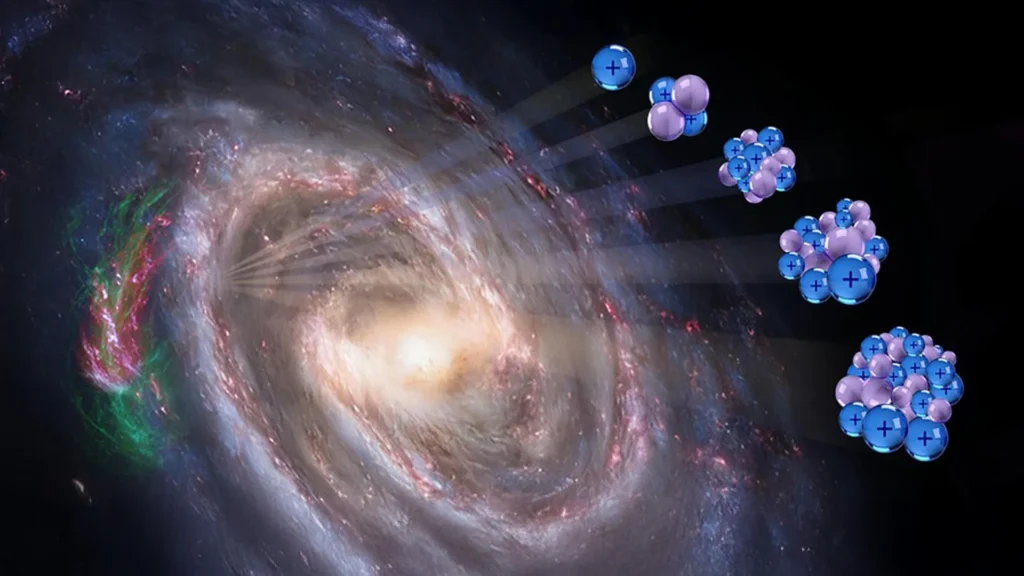
For more than a century, scientists have been grappling with one of the most enduring puzzles in astrophysics: the origin and acceleration of cosmic rays. These incredibly powerful particles, traveling across the universe at extreme energies, have remained largely enigmatic despite decades of dedicated research. Now, a groundbreaking discovery by researchers working with the Dark Matter Particle Explorer (DAMPE) space telescope has unveiled a crucial new clue. Their findings, meticulously detailed in the prestigious journal Nature, reveal a common feature shared by these mysterious particles, a universal pattern that could fundamentally reshape our understanding of their genesis and propagation through the cosmos. This insight strongly supports theories that cosmic ray acceleration and movement are governed by particle rigidity, rather than energy per nucleon, marking a significant advance in this long-standing scientific quest.
The Enduring Enigma of Cosmic Rays: A Century of Exploration
Cosmic rays represent the highest energy particles ever observed in nature, far surpassing the capabilities of even the most advanced terrestrial accelerators like the Large Hadron Collider (LHC) at CERN. Their energies can reach levels billions of times greater than those achievable on Earth, with individual particles carrying the kinetic energy of a fast-moving tennis ball. Scientists widely hypothesize that these extreme energies are imparted by some of the universe’s most violent and cataclysmic events, including the spectacular explosions of supernovae, the powerful jets emanating from supermassive black holes at the centers of galaxies, and the rapidly spinning, highly magnetized remnants of collapsed stars known as pulsars. However, pinpointing the precise sources and the exact mechanisms by which these particles are accelerated to such incredible velocities has remained one of the paramount challenges in high-energy astrophysics.
The journey to understand cosmic rays began over a hundred years ago, in 1912, when Austrian physicist Victor Hess made his pioneering balloon flights. Hess observed that ionization levels in the atmosphere increased with altitude, leading him to conclude that radiation was entering Earth’s atmosphere from outer space. This discovery earned him the Nobel Prize in Physics in 1936 and marked the birth of cosmic ray research. Since then, an international community of scientists has deployed a vast array of instruments – from ground-based arrays spanning vast areas to detectors aboard balloons, rockets, and satellites – all striving to capture and analyze these elusive particles. The difficulty lies not only in their extreme energies but also in their charge; as charged particles, they are deflected by magnetic fields throughout the galaxy, scrambling their original directions and making it nearly impossible to trace them back to their sources directly. What reaches Earth is a chaotic shower of secondary particles, further complicating their study.
The DAMPE Mission: A New Eye on the High-Energy Universe
Launched on December 17, 2015, from the Jiuquan Satellite Launch Center in China, the DAMPE space telescope, also known by its Chinese name "Wukong" (after the mythical Monkey King), was specifically designed to investigate the nature of cosmic rays and explore possible connections to dark matter. Operating in a sun-synchronous orbit at an altitude of 500 km, DAMPE is a cutting-edge instrument developed by an international collaboration led by the Chinese Academy of Sciences, with significant contributions from institutions across Europe, including a pivotal role played by the astrophysics group at the Department of Nuclear and Particle Physics (DPNC) at the University of Geneva (UNIGE).
DAMPE’s sophisticated payload is composed of four main detectors, each designed to capture different aspects of cosmic ray interactions:
- Plastic Scintillator Detector (PSD): Measures the charge of incoming particles and acts as an anti-coincidence detector to veto particles not entering the main calorimeter.
- Silicon-Tungsten Tracker (STK): Crucial for precisely tracking the paths of incident particles and determining their electrical charge. This detector was notably led in development by the Geneva group.
- Bismuth Germanate (BGO) Calorimeter: The heart of DAMPE, it measures the energy of cosmic ray electrons, photons, and nuclei with high resolution and efficiency.
- Neutron Detector (NUD): Helps to distinguish between electrons and hadrons (protons and nuclei) by detecting neutrons produced in hadronic showers.
This multi-layered architecture allows DAMPE to achieve unprecedented precision in measuring the energy spectra of various cosmic ray species, from individual electrons and photons to different types of atomic nuclei, over a broad energy range extending up to teraelectron-volts (TeV) and beyond. The mission’s dual objectives – probing cosmic rays and searching for signatures of dark matter annihilation or decay – are interconnected, as an accurate understanding of the astrophysical cosmic ray background is essential to distinguish any potential dark matter signals.
A Chronology of Data Collection and Analysis Leading to the Breakthrough
Since its successful launch, DAMPE has been continuously collecting high-quality data, meticulously scanning the cosmos for high-energy particles. The mission’s operational phase has been remarkably stable, providing an extensive dataset over several years. The process of turning raw detector signals into meaningful scientific results is an arduous one, involving complex data calibration, event reconstruction, and background rejection algorithms.
The discovery published in Nature is the culmination of years of painstaking analysis of this vast dataset. Researchers first had to meticulously identify and categorize millions of particle events, distinguishing between different cosmic ray species (protons, helium, carbon, oxygen, iron nuclei) and accurately measuring their energies. This involved developing and refining sophisticated analysis techniques, including advanced machine learning algorithms, to extract the most precise information from the detector’s responses. The team focused on the "primary" cosmic rays – those directly arriving from space before significant interaction with Earth’s atmosphere – to gain insight into their original properties. The specific data analyzed for this particular study encompassed a significant fraction of DAMPE’s operational lifetime, allowing for statistically robust conclusions across a wide energy range. The iterative process of cross-checking, validating, and refining these analyses by multiple independent teams within the collaboration was critical to ensuring the reliability of the findings before their presentation to the scientific community.
The Groundbreaking Discovery: A Shared Cosmic Ray Pattern
The core of DAMPE’s breakthrough lies in the discovery of a universal pattern observed in the energy spectra of primary cosmic ray nuclei. By examining highly precise data collected across a spectrum of particles, ranging from lightweight protons to much heavier iron nuclei, researchers uncovered a consistent feature: a "spectral softening."
Andrii Tykhonov, an associate professor at the DPNC in the Faculty of Science at UNIGE and a co-author of the study, elaborated on the nature of these particles. "Cosmic rays are primarily composed of protons, but also of helium, carbon, oxygen, and iron nuclei," he explained. "These particles are also categorized according to their energy: low, up to a few billion electron-volts; intermediate, from a few billion to several hundred billion electron-volts; and high, from 1,000 billion electron-volts and beyond."
The research revealed that for every type of nucleus studied, the number of particles begins dropping much faster after reaching a certain threshold energy. While it is normal for higher-energy cosmic rays to become less common as energy increases (a phenomenon described by a power law spectrum), the DAMPE observations showed that this decline becomes dramatically steeper beyond a critical point. This "spectral softening" occurs consistently across all observed nuclei when their "rigidity" reaches approximately 15 TV (teraelectron-volts).
Rigidity is a crucial concept in this context. It describes how strongly a charged particle’s path resists being bent by magnetic fields. Mathematically, rigidity is defined as a particle’s momentum divided by its charge (R = pc/Ze, where p is momentum, c is the speed of light, Z is the atomic number, and e is the elementary charge). Because particles with higher rigidity are less affected by magnetic fields, their trajectories are straighter. The fact that this same spectral softening feature appears across many different types of particles – irrespective of their mass, but consistently at the same rigidity value – provides compelling evidence that cosmic ray acceleration and their subsequent movement through the galaxy are predominantly controlled by rigidity.
This finding carries profound implications for theoretical models. For decades, there has been a debate whether cosmic ray acceleration limits are dependent on rigidity or on "energy per nucleon" (the total energy of the particle divided by the number of protons and neutrons it contains). The DAMPE data largely rules out competing explanations based on energy per nucleon. The statistical confidence level against these alternative models reaches an astonishing 99.999%, effectively settling a long-standing debate and redirecting theoretical efforts. This high level of confidence underscores the robustness and significance of the DAMPE observations.
The University of Geneva’s Pivotal Role: AI and Advanced Detector Technology
The University of Geneva played a particularly significant role in this international breakthrough, showcasing its expertise in both advanced data analysis and cutting-edge detector development. The UNIGE team contributed substantially to several critical aspects of the DAMPE mission and this specific discovery.
"The complexity of cosmic ray data, combined with the need for extremely high precision, necessitated the development of novel analytical tools," remarked a spokesperson from the UNIGE astrophysics group, highlighting their contributions. Researchers from Geneva developed sophisticated artificial intelligence (AI) methods to reconstruct particle events detected by the telescope. These AI algorithms are essential for accurately identifying particle types, determining their energies, and filtering out background noise from the vast stream of data, enabling the high precision required for this discovery. Without such advanced computational techniques, extracting the subtle spectral features from the raw data would have been significantly more challenging, if not impossible.
Beyond AI, the Geneva team also made direct scientific contributions to important measurements. They were instrumental in analyzing proton and helium fluxes, providing crucial baseline data for the study. Furthermore, their expertise was vital in analyzing carbon nuclei data, extending the universality of the observed pattern across a broader range of elements.
Perhaps one of Geneva’s most tangible contributions was their leadership in the development of one of DAMPE’s key instruments: the Silicon-Tungsten Tracker (STK). This detector is composed of multiple layers of silicon strip sensors interleaved with tungsten plates, allowing it to precisely trace the path of incoming cosmic rays and accurately determine their electrical charge. The STK’s high spatial resolution and charge measurement capabilities are absolutely essential for distinguishing between different types of nuclei and for ensuring the purity of the collected samples, which is paramount for observing subtle spectral features like the softening discovered. The reliability and performance of the STK were critical enablers for the precision measurements that underpinned the Nature publication.
Broader Impact and Implications for Astrophysics
The findings from DAMPE mark an extremely important advance in understanding how cosmic rays are created and how they traverse the vast expanse of the galaxy. By establishing that the spectral softening is rigidity-dependent and universal across different nuclei, the new results place much tighter constraints on existing theoretical models of particle acceleration in astrophysical sources.
Previously, models had to account for both rigidity-dependent and energy-per-nucleon-dependent scenarios, leading to a wider range of possibilities for source characteristics. Now, the overwhelming evidence from DAMPE points strongly towards rigidity as the dominant factor. This implies that the mechanisms responsible for accelerating these particles, such as diffusive shock acceleration in supernova remnants or magnetic reconnection events, must operate in a way that imposes a rigidity-dependent cutoff or break in the acceleration efficiency. For instance, it might suggest that the maximum energy a particle can attain within an accelerator is limited by the size of the acceleration region and the strength of its magnetic field, affecting particles based on their rigidity.
Furthermore, these results significantly improve our understanding of how high-energy particles propagate through interstellar space. The interstellar medium is permeated by turbulent magnetic fields that scatter cosmic rays. A rigidity-dependent spectral softening could also be influenced by propagation effects, where particles of different rigidities escape their sources or diffuse through the galactic magnetic field differently. The new data provides critical benchmarks for models that simulate cosmic ray transport, helping to refine parameters such as the diffusion coefficient and the size of the galactic halo where cosmic rays are confined.
This discovery also holds implications for understanding the broader cosmic ray spectrum, particularly the "knee" and "ankle" features observed at much higher energies (around 10^15 eV and 10^18 eV, respectively). While the DAMPE observation is at a lower energy range (around 15 TV or 1.5 x 10^13 eV), understanding the rigidity-dependent behavior at these lower energies provides crucial context for interpreting the origin of these higher-energy spectral features, which are believed to mark the transition from galactic to extragalactic cosmic ray sources.
Expert Commentary and Future Outlook
The scientific community has widely recognized the significance of DAMPE’s findings. The publication in Nature, one of the world’s most prestigious scientific journals, underscores the impact of this work. "This finding represents a major leap forward in our quest to unravel the century-old mystery of cosmic ray origins," stated a leading astrophysicist not directly involved with DAMPE, reflecting the general sentiment. "By providing such compelling evidence for rigidity-dependent acceleration, DAMPE has narrowed down the possibilities for how the universe’s most powerful particle accelerators operate."
The implications for theoretical astrophysics are profound, compelling theorists to refine their models of particle acceleration in extreme astrophysical environments. It provides crucial empirical data to guide the next generation of theoretical frameworks.
Looking ahead, the DAMPE mission continues to collect data, promising further insights into the high-energy universe. Future research will likely focus on refining these measurements, extending the energy range of observation, and applying the rigidity-dependent framework to other cosmic ray species and phenomena. The success of DAMPE also paves the way for future space-based cosmic ray observatories and ground-based experiments, which can build upon these findings. Missions like the Cherenkov Telescope Array (CTA), GAPS, and HELIX will be designed with an enhanced understanding of cosmic ray behavior, thanks to DAMPE’s pioneering work. Ultimately, the goal remains to definitively identify the specific astrophysical objects responsible for accelerating cosmic rays to their astonishing energies, and this latest discovery from DAMPE brings humanity a significant step closer to achieving that ambitious objective.