The fundamental understanding of the universe’s most mysterious objects has been challenged by a new theoretical breakthrough from physicists at Goethe University Frankfurt. For decades, the scientific consensus has held that when a massive star exhausts its nuclear fuel, it undergoes a gravitational collapse so absolute that it creates a black hole—a region of spacetime where gravity is so intense that nothing, not even light, can escape. However, the mathematical "singularity" at the heart of a black hole, where density becomes infinite and the laws of physics break down, has long remained a point of contention and discomfort for theoretical physicists. A new solution to Albert Einstein’s equations of general relativity, proposed by Daniel Jampolski and Professor Luciano Rezzolla, suggests that these objects might not be black holes at all, but rather "gravastars" fueled by the birth of a miniature universe.
The Architectural Crisis of Modern Physics
To understand the significance of the Jampolski-Rezzolla solution, one must first examine the inherent contradictions within the standard model of black holes. According to general relativity, a sufficiently compact mass can deform spacetime to such a degree that it forms a singularity. At this mathematical point, the volume is zero and the density is infinite. While the mathematics of Einstein’s theory allows for this, the physical reality is problematic. Infinite values usually signal that a theory has reached its limit and requires a more comprehensive framework, such as quantum gravity, which does not yet exist in a completed form.
Furthermore, black holes present the "information paradox." If an object falls into a black hole, the information describing its physical state is seemingly lost to the rest of the universe once it passes the event horizon. This violates a core tenet of quantum mechanics: that information must be preserved. These conceptual hurdles have led a segment of the scientific community to seek "black hole mimics"—objects that look and act like black holes from the outside but lack the problematic singularity and event horizon.
The Gravastar Alternative: A History of Theoretical Defiance
The concept of a gravastar—short for Gravitational Vacuum Star—was first proposed in 2001 by physicists Pawel Mazur and Emil Mottola. They envisioned an object where the vacuum of space itself undergoes a phase transition during the collapse of a star. In their model, the interior of the object is not a void leading to a singularity, but a region filled with "dark energy" or vacuum energy.
Dark energy is characterized by negative pressure. While ordinary gravity pulls matter inward, the negative pressure of dark energy pushes outward. In a gravastar, this outward pressure perfectly balances the inward pull of gravity, creating a stable, ultra-compact shell of matter. Because there is no singularity, the laws of physics remain intact throughout the object. However, for 25 years, the gravastar remained a purely static concept. Scientists could describe what a gravastar looked like, but they could not explain the dynamic process of how a collapsing star could actually transform into one.
A Dynamic Solution: The Birth of a Mini Universe
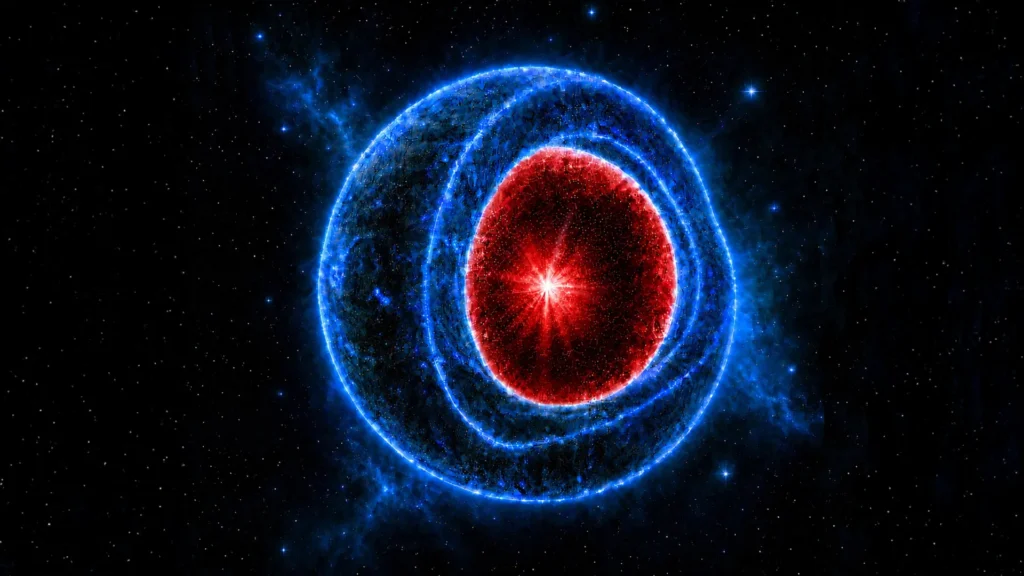
The breakthrough by Jampolski and Rezzolla provides the missing link: a "dynamic solution" that describes the transition from a collapsing star to a gravastar. Their research suggests that as a star collapses toward the threshold of becoming a black hole, the extreme compression of matter triggers a phenomenon akin to the Big Bang.
In this model, the intense energy density at the final stages of collapse initiates the creation of a new, miniature universe inside the stellar shell. This interior space is governed by a cosmological constant—the same force believed to be driving the expansion of our own universe. As this internal "mini-cosmos" expands, it exerts a powerful outward force against the layers of the collapsing star.
"The Big Bang of the emerging universe can unfold once the star has already collapsed almost to the point of becoming a black hole," explained Daniel Jampolski, who developed the framework during his Master’s thesis. This timing is crucial; it allows the object to reach the extreme densities observed in black hole candidates while providing a physical mechanism—new physics emerging at high densities—to halt the collapse before a singularity can form.
Chronology of Gravitational Theory and the Search for Alternatives
The evolution of our understanding of gravitational collapse has moved through several distinct eras:
- 1915–1916: Albert Einstein publishes the General Theory of Relativity. Shortly after, Karl Schwarzschild derives the first solution for a non-rotating, spherical mass, implying the existence of what would later be called the "Schwarzschild radius" or event horizon.
- 1939: Robert Oppenheimer and Hartland Snyder provide the first description of how a star could collapse into a black hole.
- 1960s–1970s: The "Golden Age" of black hole physics. Stephen Hawking and Roger Penrose prove that singularities are inevitable under general relativity, while Hawking proposes that black holes can "evaporate" via Hawking radiation.
- 2001: Mazur and Mottola propose the gravastar as a way to avoid the singularity and the information paradox.
- 2015–2019: The first detection of gravitational waves by LIGO and the first image of a black hole’s shadow by the Event Horizon Telescope (EHT) provide concrete evidence for ultra-compact objects, though they do not definitively prove the existence of a singularity.
- 2024: Jampolski and Rezzolla publish their dynamic solution, offering a mathematical pathway for the formation of gravastars through internal cosmic expansion.
Supporting Data and Mathematical Modeling
The Jampolski-Rezzolla model relies on a complex interplay of two different types of spacetime metrics. The exterior of the gravastar is described by the Schwarzschild metric, which matches the gravitational field of a black hole. This explains why, to an outside observer or a telescope, a gravastar would be indistinguishable from a black hole of the same mass.
The interior, however, is described by a de Sitter metric, which represents a universe with a positive cosmological constant. The researchers successfully modeled the "thin shell" that separates these two regions. According to their calculations, the shell consists of ultra-dense matter where the pressure equals the energy density, a state known as "stiff matter."
Data from the study indicates that this balance is stable. The outward pressure of the internal de Sitter space prevents the shell from collapsing inward, while the gravitational pull of the shell prevents the internal universe from expanding indefinitely into the surrounding space. This results in an object that is nearly as compact as a black hole but possesses a physical surface rather than an abyss.
Official Responses and Scientific Perspective
The proposal has been met with significant interest in the theoretical physics community, though it is viewed as a bold alternative rather than a replacement for the standard black hole model. Professor Luciano Rezzolla, a leading figure in theoretical astrophysics at Goethe University, maintains a balanced view of the discovery.
"Looking for alternatives to black holes should not suggest a skepticism towards black holes, which still represent the most natural and simplest solution to the fate of gravitational collapse," Rezzolla stated. He emphasized that the goal of the research is to push the boundaries of what is mathematically possible under Einstein’s equations. "As scientists… it is essential to maintain an unbiased approach towards what we do not know and hence explore both the accepted wisdom and the more exotic interpretations. History teaches us that it is not unusual for the latter to become the former."
Independent researchers have noted that while the math is sound, the "new physics" required to trigger a mini-Big Bang inside a star remains speculative. However, the solution is praised for being the first to move the gravastar from a static mathematical curiosity to a plausible end-state of stellar evolution.
Broader Implications for Cosmology and Observation
The implications of gravastars existing in our universe are profound. If some of the objects we currently identify as black holes are actually gravastars, it would change our understanding of the lifecycle of matter and the nature of dark energy.
From an observational standpoint, the challenge is now to find ways to distinguish between the two. Current technology, such as the Event Horizon Telescope, looks for the "shadow" cast by the event horizon. A gravastar would also cast a shadow, but there might be subtle differences in the "brightness" of the ring or the presence of gravitational wave "echoes." When two black holes merge, they produce a specific gravitational wave signal that dies out quickly (a "ringdown"). If the objects were gravastars, the waves might reflect off the solid shells, creating faint echoes in the signal.
As gravitational wave detectors like LIGO, Virgo, and the future LISA mission become more sensitive, they may be able to detect these echoes. If found, it would provide the first empirical evidence that the heart of a collapsed star is not a point of infinite nothingness, but perhaps a gateway to a new universe.
The work of Jampolski and Rezzolla serves as a reminder that even after a century, Einstein’s equations continue to yield surprises. By providing a dynamic birth for gravastars, they have opened a new chapter in the study of the extreme universe, one where the end of a star might simply be the beginning of another cosmos.