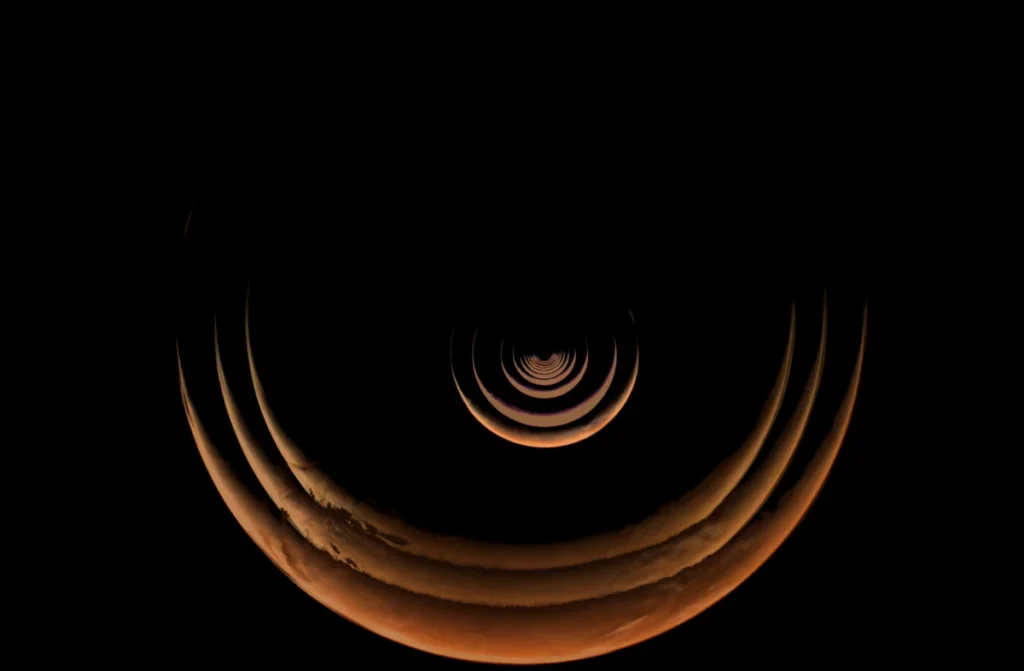
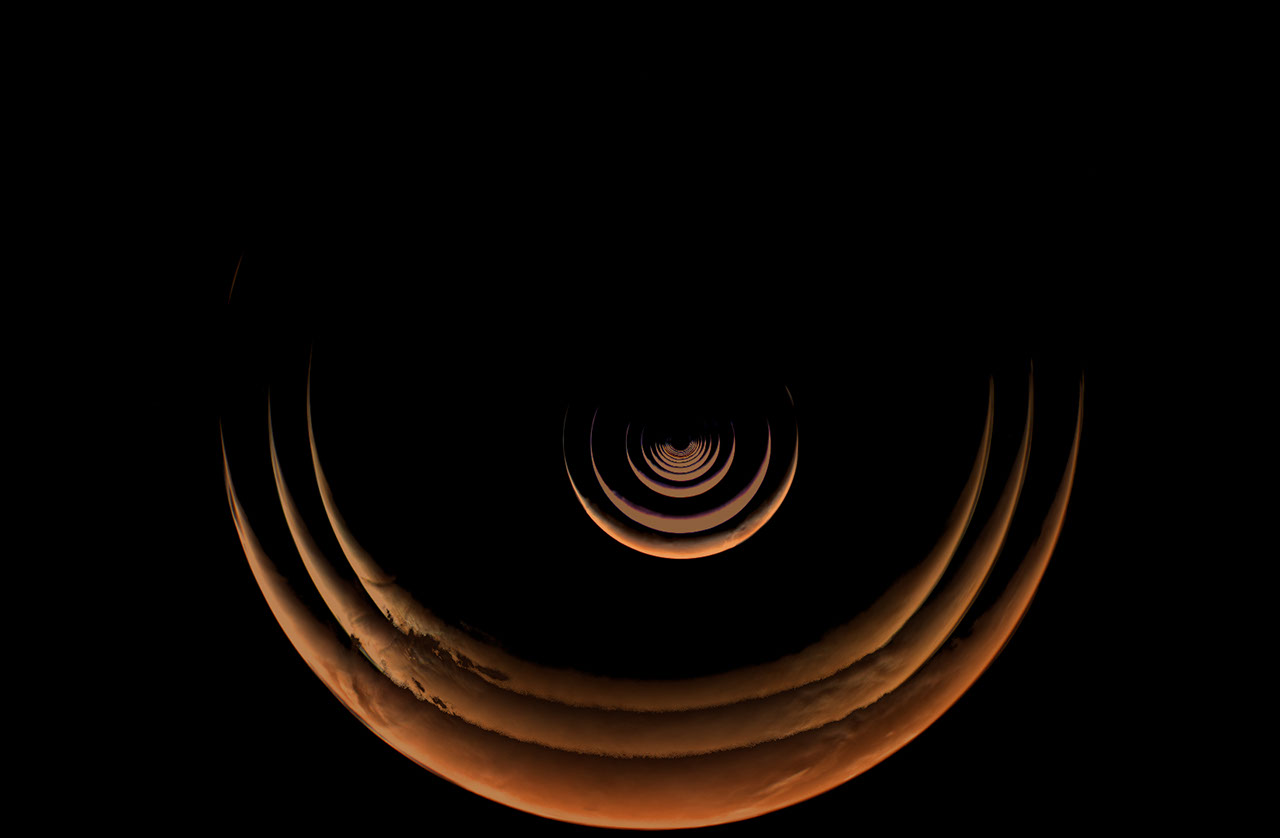
NASA’s Psyche mission has delivered a breathtaking visual narrative of its encounter with Mars, culminating in a spectacular time-lapse composite that chronicles the Red Planet’s crescent phases as the spacecraft maneuvered for a crucial gravity assist. The series of images, captured between May 2 and May 15, 2026, showcases the gradual expansion of Mars’ illuminated sliver as the spacecraft, on its journey to the asteroid belt, drew nearer to the fourth planet from the Sun. This meticulously compiled visual record offers a unique perspective on celestial mechanics and the intricate dance of spacecraft navigation in the vast expanse of our solar system.
The composite image, a testament to the scientific and engineering prowess of NASA’s Jet Propulsion Laboratory (JPL) and Arizona State University (ASU), begins with Mars appearing as a delicate, small crescent at the center of the frame. This initial view represents the farthest point of the spacecraft’s approach. As Psyche continued its trajectory, Mars progressively filled the field of view, its crescent shape widening dramatically. This visual progression is not merely an aesthetic marvel; it is a direct illustration of the spacecraft’s changing position relative to Mars and the Sun, demonstrating the principles of orbital mechanics in a visually accessible format.
The Science Behind the Crescent
The phenomenon of observing Mars as a crescent is directly related to the geometry of the encounter. Psyche approached Mars from a high phase angle. In astronomical terms, the phase angle is the angle between the Sun, the observed object (Mars), and the observer (the spacecraft). When the phase angle is high, the observer sees only a portion of the sunlit side of the planet, much like the phases of the Moon as seen from Earth. As Psyche drew closer, the phase angle decreased, revealing a larger and larger portion of Mars’ illuminated hemisphere, thus creating the expanding crescent effect.
The multispectral imager instrument aboard the Psyche spacecraft was responsible for capturing these detailed observations. This instrument is designed to capture images across various wavelengths of light, providing scientists with rich data about the composition and properties of celestial bodies. While the primary objective of the Psyche mission is to explore the metal-rich asteroid Psyche, opportunistic observations of planets during transit are invaluable for calibrating instruments, testing navigation systems, and contributing to our broader understanding of the solar system.
A Chronology of the Martian Encounter
The period of observation, from May 2 to May 15, 2026, was a critical phase for the Psyche mission. This two-week window allowed for a detailed study of Mars from multiple vantage points.
- Early Approach (May 2 – May 8): During the initial days of this observation period, Mars appeared as a small, thin crescent. This phase was crucial for initial instrument calibration and for confirming the spacecraft’s trajectory relative to Mars. The increasing size of the crescent provided early confirmation that the gravity assist maneuver was proceeding as planned.
- Mid-Approach and Close Encounter (May 9 – May 14): As Psyche neared its closest approach to Mars, the crescent grew significantly larger, transitioning into a more substantial gibbous phase. During this period, the spacecraft was also able to capture a series of high-resolution images of the Martian surface. These images, taken as Mars began to "overfill" the field of view of the imager, will provide scientists with unprecedented detail of specific regions on the planet.
- Post-Close Approach (May 15 onwards): Following the closest point of the flyby, Psyche would have begun to recede from Mars, with the planet’s illuminated portion again appearing to shrink from the spacecraft’s perspective. The data gathered during this entire sequence will be analyzed to refine our understanding of Mars’s atmosphere, surface features, and the overall dynamics of the Martian system.
The culmination of these observations is a "stunning time-lapse video," as described by the Psyche team, which encapsulates the entire Mars encounter. This video allows viewers to witness the dynamic process of a spacecraft’s approach to a planet, offering an intuitive understanding of orbital mechanics and the visual transformations that occur during such celestial rendezvous.
Supporting Data and Mission Context
The Psyche mission, launched in October 2023, is a groundbreaking endeavor to explore a unique celestial body: the asteroid 16 Psyche. Located in the main asteroid belt between Mars and Jupiter, Psyche is believed to be the exposed nickel-iron core of an early planetesimal, a protoplanet that lost its outer rocky layers billions of years ago. Studying Psyche could provide invaluable insights into the formation of terrestrial planets, including Earth, by offering a direct look at the internal structure that is typically hidden beneath a planet’s crust.
The gravity assist maneuver performed with Mars is a fundamental technique in interplanetary mission planning. By utilizing the gravitational pull of a planet, spacecraft can alter their speed and trajectory, effectively "slingshotting" themselves towards their ultimate destination. This maneuver significantly reduces the amount of fuel required for the journey, making missions to distant targets more feasible and cost-effective. For Psyche, this Mars flyby was essential for gaining the necessary velocity to reach the asteroid belt efficiently.
The multispectral imager, one of the scientific instruments aboard Psyche, plays a dual role. Its primary function is to map the surface composition of the asteroid Psyche. However, its capabilities are also valuable for observing other celestial bodies. The data collected during the Mars flyby will not only contribute to the understanding of Mars but also serve as a critical calibration point for the instrument’s performance in the harsh environment of deep space.
Official Statements and Reactions
While specific direct quotes from mission scientists regarding this particular time-lapse have not been released in the initial announcement, the broader context of NASA’s approach to public outreach and scientific communication suggests a high level of enthusiasm. Typically, when such compelling visual data is acquired, mission teams express excitement about sharing these discoveries with the public.
Dr. Lindy Elkins-Tanton, the principal investigator of the Psyche mission from Arizona State University, has consistently emphasized the scientific potential of exploring the asteroid Psyche. Her team’s dedication to achieving mission objectives, coupled with their ability to capture and process such engaging imagery, reflects a deep commitment to both scientific discovery and public engagement. A NASA spokesperson might typically state that "these images not only showcase the remarkable capabilities of our spacecraft but also inspire future generations of explorers and scientists by bringing the wonders of space exploration directly into people’s homes."
The compilation of this time-lapse is a testament to the collaborative efforts of the mission control teams at JPL and the scientific analysis conducted by researchers at ASU. The successful execution of the Mars flyby and the subsequent release of this captivating visual narrative underscore the meticulous planning and dedication of all individuals involved in the Psyche mission.
Broader Impact and Future Implications
The visual narrative provided by the Psyche mission’s Mars flyby extends beyond mere aesthetic appeal. It serves several crucial functions:
- Educational Tool: The time-lapse offers an accessible and engaging way to teach fundamental concepts of orbital mechanics, planetary science, and space exploration. For students and the general public, it provides a tangible representation of the complex maneuvers undertaken by spacecraft.
- Mission Validation: The successful execution of the Mars gravity assist and the quality of the imagery captured validate the performance of the Psyche spacecraft’s systems, particularly its navigation and imaging instruments. This provides confidence for the subsequent phases of the mission.
- Scientific Data Acquisition: While the primary focus of the mission is the asteroid Psyche, the opportunistic collection of data on Mars is invaluable. It contributes to the vast repository of knowledge about our solar system, potentially revealing new details about Martian atmospheric conditions, geological features, or even atmospheric dust dynamics during the flyby.
- Public Engagement and Inspiration: Compelling visuals like this time-lapse have a profound impact on public interest in space exploration. They foster a sense of wonder and curiosity, encouraging greater support for scientific endeavors and inspiring young people to pursue careers in STEM fields. The "wow" factor of seeing a planet transform from a sliver to a near-full disk as a spacecraft approaches is a powerful tool for connecting humanity with the cosmos.
The Psyche mission’s journey to the asteroid belt is a long and complex one, and this successful Mars flyby marks a significant milestone. The data and imagery gathered during this encounter will undoubtedly fuel scientific research and public fascination for years to come, underscoring the enduring allure of our solar system and humanity’s relentless drive to explore it. The mission’s ongoing progress and future discoveries are eagerly anticipated by the scientific community and the public alike. The ability to capture such evocative imagery during a critical mission phase highlights the multi-faceted nature of modern space exploration, where scientific objectives are interwoven with the art of visual storytelling.