The Jiangmen Underground Neutrino Observatory (JUNO), a massive subatomic particle detector located in southern China, has officially entered the "precision era" of particle physics with the publication of its first major scientific results. On June 10, the prestigious journal Nature featured the experiment’s debut physics findings as its cover article, signaling a transformative moment for the global scientific community’s understanding of the neutrino. Based on an initial 59-day window of validated data collected between August 26 and November 2, 2025, the international JUNO Collaboration has successfully produced the most precise measurements to date of two fundamental neutrino oscillation parameters. This achievement, led by the Institute of High Energy Physics (IHEP) of the Chinese Academy of Sciences (CAS), marks the beginning of a new chapter in the quest to solve some of the most enduring mysteries of the universe.
The analysis of this early data set has already demonstrated the extraordinary capabilities of the JUNO detector. By refining the measurements of neutrino behavior, the collaboration reduced the uncertainties associated with these specific oscillation parameters by a factor of 1.6 when compared to the combined results of all previous experiments conducted globally over several decades. This rapid advancement highlights the JUNO facility’s role as a cornerstone of modern high-energy physics.
The Enigma of the Ghost Particle
To appreciate the significance of JUNO’s first milestone, one must understand the elusive nature of the neutrino. Often referred to as "ghost particles," neutrinos are among the most abundant yet least understood elementary particles in the Standard Model of physics. They carry no electric charge, possess an infinitesimal mass that was long thought to be zero, and interact with other matter only through the weak nuclear force and gravity.
Every second, trillions of neutrinos produced by the Sun, distant supernovae, and nuclear reactions within the Earth pass through every square inch of our bodies without a single interaction. Because they so rarely "touch" normal matter, detecting them requires massive, highly sensitive instruments shielded from the "noise" of cosmic radiation. Despite their ubiquity, neutrinos remain a primary focus of modern research because they hold the key to understanding the fundamental laws of nature, the evolution of stars, and the reasons why the universe is dominated by matter rather than antimatter.
Engineering a Giant: The JUNO Facility
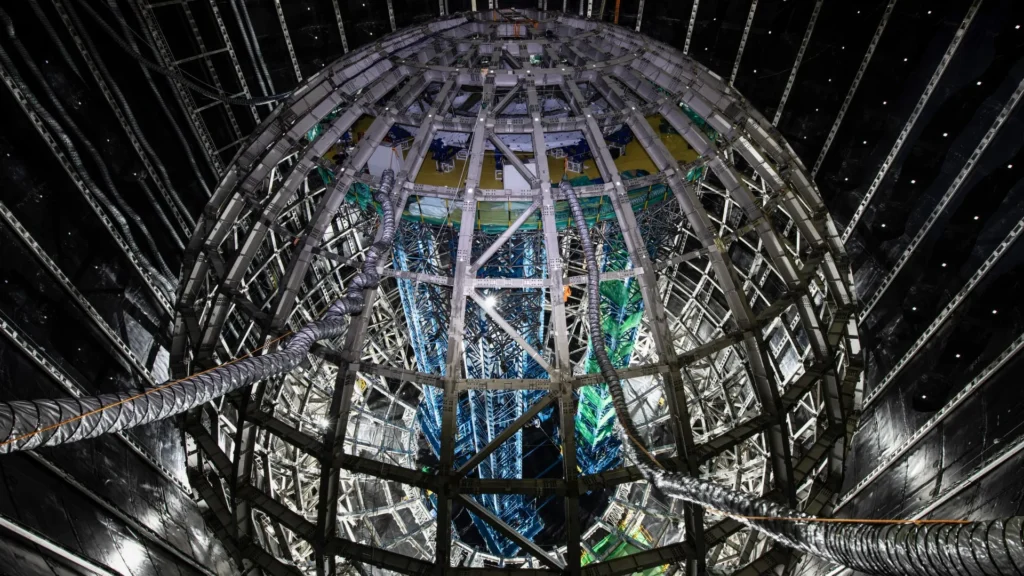
The JUNO experiment is a marvel of modern engineering, situated 700 meters underground in Jiangmen, Guangdong Province. This depth is critical, as the overlying rock provides a natural shield against cosmic rays that would otherwise overwhelm the delicate signals produced by neutrino interactions. At the heart of this subterranean laboratory is a massive liquid scintillator detector with an effective mass of 20,000 tons—roughly 20 times larger than any existing detector of its kind.
The architecture of the detector is as complex as the physics it studies. The core is a 35.4-meter-wide acrylic sphere, which houses the liquid scintillator. This sphere is supported by a stainless steel structure measuring 41.1 meters in diameter. Surrounding the sphere is an array of light-sensing technology: 20,000 20-inch photomultiplier tubes (PMTs) and 25,600 3-inch PMTs. These sensors are designed to detect the faint flashes of light, known as scintillation, that occur when a neutrino strikes a nucleus within the liquid.
The entire assembly is submerged in a 44-meter-deep pool of ultrapure water, which serves as a secondary shield and a "veto" detector to identify and exclude signals from remaining cosmic-ray muons. This intricate design allows JUNO to achieve unprecedented energy resolution and radiopurity, which are essential for its primary mission.
A Chronology of Success and Data Validation
The journey toward this Nature cover article began years ago with the conceptualization of the Jiangmen facility, following the success of the Daya Bay Reactor Neutrino Experiment. JUNO was strategically placed 53 kilometers from both the Yangjiang and Taishan Nuclear Power Plants. This specific distance is the "sweet spot" for observing the oscillation of reactor antineutrinos, allowing scientists to measure how these particles change "flavor" as they travel.
Following a rigorous construction and commissioning phase, JUNO began its official data collection in August 2025. The 59 days of data analyzed for the current report represent a "first light" phase for the observatory. During this period, the collaboration focused on validating the detector’s performance, ensuring that the complex network of PMTs, electronics, and cabling functioned in perfect synchronization.
In April 2026, the journal Chinese Physics C featured the detector’s technical performance on its cover, setting the stage for the physics results that would follow in June. The transition from technical validation to groundbreaking physics results in less than a year underscores the efficiency and readiness of the JUNO team.
Precision Measurements and Scientific Impact
The primary goal of the first analysis was to measure two parameters of neutrino oscillation: the mass-squared difference ($Delta m^221$) and the mixing angle ($theta12$). These parameters describe how neutrinos transition between their three known types—electron, muon, and tau neutrinos—as they propagate through space.
By achieving a 1.6-fold reduction in uncertainty, JUNO has provided a more stable foundation for the "three-flavor paradigm," the current theoretical framework used to describe neutrino behavior. This level of precision is not merely an incremental improvement; it is a necessary prerequisite for JUNO’s most ambitious objective: determining the neutrino mass ordering (NMO).
The NMO refers to whether the third neutrino mass state is heavier or lighter than the other two. Solving this puzzle is vital for determining the absolute mass scale of neutrinos and for experiments searching for neutrinoless double-beta decay, which could prove that neutrinos are their own antiparticles.
Global Recognition and Peer Review
The international physics community has responded to JUNO’s debut with high praise. Peer reviewers for Nature noted that the results establish JUNO as a "key player in the emerging precision era of neutrino oscillation physics." The reviewers emphasized that the study does more than just present data; it validates the entire methodology and detector performance, providing confidence that the experiment will eventually solve the mass ordering mystery.
Professor Arthur McDonald, who shared the 2015 Nobel Prize in Physics for the discovery of neutrino oscillations, lauded the achievement. "JUNO has met its design objectives, achieving exceptional radiopurity, energy resolution, and detector stability," McDonald stated. He further noted that the experiment is now "fully operational and ready to pursue its ambitious physics goals," including the exploration of physics beyond the Standard Model.
Nature’s editorial team further highlighted the work in a "News & Views" feature, describing the results as the "dawn of the next era." The publication argued that understanding neutrino behavior is paramount to a complete description of matter and forces at the smallest scales.
Broader Implications for Cosmology and Particle Physics
The implications of JUNO’s continued operation extend far beyond reactor neutrinos. The observatory is designed to be a multi-purpose facility. Its location and sensitivity make it an ideal "telescope" for neutrinos from various sources:
- Supernovae: JUNO is poised to detect a massive burst of neutrinos if a star collapses in our galaxy, providing a "live" look at the physics of stellar death.
- The Sun: It will perform high-precision measurements of solar neutrinos to refine our models of nuclear fusion in the solar core.
- The Earth: By detecting "geo-neutrinos" produced by radioactive decay within the Earth’s mantle and crust, JUNO will provide insights into the planet’s internal heat and chemical composition.
- Atmospheric Neutrinos: The detector will study neutrinos created by cosmic rays hitting the Earth’s atmosphere, providing further data on oscillations over longer distances.
Looking Ahead: The Summer of Discovery
With nine months of smooth operation now complete, the JUNO Collaboration is moving into a period of high-frequency scientific output. Researchers have indicated that a series of new results are expected to be released beginning in the summer of 2026.
As the data set grows from 59 days to several years, the statistical power of the experiment will increase exponentially. This will allow the team to move closer to the 1% precision threshold for three of the six neutrino mixing parameters, a feat that would be unparalleled in the history of particle physics.
The success of JUNO is a testament to international scientific cooperation, involving hundreds of scientists from dozens of countries. By pushing the boundaries of what is technically possible, JUNO is not only answering fundamental questions about the smallest building blocks of the universe but is also cementing its legacy as one of the most important scientific endeavors of the 21st century. The world now waits as this underground giant continues to peer into the invisible, peeling back the layers of the "ghost particle" and the laws that govern our existence.