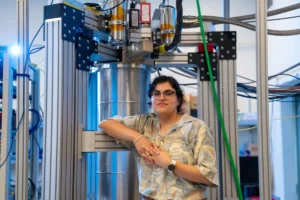
Scientists at the University of New Hampshire are leveraging the power of artificial intelligence to dramatically accelerate the quest for advanced magnetic materials, culminating in the creation of a vast, searchable resource that not only catalogs 67,573 magnetic compounds but also remarkably identifies 25 novel materials previously unrecognized for their high-temperature magnetic stability. This groundbreaking endeavor signifies a pivotal shift in materials science, offering a tangible pathway to mitigate global reliance on geopolitically sensitive rare earth elements, substantially reduce manufacturing costs for critical technologies like electric vehicles and renewable energy systems, and fortify the domestic industrial base of the United States. The implications of this research, published in the esteemed journal Nature Communications, extend far beyond the laboratory, touching upon economic resilience, national security, and the very methodology of scientific discovery itself.
The urgency of this scientific pursuit is underscored by the current landscape of modern technology, where permanent magnets are indispensable components across an astonishing array of devices, from the precision motors in smartphones and sophisticated medical imaging equipment to the large-scale generators in wind turbines and the propulsion systems of electric vehicles. However, the most powerful and efficient magnets available today are heavily dependent on a class of materials known as rare earth elements (REEs). These elements, despite their name, are not exceptionally rare in the Earth’s crust but are geographically concentrated and environmentally challenging to extract and process. The global supply chain for REEs is currently dominated by a single nation, leading to significant cost volatility, import dependencies, and inherent vulnerabilities that pose strategic risks to industrial nations.
The Global Challenge of Rare Earth Dependence
The global demand for rare earth elements has surged dramatically over the past few decades, driven by the proliferation of high-tech applications. Elements like Neodymium, Samarium, and Dysprosium are crucial for creating high-strength permanent magnets, which are central to the performance of everything from compact electronics to the burgeoning green energy sector. For instance, Neodymium-iron-boron (NdFeB) magnets are the strongest known permanent magnets, enabling the miniaturization and efficiency gains seen in countless products. However, the mining and refining of these elements are energy-intensive and often result in significant environmental degradation, including acid mine drainage and radioactive waste. Beyond the environmental concerns, the geopolitical dimension adds another layer of complexity. China currently controls the vast majority of the world’s rare earth processing capacity, giving it substantial leverage over global supply. This concentration of supply poses a significant challenge for countries like the United States, which imports a substantial portion of its rare earth needs, impacting national security interests and the competitiveness of its manufacturing sector. Efforts to diversify supply chains and develop alternative materials have therefore become a strategic imperative, with governments and industries investing heavily in research and development.
Historically, the discovery of new materials has been a laborious, expensive, and often serendipitous process. Traditional methods involve painstaking laboratory experimentation, trial-and-error synthesis, and characterization of countless elemental combinations. Given that the number of potential material compositions can easily run into the millions or even billions, relying solely on empirical testing is impractical and time-prohibitive. This is particularly true for complex intermetallic compounds and alloys, where subtle changes in composition or processing can dramatically alter magnetic properties. The bottleneck in materials discovery has long been a significant impediment to technological advancement, especially in fields requiring highly specific material properties, such as high-temperature magnetism.
AI’s Transformative Approach to Materials Discovery
The UNH team, led by doctoral student Suman Itani, alongside physics professor Jiadong Zang and postdoctoral researcher Yibo Zhang, recognized this inherent limitation and sought to circumvent it by harnessing the burgeoning capabilities of artificial intelligence. Their innovative approach involved developing an AI system specifically designed to sift through the immense volume of existing scientific literature. This system functions much like a highly specialized digital librarian and data extractor, capable of reading and interpreting thousands of scientific papers, journal articles, and research reports. From these diverse sources, the AI was trained to meticulously identify and extract critical experimental data points. This data included detailed information about material compositions, synthesis conditions, and, crucially, their magnetic properties, particularly the Curie temperature—the specific temperature at which a magnetic material loses its permanent magnetism.
The extracted data then served as the training ground for sophisticated computer models. By feeding this vast dataset to the AI, the models learned to recognize patterns and correlations between material structure, composition, and magnetic behavior. This enabled the AI to accurately predict whether a given material would exhibit magnetism and, if so, to calculate its Curie temperature with a high degree of precision. This predictive capability is a game-changer, allowing researchers to rapidly screen a multitude of hypothetical or poorly characterized compounds without the need for time-consuming and costly laboratory synthesis and testing. The culmination of this intensive data extraction and AI-driven analysis is the Northeast Materials Database, a comprehensive and intuitively searchable repository that now serves as an invaluable resource for scientists worldwide.
The Northeast Materials Database: A New Frontier
The database itself is a monumental achievement, housing information on 67,573 magnetic compounds. What makes this resource particularly revolutionary is its ability to not only consolidate existing knowledge but also to unearth previously overlooked treasures. Among the tens of thousands of entries, the AI system identified 25 materials that had never before been recognized as magnets capable of retaining their magnetic properties at high temperatures. This discovery is particularly significant because high-temperature magnets are crucial for applications where devices operate in demanding environments, such as electric motors, power generators, and high-performance electronics, where heat generation can otherwise degrade magnetic performance. The ability to function effectively at elevated temperatures often translates to greater efficiency, durability, and a wider range of operational conditions for these technologies.
"By accelerating the discovery of sustainable magnetic materials, we can reduce dependence on rare earth elements, lower the cost of electric vehicles and renewable-energy systems, and strengthen the U.S. manufacturing base," emphasized Suman Itani, highlighting the multifaceted benefits of their work. The implications for industries reliant on high-performance magnets are profound. For instance, the electric vehicle market, projected to grow exponentially in the coming decade, currently relies heavily on rare earth magnets for its efficient motors. Finding viable, cost-effective, and domestically sourced alternatives could drastically reduce production costs, making EVs more accessible and competitive. Similarly, the renewable energy sector, particularly wind turbine generators, stands to benefit immensely from more sustainable and affordable magnet technologies, accelerating the global transition to clean energy.
Strategic Implications for U.S. Innovation and Security
The development of the Northeast Materials Database and the methodology behind it represents a significant step towards achieving U.S. strategic objectives in materials science and manufacturing. The U.S. Department of Energy (DOE) has long recognized the critical importance of secure and sustainable supply chains for advanced materials, especially those vital to national security and economic competitiveness. The project received crucial support from the Office of Basic Energy Sciences, Division of Materials Sciences and Engineering, U.S. Department of Energy, underscoring its alignment with national priorities.
"We are tackling one of the most difficult challenges in materials science — discovering sustainable alternatives to permanent magnets — and we are optimistic that our experimental database and growing AI technologies will make this goal achievable," stated Jiadong Zang, articulating the team’s confidence in their approach. The ability to discover and develop new materials domestically reduces vulnerability to supply chain disruptions and geopolitical pressures. It fosters a more robust and resilient manufacturing ecosystem within the United States, encouraging innovation and job creation in high-tech sectors. This move towards self-sufficiency in critical materials aligns with broader governmental strategies aimed at re-shoring manufacturing and bolstering domestic technological leadership. Furthermore, the economic impact could be substantial, potentially leading to billions of dollars in cost savings across various industries, from consumer electronics to defense applications.
Expert Perspectives and Broader Scientific Impact
Industry experts and academic peers are likely to view this development with considerable optimism. A representative from a major electric vehicle manufacturer, for example, might comment on the potential for significant cost reductions and improved supply chain stability, stating, "Reducing our reliance on rare earth elements for our motors is a top priority. This breakthrough offers a promising path to more sustainable and affordable EV production, which is crucial for widespread adoption." Similarly, a spokesperson from a renewable energy company could highlight the positive impact on the cost and efficiency of wind turbine generators, noting, "Cheaper, more accessible high-performance magnets will accelerate the deployment of clean energy infrastructure, making renewable power more competitive globally."
Beyond the immediate applications in magnetism, this research exemplifies a broader paradigm shift in scientific discovery. The integration of artificial intelligence and machine learning into the research workflow is transforming how scientists approach complex problems. It enables the rapid analysis of vast datasets, the identification of subtle patterns invisible to human observation, and the acceleration of the hypothesis-testing cycle. This "AI-driven science" promises to unlock breakthroughs in numerous fields, from drug discovery and genomics to quantum computing and advanced materials. The UNH project serves as a powerful case study for the effectiveness of this interdisciplinary approach, demonstrating how computational power can augment human ingenuity to overcome long-standing scientific challenges.
Beyond Magnets: AI’s Expanding Horizon in Academia
The implications of this research extend even beyond the realm of materials science and industrial applications. The core technology, particularly the large language model (LLM) employed in this project, holds significant promise for broader applications, especially within higher education and research infrastructure. The same AI capabilities used to extract and categorize scientific data from research papers could be repurposed for other demanding data management tasks. For instance, the technology could be adapted to convert historical scientific documents, handwritten notes, or scanned images into modern, searchable rich text formats. This capability would be invaluable for updating and preserving vast library collections, making invaluable historical data more accessible for contemporary research and scholarship. Imagine archives of rare manuscripts or early scientific observations becoming instantly searchable and analyzable, unlocking new avenues for historical and comparative research.
This potential application highlights the versatility of advanced AI models. As Yibo Zhang, a postdoctoral researcher involved in both physics and chemistry, noted, the underlying principles of text analysis and data structuring could revolutionize how academic institutions manage and leverage their knowledge bases. It foreshadows a future where AI not only accelerates scientific discovery but also enhances the very infrastructure of academic learning and research, making information more dynamic, interconnected, and readily available.
In conclusion, the pioneering work at the University of New Hampshire represents a monumental leap forward in the quest for sustainable and advanced magnetic materials. By harnessing the unparalleled capabilities of artificial intelligence, scientists have not only created an exhaustive database of magnetic compounds but have also identified a new class of high-temperature magnets, holding the potential to reshape critical industries, strengthen national supply chains, and reduce environmental impact. This research not only offers a concrete solution to pressing global challenges but also serves as a powerful testament to the transformative power of AI in accelerating scientific discovery and innovation across a multitude of disciplines. The Northeast Materials Database stands as a beacon of progress, illuminating a path towards a future less reliant on finite resources and more driven by intelligent, sustainable design.