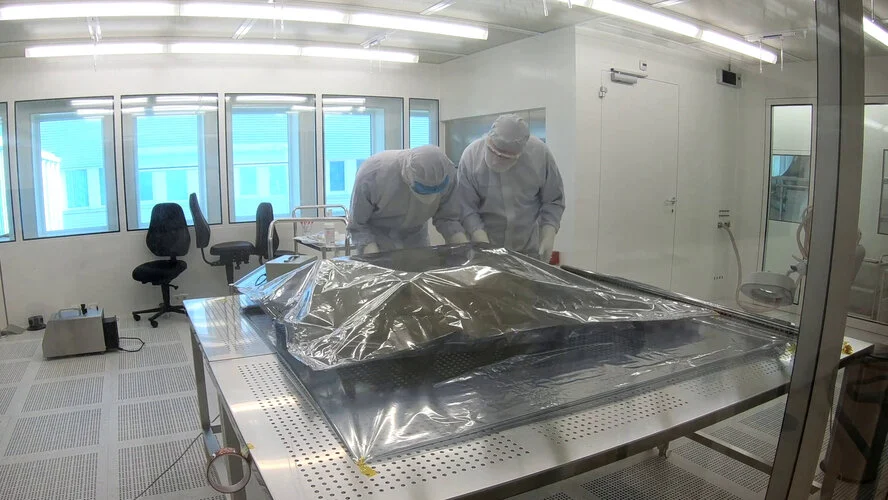
The European Space Agency (ESA) is meticulously preparing the Rosalind Franklin rover, a cornerstone of the ExoMars mission, for its ambitious journey to Mars in 2028. A critical and fascinating aspect of this preparation involves the stringent sterilization of the mission’s vital parachute system. ESA’s chief engineer for Mars, Albert Haldemann, has shed light on this complex process, emphasizing its paramount importance in the quest to detect signs of past or present life on the Red Planet. The 35-meter diameter parachute, a colossal piece of engineering designed to safely land the 74 kg rover, is currently undergoing a rigorous baking process within a specialized dry-heat sterilizer oven. This procedure aims to render the parachute at least 10,000 times cleaner than a typical smartphone, a stark illustration of the extreme measures required for planetary protection.
The Imperative of Sterilization: Safeguarding Mars and the Mission
The core objective of the ExoMars Rosalind Franklin rover mission is to search for evidence of life beneath the Martian surface. This profound scientific endeavor is inherently sensitive to contamination. The presence of even a single terrestrial microbe, hardy enough to survive the harsh vacuum and radiation of interplanetary space, could irrevocably compromise the mission’s findings. Such an intrusion, termed "forward contamination," could lead to a false positive result, mistakenly identifying terrestrial life as indigenous Martian life. This would not only invalidate years of scientific effort and significant financial investment but also undermine the integrity of our understanding of extraterrestrial biology.
"The potential existence of past and perhaps even present-day life on our closest planetary neighbour requires rigorous sterilization," explained Haldemann. "We must ensure that no microbes piggyback their way there from Earth. Any terrestrial microbes hardy enough to survive the ride through space could interfere with the investigation by causing ‘forward contamination’ and triggering a false positive."
Beyond safeguarding the scientific integrity of the mission, planetary protection protocols, mandated by international agreements, also dictate the imperative to protect the Martian environment itself from Earth-based biological contamination. This dual responsibility – to protect the target planet from us, and to protect our scientific inquiry from terrestrial interference – forms the bedrock of all astrobiological exploration. The sterilization of every component, from the rover’s instruments to its landing system, is a non-negotiable prerequisite.
A Sterilization Chamber Fit for a Martian Descent
The specialized oven currently housing the ExoMars parachute is located within ESA’s Life Support and Physical Sciences Laboratory at ESTEC, the agency’s technical center in the Netherlands. This facility is designed to simulate the extreme environmental conditions and cleanliness requirements of space missions. The sterilization process itself involves heating the parachute to high temperatures, a method chosen for its effectiveness in eradicating microbial life. While specific temperatures and durations are proprietary to the mission’s protocols, the goal is to achieve a state of extreme biological inertness.
The environment in which this crucial sterilization takes place is itself a testament to the mission’s meticulous planning. The cleanroom where the parachute is handled and prepared is maintained at an exceptionally high standard of purity. All air circulating within the cleanroom undergoes a rigorous two-stage filtration process to remove airborne particles and potential contaminants. Furthermore, personnel entering this sensitive environment are required to adhere to protocols even more stringent than those of surgical operating rooms. This includes wearing specialized gowns and passing through an air shower to meticulously remove any residual contaminants from their clothing and bodies before they can interact with the delicate mission hardware.
The Parachute: A Giant Leap for Martian Landings
The parachute in question is not merely a piece of fabric; it is a critical component of the Rosalind Franklin rover’s complex landing system. Made primarily from advanced nylon and Kevlar fabrics, chosen for their strength, durability, and heat resistance, this 74 kg parachute is engineered to withstand the extreme forces of entering Mars’ thin atmosphere. Its 35-meter diameter is a colossal size, designed to generate sufficient drag to decelerate the rover from orbital speeds to a manageable velocity for the final landing stages.
This parachute is poised to make history. Upon successful deployment, it will be the largest parachute ever to be deployed on the Red Planet, and indeed, anywhere else in the Solar System besides Earth. This record-breaking feat underscores the challenges of landing significant payloads on Mars, a planet with an atmosphere approximately 1% as dense as Earth’s. The thin Martian atmosphere offers limited resistance, necessitating the use of large, robust parachutes. The successful operation of this parachute will be a pivotal moment in the ExoMars mission, ensuring a safe arrival for the Rosalind Franklin rover.
A Timeline of Discovery and a Legacy of Exploration
The ExoMars program is a multi-mission endeavor by ESA and its international partners, focused on exploring Mars. The Rosalind Franklin rover, named after the pioneering DNA scientist, is the centerpiece of the second phase of this program. Originally slated for launch in 2020, the mission faced delays due to technical challenges and geopolitical considerations. However, the renewed launch window in 2028 signifies a renewed commitment to this vital scientific endeavor.
The rover’s journey to Mars is expected to take over 25 months. Once on the surface, it will embark on an unprecedented search for signs of life. Unlike previous Mars missions that primarily analyzed surface materials, the Rosalind Franklin rover is equipped with a drill capable of extracting samples from up to two meters beneath the Martian surface. This depth is considered crucial because the subsurface environment offers greater protection from the harsh radiation that bombards the Martian surface, potentially harboring preserved biosignatures.
The scientific payload of the Rosalind Franklin rover is designed for comprehensive analysis. It includes instruments capable of detecting organic molecules, analyzing mineralogy, and studying the geological context of potential life-bearing sites. The mission’s primary objective is to answer fundamental questions about the possibility of life beyond Earth, a quest that has captivated humanity for centuries.
Broader Implications: Planetary Protection and the Future of Astrobiology
The rigorous sterilization protocols employed for the ExoMars mission, particularly for the Rosalind Franklin rover’s parachute, highlight the growing importance of planetary protection in space exploration. As humanity ventures further into the cosmos, the ethical and scientific imperative to avoid contaminating other celestial bodies becomes increasingly critical. This not only ensures the integrity of scientific investigations but also preserves the potential for future discovery and respects the intrinsic value of other worlds.
The success of the ExoMars Rosalind Franklin rover mission will have profound implications for our understanding of life in the universe. A definitive detection of past or present Martian life would be one of the most significant scientific discoveries in human history, fundamentally altering our perception of our place in the cosmos. Even a negative result, demonstrating the absence of life under specific conditions, would provide invaluable data for understanding the habitability of planets and the limits of life itself.
The ongoing sterilization efforts for the Rosalind Franklin rover’s parachute are a testament to the meticulous planning, engineering excellence, and unwavering scientific dedication that underpins humanity’s pursuit of knowledge beyond Earth. As the launch date approaches, each step in this complex preparation process brings us closer to unlocking the secrets of the Red Planet and potentially answering one of the most profound questions ever asked: Are we alone?