Three years after its groundbreaking orbital test, the European Space Agency’s shoebox-sized TRISAT-R CubeSat, a testament to the ingenuity of the University of Maribor in Slovenia, has undergone rigorous evaluation at CERN’s CHARM facility. This critical testing phase focused on an exceptionally miniaturized imaging technology, designed to withstand the punishing radiation environment of space and ultimately enhance spacecraft attitude and orbit determination. The experiment, which exposed the camera to an intense and diverse particle flux, yielded crucial data on its resilience and recovery capabilities, promising advancements in future space missions.
H2: A Miniature Marvel in Medium Earth Orbit
The TRISAT-R CubeSat, developed by researchers at the University of Maribor, embarked on its mission to test a revolutionary, ultra-miniaturized imaging system. This camera, remarkably no larger than the edge of a 20-cent coin, achieved a significant feat by successfully capturing an image of Earth while operating in the challenging conditions of medium Earth orbit. This orbital region is characterized by a high concentration of energetic particles – essentially very fast-moving subatomic particles – that traverse the vacuum of space in all directions, posing a constant threat to sensitive electronic equipment.
The development of this advanced imaging system was supported by the European Space Agency’s General Support Technology Programme (GSTP), an initiative aimed at fostering the maturation of innovative technologies for space applications. The TRISAT team’s success in demonstrating the camera’s capability in orbit laid the groundwork for the subsequent, more intensive testing at CERN.
H2: Rigorous Ground-Based Simulation at CERN’s CHARM Facility
To thoroughly assess the camera’s performance under simulated space radiation conditions, the TRISAT team collaborated with CERN, utilizing its pioneering CHARM (CERN High-energy Accelerator for Materials) facility. This facility is specifically designed to expose materials and electronic components to precisely controlled, high-energy particle beams that mimic the radiation encountered in various space environments.
The testing campaign, a key component of the RADNEXT project, simulated the harsh radiation conditions present in medium Earth orbit. This included exposure to particles trapped by Earth’s magnetic field, as well as those emitted during solar particle events – sudden bursts of high-energy particles from the Sun. The goal was to understand how the camera’s imaging sensor would react to this intense, mixed-field particle environment, which encompasses a broad spectrum of particle types and energies crucial for realistic space application simulations.
H3: The Exposure and Data Acquisition Process
Iztok Kramberger, the principal investigator of the TRISAT programme at the University of Maribor, detailed the extensive nature of the experiment. "Our tiny imaging system spent more than 108 hours in the CHARM chamber, exposed to a mixed-field radiation environment containing high-energy particles, including hadrons such as protons, neutrons and pions," Kramberger explained. Hadrons are a class of subatomic particles that are affected by the strong nuclear force, including protons and neutrons, which are abundant in space radiation. Pions are unstable subatomic particles that decay into other particles, further complicating the radiation environment.
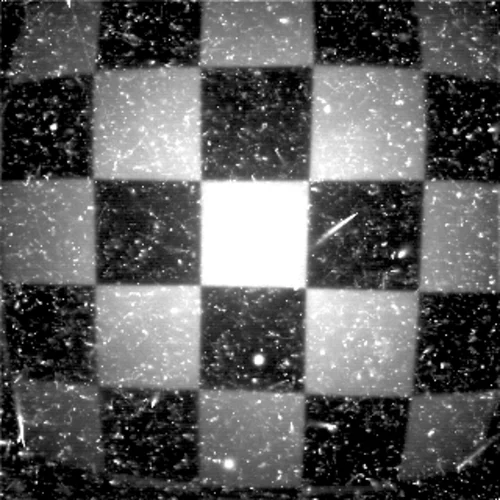
During this prolonged exposure, the camera was meticulously positioned to capture images of a 13-centimeter wide chequerboard. This standardized pattern served as a critical reference for evaluating image quality and detecting any deviations or anomalies introduced by the radiation. The camera operated at an impressive rate of 10 frames per second, acquiring over 4 million images throughout the 108-hour test period.
H3: Analyzing Radiation-Induced Artefacts
The raw output of these tests revealed the immediate impact of the high-energy particles on the image sensor. The captured images were heavily speckled with bright dots and streaks, termed "radiation-induced artefacts." Each of these visual disturbances is a direct consequence of a single energetic particle traversing the image sensor. These artefacts serve as a stark visual representation of the challenges that imaging systems must overcome to function reliably in the unforgiving radiation environment of space.
Of the millions of images captured, over 160,000 were selected for in-depth analysis. This meticulous selection process allows researchers to study the phenomenon of radiation-induced pixel activation – where a particle strike temporarily alters the electrical state of a pixel – and the subsequent recovery of the image sensor’s functionality following these interactions.
H3: Collaboration and Mitigation Strategies
Recognizing the potential for permanent damage from such intense radiation, the TRISAT team strategically partnered with SkyLabs, a company specializing in space technology solutions. SkyLabs played a pivotal role by integrating protective mechanisms into the camera system. "For this test we have joined forces with SkyLabs, who implemented protection mechanisms into the camera system to make sure the intense radiation doesn’t cause any permanent damage or loss of functionality," Kramberger added. These protective measures are crucial for ensuring the longevity and reliability of the imaging hardware.
H3: Deciphering the Data for Future Applications
The comprehensive dataset generated from the CERN tests provides a unique opportunity to gain profound insights into the behavior of miniaturized imaging systems under extreme radiation. Kramberger elaborated on the ongoing analysis: "By analysing the large dataset acquired during this campaign, we are investigating the frequency and spatial distribution of radiation-induced artefacts, the number of pixels affected by each event, how and when affected pixels recover, and how to distinguish transient, recoverable effects from permanent radiation-induced damage."
This detailed analysis is not merely an academic exercise; it directly informs the development of more robust image processing algorithms. The ability to accurately identify, filter, and correct for radiation-induced noise is paramount for extracting meaningful data from space-borne cameras. Furthermore, the findings will be instrumental in enhancing next-generation attitude and orbit determination technologies.
H2: Broader Implications for Space Exploration and Navigation
The success of the TRISAT-R camera’s radiation resilience testing at CERN has significant implications for the future of space exploration and the operational capabilities of spacecraft.
H3: Advancing Spacecraft Navigation
Accurate attitude and orbit determination are fundamental for any space mission. Whether it’s navigating to distant planets, maintaining stable communication links, or performing complex orbital maneuvers, spacecraft rely on precise knowledge of their orientation and position. Traditional methods often involve bulky and power-intensive sensor systems. The development of ultra-miniaturized, radiation-hardened imaging systems like the one tested by TRISAT offers a pathway to significantly reduce the size, weight, and power consumption of these critical navigation components.
H3: Enabling More Ambitious Missions
The ability to operate reliably in high-radiation environments, such as those found in medium Earth orbit, the Van Allen belts, or even during deep-space missions, opens up new possibilities for mission design. Spacecraft can be sent to regions previously deemed too hazardous for sensitive electronics, expanding the scope of scientific research and commercial applications. This includes missions to explore Jupiter’s intense radiation belts, the vicinity of Mars during solar storms, or even venturing into the inner solar system where solar radiation is more intense.
H3: The Role of CubeSats and Miniaturization
The TRISAT-R project is a prime example of the growing importance of CubeSats in space science and technology. These standardized, small satellites, often deployed from larger spacecraft or launched as dedicated missions, provide a cost-effective platform for testing new technologies and conducting scientific investigations. The success of miniaturized components like the TRISAT-R camera underscores the trend towards increased miniaturization and integration in satellite design, leading to more agile, versatile, and affordable space missions.
H3: International Collaboration in Space Technology
The collaboration between the University of Maribor, the European Space Agency, CERN, and SkyLabs highlights the power of international cooperation in advancing space technology. By pooling expertise and resources, these entities are able to tackle complex scientific and engineering challenges that would be insurmountable for any single organization. The RADNEXT project, facilitating such collaborations, plays a crucial role in accelerating innovation within the European space sector and beyond.
H2: Future Outlook and Continued Development
The data gathered from the CERN CHARM facility will be meticulously analyzed over the coming months. The insights gained are expected to directly influence the design and implementation of future imaging systems for a wide range of space applications. This includes not only attitude and orbit determination but also potential applications in remote sensing, planetary observation, and even in-situ monitoring of the space environment. The TRISAT programme, with its focus on pushing the boundaries of miniaturization and radiation resilience, is poised to make a lasting contribution to the evolution of space technology, enabling a new era of more capable and ambitious space exploration. The journey from a shoebox-sized CubeSat to a robust imaging system capable of enduring cosmic hazards is a testament to human ingenuity and the relentless pursuit of scientific advancement.