More than 50 years ago, physicist Sir Roger Penrose proposed a remarkable idea: under the right conditions, it might be possible to extract energy from a rapidly spinning black hole. In his concept, a particle entering the black hole’s ergosphere, a region where spacetime is dragged along by the object’s rotation, could split into two. One fragment would fall into the black hole while the other escaped carrying away more energy than the original particle. Later, physicist Yakov Zel’dovich expanded on this concept, predicting that waves interacting with an object rotating fast enough could also gain energy and become amplified. Now, researchers at the Advanced Science Research Center at the CUNY Graduate Center (CUNY ASRC) have demonstrated an experimental approach inspired by those long-standing theories. Writing in the journal Nature, the team showed that wave amplification can be achieved using a device that simulates extreme rotation without physically spinning. This groundbreaking work translates abstract astrophysical principles into tangible laboratory physics, opening new frontiers for both fundamental science and practical technological applications.
The Genesis of a Cosmic Idea: Penrose and Zel’dovich
The journey to this experimental breakthrough began in the fertile intellectual landscape of the 1960s and 1970s, a period marked by profound advancements in our understanding of gravity and black holes. In 1969, British mathematical physicist Sir Roger Penrose, who would later share the Nobel Prize in Physics for his work on black holes, published a seminal paper proposing a mechanism to extract rotational energy from a Kerr black hole – a rotating black hole.
Penrose’s visionary concept centered on the ergosphere, a unique region surrounding a rotating black hole. Unlike the event horizon, which marks the point of no return, the ergosphere is a region where spacetime itself is so intensely dragged by the black hole’s rotation that it’s impossible for anything within it to remain stationary relative to a distant observer. Objects inside the ergosphere are forced to co-rotate with the black hole. Penrose theorized that if a particle entered this ergosphere and fragmented, one part could fall into the black hole with negative energy relative to infinity, while the other part escaped, carrying away more energy than the original incident particle. This seemingly paradoxical "negative energy" is possible because energy, in the context of general relativity and rotating spacetime, is not a simple scalar quantity but depends on the observer’s frame of reference. In essence, the escaping fragment would siphon off some of the black hole’s vast rotational energy, a process now famously known as the Penrose Process. Theoretically, a rotating black hole could lose up to 29% of its mass-energy through this mechanism.
A few years later, in 1971, Soviet physicist Yakov Zel’dovich further expanded on this idea, but applied it to waves rather than particles. Zel’dovich predicted a phenomenon called superradiance, where waves interacting with a rapidly rotating absorber (like a metal cylinder) could be amplified if the wave’s frequency was below a certain critical value and the absorber’s rotational speed exceeded a threshold. He famously illustrated this with the analogy of light waves hitting a rotating cylinder. If the cylinder spun fast enough, the reflected waves would emerge with greater energy than the incident waves, drawing energy from the cylinder’s rotation. This was a crucial conceptual leap, suggesting that the Penrose Process wasn’t limited to particles but was a more general phenomenon of wave-matter interaction in extreme rotational environments. Zel’dovich even speculated about a "black hole bomb," where waves trapped between a black hole and a mirror could be exponentially amplified through superradiance, theoretically extracting immense energy.
These theoretical predictions, while captivating, posed immense challenges for experimental verification. The conditions required – a rapidly spinning black hole, or an object rotating at speeds approaching relativistic limits – were, until now, confined to the realm of astrophysics and abstract thought experiments. Decades of theoretical work refined these concepts, but direct laboratory demonstration remained elusive, primarily due to the practical impossibility of physically rotating macroscopic objects at the required speeds.
Synthetic Rotation Recreates Extreme Physics
The CUNY ASRC team’s breakthrough lies in their ingenious solution to this experimental impasse: synthetic rotation. Instead of attempting to rotate an object mechanically at impossible speeds, the researchers engineered a radio frequency device whose properties could be rapidly changed across both space and time. This meticulously designed system creates the illusion of ultrafast rotation, reaching effective rotational speeds far beyond what conventional mechanical systems can achieve. By replacing physical motion with synthetic rotation, the researchers successfully overcame challenges that have limited experimental studies of extreme rotational physics for decades.
"Our approach facilitates a new method of wave-matter interaction in which waves with selected rotational properties extract energy from synthetic time-engineered rotation, producing a form of broadband selective amplification," said principal investigator Andrea Alù, Distinguished Professor and Einstein Professor of Physics at the CUNY Graduate Center and founding director of the CUNY ASRC’s Photonics Initiative. This novel method bypasses the kinematic limitations of physical rotation, opening a pathway to explore phenomena that would otherwise require astrophysical scales or speeds.
Lead author Hadiseh Nasari, a post-doctoral researcher with the CUNY ASRC’s Photonics Initiative, underscored the transformative nature of the experiment. "This successful experiment moves ideas about extreme rotational dynamics from theory to practice and creates a versatile experimental platform for exploring a broad range of phenomena at the intersection of astrophysics, wave physics, and quantum science," said Nasari. "The work has implications for advances in fundamental science and in communications, optics and photonics." The ability to mimic such extreme conditions in a controlled laboratory setting is a monumental leap, offering a tangible bridge between theoretical physics and experimental verification.
How the Experiment Worked: Engineering Spacetime Analogs
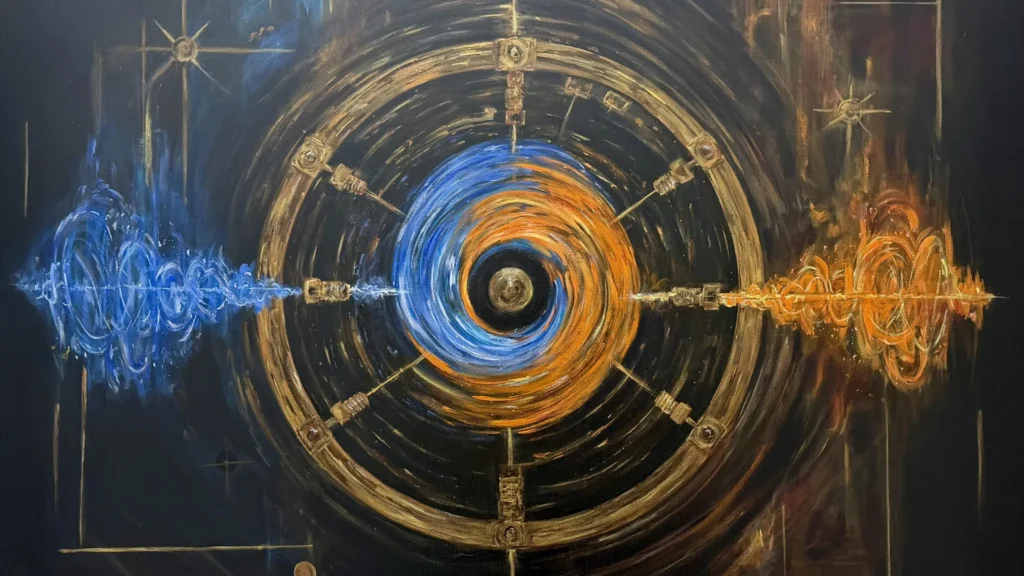
The core of the CUNY ASRC experiment revolved around a fundamental question: Could electromagnetic waves interacting with a completely stationary device behave as though they were encountering an object rotating at ultrafast speed and draw energy from that synthetic motion? To investigate this, the team constructed a ring of electronic resonators. These resonators were not physically spinning; instead, their properties – such as their resonant frequency or impedance – were rapidly adjusted in a carefully synchronized sequence.
This timed manipulation generated a traveling pattern around the ring. Imagine a ripple moving across a pond, but instead of water molecules moving, it’s the properties of the resonators that are changing sequentially, creating a dynamic, propagating ‘virtual’ rotation. As a result, the electromagnetic waves interacting with this system effectively experienced it as though it were spinning at extraordinary, even "superluminal" speeds. The concept of "superluminal" here refers to the phase velocity of the synthetic pattern, not the actual movement of matter or information faster than light, which remains impossible. This distinction is crucial for understanding how such extreme conditions can be simulated.
"Waves with the appropriate rotational characteristics extracted energy from the system and became amplified, reproducing the essential physics of the Penrose-Zel’dovich process," said co-lead author Hady Moussa, a former PhD student with the CUNY ASRC Photonics Initiative. "Our approach relies on engineered metamaterials that are designed to control how waves propagate." Metamaterials are artificially structured materials engineered to have properties not found in nature, often exhibiting unusual electromagnetic responses. In this context, the ring of electronic resonators acts as a reconfigurable metamaterial, dynamically altering the medium through which the waves propagate to emulate the effects of extreme rotation. The system effectively creates an "analog spacetime" where the physics of rotating black holes can be observed and studied. This ability to manipulate the effective spacetime for waves offers an unprecedented tool for exploring complex gravitational phenomena without requiring a real black hole.
Broader Implications for Fundamental Physics and Analog Gravity
The successful demonstration of synthetic rotation and wave amplification has profound implications for fundamental physics. For decades, many phenomena predicted by general relativity, particularly those involving extreme gravitational fields like black holes, have remained purely theoretical due to the insurmountable challenges of direct observation or replication. This experiment provides a powerful new tool for analog gravity research.
Analog gravity is a field where phenomena in curved spacetime, such as black holes, are simulated in laboratory systems involving other types of waves (like sound waves in fluids, or light waves in engineered media). These analog systems allow physicists to study complex gravitational effects in a controlled environment, providing insights into general relativity and even quantum gravity without needing to observe distant astrophysical objects. The CUNY ASRC experiment pushes the boundaries of analog gravity by providing a robust platform to investigate superradiance and energy extraction in a highly controllable manner.
Because synthetic rotation can imitate motion beyond the speed of light (in terms of the effective pattern’s phase velocity), researchers now have a controlled laboratory platform for exploring physical regimes that would otherwise be impossible to study directly. This opens new opportunities for investigating extreme physics, including:
- Black Hole Thermodynamics: Gaining a deeper understanding of how black holes interact with their environment and exchange energy. While the experiment doesn’t involve real gravity, the underlying wave mechanics share crucial similarities.
- Quantum Gravity: Providing insights into how quantum fields behave in strong gravitational fields, a key area of research in the quest for a unified theory of quantum gravity. The synthetic system could potentially be adapted to study quantum versions of superradiance.
- Cosmology: Exploring wave propagation in rapidly expanding or rotating universes, drawing parallels between the experimental setup and cosmological models.
- Fundamental Limits of Energy Extraction: Precisely measuring the efficiency and characteristics of energy extraction processes under various synthetic rotational speeds and wave properties.
This experimental platform effectively allows physicists to "tune" the properties of a virtual black hole, altering its "rotational speed" and "gravitational pull" (in an analogous sense) to observe how waves behave. Such precise control is impossible in astrophysical observations, making this a unique and invaluable research tool.
Technological Frontiers: Communications, Optics, and Quantum Technologies
Beyond its profound implications for fundamental science, this research also points toward future advances in a range of practical technologies, including wireless communications, optics, photonics, and quantum technologies. The ability to amplify waves by drawing energy from a "synthetically rotating" system offers several exciting avenues:
-
Wireless Communications: In an era of ever-increasing demand for bandwidth and reliable signal transmission, broadband selective amplification could revolutionize wireless communication systems. Current amplifiers often introduce noise or distort signals. A system that can selectively amplify specific wave properties while drawing energy from a background "synthetic rotation" could lead to:
- Higher Efficiency Amplifiers: Reducing power consumption in communication devices.
- Improved Signal-to-Noise Ratio: Making wireless communication more robust and clearer, especially in noisy environments.
- New Modulation Techniques: Potentially enabling novel ways to encode and transmit information.
- Dynamic Channel Management: Adapting amplification characteristics in real-time to optimize data flow.
-
Optics and Photonics: The principles demonstrated in the radio frequency domain are expected to be applicable to light waves. This could lead to:
- Novel Optical Amplifiers: Beyond current laser-based amplifiers, potentially allowing for more efficient and broadband amplification of light signals in fiber optic networks.
- Advanced Optical Modulators: Devices that control the properties of light, crucial for high-speed data transmission and optical computing.
- Active Metamaterials: Creating optical components whose properties can be dynamically reconfigured, leading to smarter lenses, cloaking devices, or reconfigurable optical circuits.
- Integrated Photonic Circuits: Miniaturizing these amplification capabilities for use in compact optical systems.
-
Quantum Technologies: The implications for quantum science are particularly intriguing. If the same principles can be applied to quantum systems, it could open new possibilities for:
- Controlling Quantum States: Manipulating the quantum properties of light or matter with unprecedented precision.
- Quantum Information Processing: Developing new methods for amplifying quantum signals without introducing noise (a critical challenge in quantum computing).
- Quantum Sensing: Enhancing the sensitivity of quantum sensors by amplifying weak signals.
- Studying Wave Behavior in Quantum Fields: Investigating how quantum fields interact with extreme effective rotational environments, potentially offering experimental insights into phenomena like Hawking radiation in analog systems.
The CUNY ASRC researchers note that additional work will be needed before these ideas can be translated into practical devices. The transition from a proof-of-concept radio frequency experiment to deployable optical or quantum technologies will involve significant engineering and materials science challenges. However, the foundational physics has been established, paving the way for future innovations.
A Glimpse into the Future
This pioneering research represents a significant milestone in experimental physics, bridging the gap between theoretical astrophysics and laboratory-scale demonstrations. By harnessing the power of synthetic rotation, the CUNY ASRC team has not only validated long-standing predictions from Penrose and Zel’dovich but has also unlocked a powerful new paradigm for scientific inquiry.
The work creates new opportunities for investigating extreme physics while also pointing toward future advances in wireless communications, optics, photonics, and quantum technologies. The ability to manipulate wave-matter interactions in such a sophisticated manner promises a future where technologies are designed not just based on conventional physics, but on principles inspired by some of the universe’s most extreme and enigmatic environments. As research continues, the boundaries between the cosmic and the microscopic, the theoretical and the tangible, will undoubtedly continue to blur, leading to discoveries that will shape our understanding of the universe and our technological capabilities for decades to come.
The research was supported by the U.S. Department of Defense, the U.S. National Science Foundation, and the Simons Foundation.