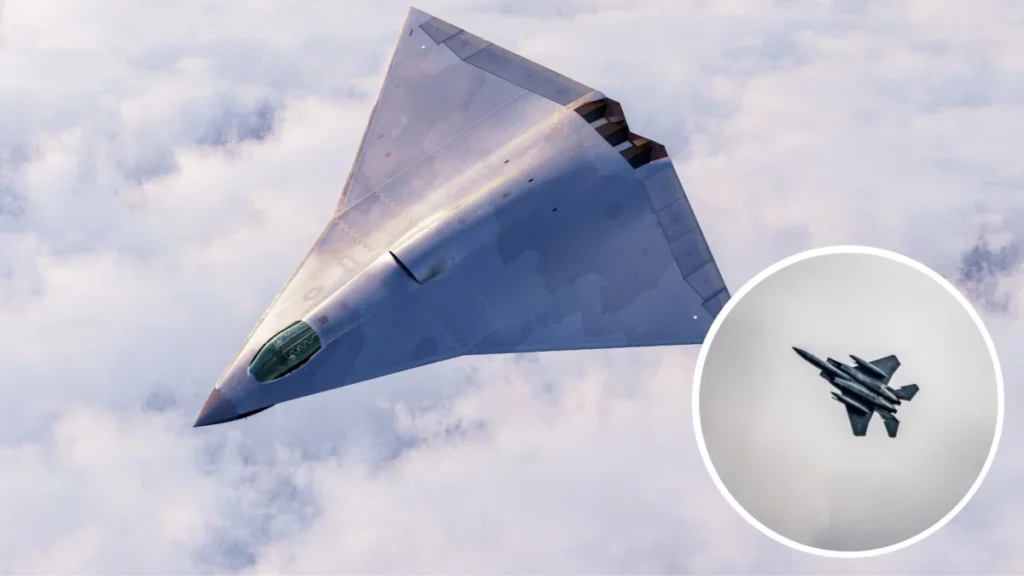
New images circulating online appear to reveal what defense analysts widely believe to be the fifth prototype of China’s highly anticipated sixth-generation J-36 fighter jet. While Beijing has maintained its characteristic silence on the aircraft’s existence and development status, the latest visual evidence has significantly reinvigorated global interest and scrutiny regarding China’s rapid advancements in next-generation combat aviation. The emergence of yet another variant suggests an accelerated and iterative flight-testing program, signaling China’s earnest commitment to securing future air superiority in an increasingly contested geopolitical landscape.
The Emergence of the Fifth Prototype and Observed Refinements
The recently observed prototype, captured in unofficial photographs, reportedly exhibits several key refinements when compared to its predecessors. Experts note potential improvements across critical areas such as the airframe, engine integration, and overall aerodynamic design. These modifications are indicative of an ongoing, intensive engineering evaluation process, where successive prototypes are used to test, validate, and enhance various aspects of the aircraft’s performance and capabilities through rigorous flight trials. Such an approach is standard in advanced military aircraft development, allowing engineers to incrementally refine designs and resolve technical challenges before committing to mass production.
The J-36 is widely conceptualized by defense observers as a large, stealth-oriented combat aircraft, reportedly under development by the Chengdu Aircraft Corporation (CAC), a state-owned aerospace manufacturer known for its pivotal role in producing advanced Chinese military aircraft, including the J-10 multirole fighter and the J-20 stealth fighter. Analysts describe the J-36 as featuring a distinctive tailless configuration and a unique three-engine layout. These design choices are believed to be aimed at supporting several advanced operational requirements, including extended range and endurance for long-duration missions, significantly reduced radar visibility through enhanced stealth characteristics, and the seamless integration of cutting-edge sensors, electronic warfare systems, and advanced weaponry. However, the exact specifications and full scope of the J-36 program remain unverified, shrouded in the profound secrecy typical of China’s most sensitive defense initiatives.
The Global Race for Sixth-Generation Air Dominance
The development of the J-36 is taking place against a backdrop of an intense global competition to develop sixth-generation fighter aircraft. Major military powers, primarily the United States, China, and several European nations, are investing heavily in research and development to define and achieve the capabilities that will characterize the next era of air combat. A sixth-generation fighter is envisioned as a quantum leap beyond current fifth-generation platforms like the F-22 Raptor and J-20 Mighty Dragon, integrating a suite of revolutionary technologies.
Key technological pillars defining the sixth generation include:
- Enhanced Stealth and Survivability: Beyond current stealth capabilities, incorporating adaptive stealth technologies, advanced signature management across multiple spectrums (radar, infrared, visual, acoustic), and potentially active countermeasures.
- Artificial Intelligence (AI) and Machine Learning (ML): Deep integration of AI for advanced decision-making, sensor fusion, threat assessment, autonomous operations, and human-machine teaming.
- Manned-Unmanned Teaming (MUM-T): The ability to seamlessly command and control multiple autonomous drones, often referred to as "loyal wingmen," which can conduct reconnaissance, carry additional weapons, or act as decoys, dramatically expanding the manned fighter’s operational reach and survivability.
- Advanced Networking and Data Fusion: High-bandwidth, secure communication links allowing for unprecedented levels of data sharing and situational awareness across an entire combat network, integrating air, space, sea, and ground assets.
- Optionally Manned Capabilities: The potential for the aircraft to operate autonomously in certain missions, reducing risk to human pilots in highly contested environments.
- Next-Generation Sensors and Weapons: Integration of highly sophisticated active electronically scanned array (AESA) radars, infrared search and track (IRST) systems, and potentially directed energy weapons (lasers) or hypersonic missiles.
- Adaptive Engines: Propulsion systems capable of varying their thrust and fuel efficiency for different flight regimes, enhancing range and performance.
The United States, through its Next-Generation Air Dominance (NGAD) program, is actively pursuing its own vision for a sixth-generation air combat system, which is not just a single aircraft but a "system of systems." The NGAD initiative, involving both the U.S. Air Force and Navy, aims to field a family of interconnected platforms, including manned fighters, uncrewed combat aircraft, and advanced sensors, by the mid-2030s. Similarly, European nations are collaborating on ambitious projects like the UK-led Tempest program and the Franco-German-Spanish Future Combat Air System (FCAS), both aiming for operational readiness in the same timeframe. These parallel efforts underscore the global strategic importance placed on achieving supremacy in future air warfare.
China’s Ambitious Aerospace Trajectory
China’s journey in military aviation has been characterized by rapid progress, evolving from a reliance on licensed production and reverse-engineered designs to becoming a formidable innovator. Early Chinese fighter jets were often derivatives of Soviet designs, but decades of sustained investment in indigenous research and development have transformed the landscape. The J-10, a domestically designed multirole fighter, marked a significant step. The subsequent introduction of the J-20 stealth fighter, which entered service in 2017, firmly established China as only the second nation, after the United States, to indigenously develop and field a fully operational fifth-generation fighter. This achievement demonstrated China’s growing technical prowess and its ability to master complex aerospace engineering challenges.
The development of a sixth-generation aircraft like the J-36 is a logical, albeit ambitious, progression of this trajectory. For Beijing, achieving air dominance is not merely a military objective but a strategic imperative tied to its broader national security goals and aspirations for regional hegemony and global power projection. A technologically superior air force is crucial for protecting its expanding interests in the Indo-Pacific, including contested territories in the South China Sea, and for projecting power further afield. The J-36 represents China’s determination to not only catch up with but potentially surpass its rivals in critical defense technologies.
The program’s extreme secrecy is consistent with China’s broader approach to sensitive military developments. Official confirmation of such projects is rarely provided until they are well advanced or ready for public display. This opacity makes detailed analysis challenging, relying heavily on open-source intelligence, satellite imagery, and the observations of independent defense analysts.
Technical Analysis of the J-36’s Design Cues
The observed structural differences between earlier prototypes and the latest J-36 variant provide valuable insights into its potential design philosophy. The tailless configuration, for instance, is a radical departure from conventional fighter jet designs. While it offers significant advantages in stealth by eliminating vertical and horizontal stabilizers that are major radar reflectors, it presents considerable aerodynamic control challenges. Modern fly-by-wire flight control systems, coupled with advanced computational fluid dynamics, are essential to manage such designs, suggesting sophisticated software and control surface integration. This configuration also contributes to reduced drag, potentially enhancing speed and fuel efficiency.

The reported three-engine layout is another intriguing feature. Most contemporary fighters are twin-engine, balancing power with fuel efficiency and redundancy. A three-engine configuration could provide exceptional thrust, enabling higher speeds and greater payload capacity, crucial for a large aircraft envisioned for long-range missions. It could also provide substantial electrical power generation necessary for operating advanced sensors, electronic warfare systems, and potentially future directed energy weapons. Furthermore, a three-engine design could offer increased redundancy, improving survivability in combat. The challenge, however, lies in integrating three engines efficiently without significantly increasing the aircraft’s radar cross-section or infrared signature, requiring sophisticated exhaust management systems.
The observed refinements, such as revised air intake geometry and modified engine exhaust arrangements, are direct indicators of efforts to further enhance stealth. Air intakes are notoriously difficult to render stealthy, as they expose engine compressor blades to radar waves. Advanced designs typically involve serpentine ducts and radar-absorbing materials. Similarly, engine exhausts are significant sources of infrared radiation, making an aircraft vulnerable to heat-seeking missiles. Modified exhaust nozzles can help to diffuse and cool exhaust gases, reducing the infrared signature. These detailed adjustments suggest a comprehensive approach to multi-spectral stealth, aiming to reduce the aircraft’s detectability across various sensor types.
Acceleration of the Flight-Testing Program
The appearance of a fifth prototype strongly indicates that China is indeed accelerating its flight-testing program for the J-36. Developing multiple prototypes is a common, yet resource-intensive, strategy in advanced aircraft development. Each prototype can incorporate different design changes or test specific systems, allowing engineers to validate performance parameters, identify and rectify technical issues, and explore various design permutations concurrently. This iterative process allows for rapid learning and refinement, significantly compressing the development timeline.
Andreas Rupprecht, a respected aviation analyst and expert on China’s air force, has noted that the structural differences between the earliest observed examples and the latest prototype make it highly improbable that these sightings merely represent a single aircraft undergoing repeated modifications. This expert opinion lends credibility to the notion of a robust, multi-prototype testing regimen, which is a hallmark of a mature and well-funded aerospace development program. The speed at which these prototypes are emerging underscores China’s ambition to field its sixth-generation fighter within a competitive timeframe, potentially by the mid-2030s, aligning with the projected timelines of US and European programs.
Broader Geopolitical and Strategic Implications
The progress of the J-36 program carries significant geopolitical and strategic implications. It intensifies the technological arms race between China and the United States, particularly in the Indo-Pacific region, where both powers are vying for influence. The development of advanced air combat capabilities directly impacts the regional military balance, affecting the strategic calculations of allies and potential adversaries alike. For countries like Japan, South Korea, Australia, and Taiwan, which rely heavily on air superiority for their defense, China’s advancements necessitate continuous evaluation of their own defense strategies and procurement plans.
The cost of this technological competition is immense. Developing and producing a sixth-generation fighter involves unprecedented investments in research, manufacturing infrastructure, and human capital. These expenditures strain national defense budgets, potentially diverting resources from other critical areas. However, for leading military powers, the perceived advantages of air dominance—including deterrence, power projection, and battlefield control—are deemed worth the substantial financial outlay.
The J-36’s emergence also foreshadows a fundamental shift in the nature of air warfare. The emphasis on AI, manned-unmanned teaming (MUM-T), and advanced networking suggests a future battlefield where individual platforms are less important than the cohesive, networked "system of systems" they comprise. This paradigm shift will require not only new aircraft but also new doctrines, training methodologies, and command and control structures. China’s pursuit of these capabilities indicates its strategic intent to be at the forefront of this revolution in military affairs.
Challenges and Uncertainties
Despite the apparent progress, the J-36 program faces formidable challenges. The technological hurdles associated with integrating such a complex array of advanced systems—from AI algorithms to directed energy weapons—are immense. Ensuring seamless interoperability between manned aircraft and autonomous drones, and maintaining secure, high-bandwidth communication links in contested environments, will require breakthroughs in software and hardware development.
Furthermore, economic constraints and resource allocation will always play a role. While China has demonstrated a willingness to invest heavily in its military, the sheer scale of a sixth-generation program will demand sustained commitment over decades. The long road to operational readiness also involves extensive flight testing, pilot training, and the development of logistical support infrastructure. Experts caution that while prototypes indicate progress, transitioning from a successful test aircraft to a fully operational, combat-ready fleet is a monumental undertaking.
Conclusion
The suspected sightings of a fifth prototype of China’s J-36 fighter jet underscore the rapid and significant progress being made in its next-generation fighter program. While official details remain scarce, the observed design refinements and the iterative nature of the flight-testing program indicate a robust and determined effort by China to secure its place at the forefront of military aviation technology. This development not only intensifies the global competition for air dominance, particularly with the United States, but also signals a fundamental shift in the future of air combat, emphasizing advanced stealth, artificial intelligence, and networked warfare. The J-36, whether confirmed or not, serves as a potent symbol of China’s growing military ambition and technological prowess, demanding close monitoring and strategic reassessment from nations worldwide.