For nearly a century, the scientific community operated under the understanding that the world of magnetism was governed by two primary regimes: ferromagnetism and antiferromagnetism. This binary classification shaped the development of modern technology, from the simple compass to the high-density hard drives that power the global internet. However, a seismic shift in condensed matter physics is currently underway following the theoretical discovery of a third class of magnetic materials known as altermagnets. Now, researchers at the University at Buffalo (UB) have unveiled a sophisticated quantum sensing proposal that could provide the definitive tools needed to identify and harness these elusive materials, potentially ushering in an era of electronics that are faster, smaller, and significantly more energy-efficient than current silicon-based standards.
The study, published in the prestigious journal Physical Review Letters, outlines a non-invasive methodology using diamond-based quantum sensors to detect the unique magnetic signatures of altermagnets. Led by Jamir Marino, PhD, an assistant professor in the UB Department of Physics, the research represents a critical bridge between theoretical prediction and practical application. By leveraging the hyper-sensitive properties of nitrogen-vacancy centers in diamonds, the team believes they have found a way to observe the "hidden" magnetic patterns that distinguish altermagnets from their better-known cousins.
The Evolution of Magnetic Theory: From Lode Stones to Altermagnets
To understand the significance of the University at Buffalo’s proposal, one must look at the chronology of magnetic discovery. For millennia, humanity was only aware of ferromagnetism—the property found in iron, nickel, and cobalt where atomic spins align in a single direction. This alignment creates a macroscopic magnetic field, allowing these materials to stick to refrigerators or store bits of data in traditional magnetic recording media.
In the 1930s, physicist Louis Néel expanded the horizon of the field by discovering antiferromagnetism, a feat for which he later received the Nobel Prize. In antiferromagnets, neighboring electron spins point in opposite directions, effectively canceling each other out. Because they produce no external magnetic field, they are "invisible" to traditional magnetic probes. However, their internal dynamics are incredibly fast, operating at terahertz frequencies, which makes them highly attractive for the future of "spintronics"—an area of electronics that uses the spin of electrons rather than just their charge to process information.
The third pillar, altermagnetism, was only formally conceptualized within the last decade, with significant momentum building around 2019. Researchers at the Johannes Gutenberg University of Mainz, including Libor Šmejkal and Jairo Sinova—who are co-authors of the new UB study—began noticing anomalies in materials like ruthenium dioxide. These materials lacked a net magnetic field (like an antiferromagnet) yet exhibited electronic properties typically reserved for ferromagnets. This "hybrid" nature suggested a new state of matter where the crystal symmetry of the material allows for a unique arrangement of spins that is neither purely aligned nor purely opposing in the traditional sense.
The Challenge of Identification
While theoretical models suggest that altermagnets could be abundant—with over 200 candidate materials identified through computational screening—detecting them in a laboratory setting has proven notoriously difficult. Traditional methods like Angle-Resolved Photoemission Spectroscopy (ARPES) or neutron scattering require large, high-quality crystal samples and often involve invasive procedures that can disturb the very magnetic states they aim to measure.
"The difficulty lies in the fact that altermagnets do not produce a large-scale magnetic field that you can simply measure with a Hall probe," explains Dr. Marino. "Their magnetic properties are tucked away in the momentum space of the electrons. To confirm if a material is truly an altermagnet, we need a probe that is sensitive enough to detect subtle, directional fluctuations in magnetic noise at the atomic scale."
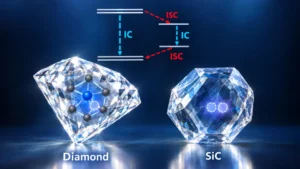
This is where the University at Buffalo’s quantum sensing approach enters the fray. The proposed technique utilizes a "nitrogen-vacancy (NV) center"—a microscopic defect in a diamond lattice where a nitrogen atom replaces a carbon atom next to a vacancy. These NV centers act as atomic-sized bar magnets that are incredibly sensitive to their environment.
The Mechanics of the Quantum Sensing Proposal
The methodology described in Physical Review Letters involves placing a diamond containing an NV center in close proximity to a candidate altermagnetic material. The researchers propose a "relaxation-based" sensing technique. In this setup, the magnetic spin of the NV center is initialized into a specific quantum state using laser pulses. Over time, the magnetic fluctuations emanating from the candidate material will cause the NV center’s spin to "relax" or flip.
The breakthrough in the UB proposal is the focus on directionality. In a standard antiferromagnet, the magnetic noise would likely be isotropic (the same in all directions). However, the internal symmetry of an altermagnet is predicted to create "anisotropic" magnetic fluctuations. By rotating the spin of the NV center defect and measuring how the relaxation rate changes depending on the orientation, researchers can map out the specific symmetry of the material.
If the relaxation occurs significantly faster when the spin is oriented along one axis compared to another, it provides a "smoking gun" signature of altermagnetism. This technique is particularly advantageous because it is non-destructive and can be performed on smaller samples than those required for neutron scattering, making it a more versatile tool for material scientists.
Supporting Data and Candidate Materials
The urgency of developing this sensing technique is underscored by the sheer number of potential altermagnets waiting to be verified. While ferromagnets are relatively rare in nature, comprising only a few dozen known materials, altermagnets are theorized to be far more common.
Current research highlights several key candidates:
- Ruthenium Dioxide ($RuO_2$): Often cited as the prototypical altermagnet, it shows a "spin-splitting" of electronic bands that was previously thought impossible in materials without a net magnetic field.
- Manganese Telluride ($MnTe$): Recent experiments have shown that this material exhibits the high-speed switching of an antiferromagnet while maintaining the spin-polarized currents of a ferromagnet.
- Chromium Antimonide ($CrSb$): Another high-temperature candidate that could be integrated into existing semiconductor fabrication processes.
The UB team’s model suggests that their quantum sensing approach could distinguish between these materials and traditional antiferromagnets with high statistical confidence. By analyzing the "spin-lattice relaxation time" (often denoted as T1 in quantum physics), the researchers demonstrated that the unique d-wave or g-wave symmetry of altermagnets leaves a distinct imprint on the NV center’s quantum state.
Official Responses and Collaborative Efforts
The research is a result of an international collaboration, highlighting the global interest in mastering altermagnetism. Jairo Sinova, a professor at the Johannes Gutenberg University of Mainz and a leading figure in the discovery of altermagnets, noted the importance of this new sensing tool.
"This sensing technique could become a very important tool for exploring candidate altermagnetic materials," Sinova said. "It offers advantages over conventional experimental techniques by detecting subtle directional magnetic patterns across different regions of a material without significantly disturbing it."
The collaboration also included Hossein Hosseinabadi, a former graduate student at UB now at the Max Planck Institute for the Physics of Complex Systems, and V.A.S.V. Bittencourt from the University of Strasbourg. This multi-institutional effort reflects the multidisciplinary nature of the work, combining quantum optics, condensed matter physics, and material science.
Broader Impact: The Future of Spintronics and Computing
The implications of successfully identifying and utilizing altermagnets extend far beyond the laboratory. The technology sector is currently facing a "thermal wall" where traditional silicon transistors generate too much heat as they are shrunk to smaller sizes. This heat dissipation is a primary bottleneck in the development of faster processors and more efficient data centers.
Altermagnets offer a potential solution through the field of spintronics. Because altermagnets have no macroscopic magnetic field, they do not suffer from "stray fields" that cause interference between neighboring bits in a high-density memory chip. This allows for much tighter packing of information. Furthermore, because their internal dynamics operate at the terahertz scale—thousands of times faster than the gigahertz frequencies of current computers—altermagnet-based devices could theoretically process information at speeds that are currently unattainable.
"Altermagnets could completely revolutionize the way we transport information," says Dr. Marino. "The goal is to create technology that is radically more efficient. By using the spin of the electron rather than moving the entire electron charge through a wire, we can reduce power consumption and heat generation significantly."
Analysis of Implications and Next Steps
While the University at Buffalo’s proposal is currently theoretical, it provides a clear roadmap for experimentalists. The next phase will involve laboratory validation, where physicists will use NV-center microscopes to probe the candidate materials identified by the Mainz team.
The success of this sensing approach could also lead to the discovery of new quantum phases of matter. If altermagnets are as prevalent as the data suggests, we may find that many materials previously dismissed as "boring" antiferromagnets are actually high-performance altermagnets. This could lead to a gold rush in material science, as researchers revisit known compounds with these new quantum tools.
Furthermore, the integration of diamond-based quantum sensors into material science represents a broader trend of using quantum technology to solve classical problems. The sensitivity of the NV center is a testament to how "quantum noise," usually seen as a hindrance in quantum computing, can be harnessed as a powerful diagnostic tool.
In conclusion, the work by Dr. Marino and his colleagues at the University at Buffalo, Mainz, and the Max Planck Institute marks a pivotal moment in the study of magnetism. By providing a sophisticated, non-invasive method to identify the third branch of magnetism, they have laid the groundwork for a future where electronic devices are not only faster and more powerful but also more sustainable. As the scientific community moves from theory to experiment, the altermagnet stands poised to become the cornerstone of 21st-century hardware.