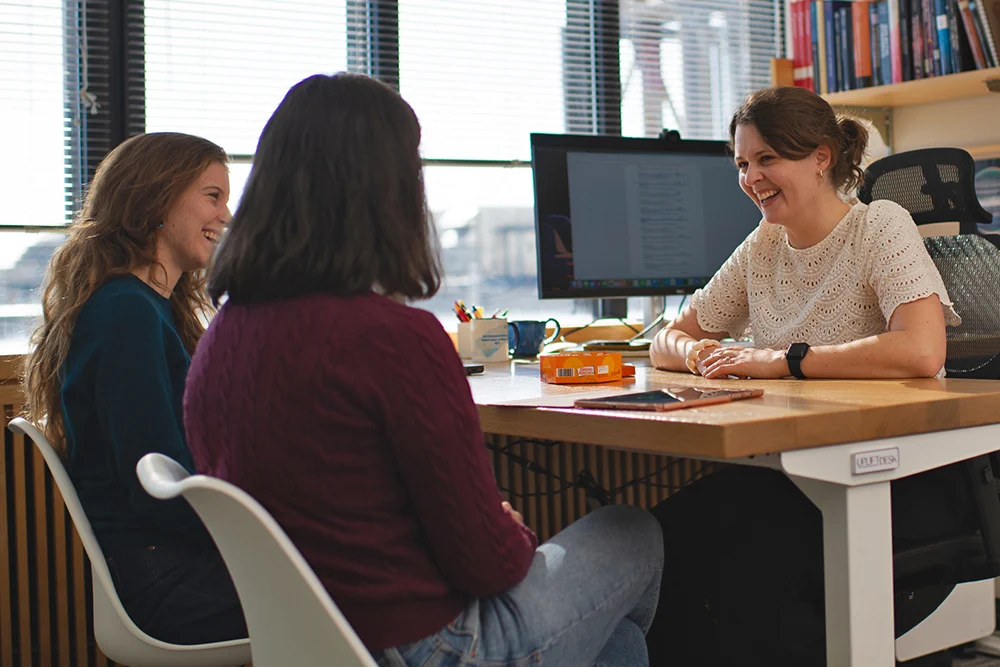
The Massachusetts Institute of Technology (MIT) has officially recognized Professor Anna-Christina Eilers for her exceptional contributions to graduate student mentorship, naming her a recipient of the Committed to Caring (C2C) honor. An Assistant Professor in the Department of Physics and a member of the Kavli Institute for Astrophysics and Space Research, Eilers has distinguished herself not only through her groundbreaking inquiries into the early universe but also through a pedagogical approach that prioritizes the psychological well-being and professional autonomy of her researchers. This recognition, which is part of a student-driven initiative, highlights a growing trend within elite academic institutions to formalize and reward the "soft skills" of mentorship that are often overlooked in traditional tenure and research evaluations.
The Intersection of Scientific Rigor and Empathetic Leadership
In the high-pressure environment of astrophysical research, the relationship between a principal investigator and their graduate students often dictates the trajectory of a young scientist’s career. For the students within Professor Eilers’ research group, the experience has been defined by a rare balance of high academic expectations and a supportive, community-oriented atmosphere.
Eilers, an observational astrophysicist, focuses her work on the "cosmic dawn"—the epoch in which the first stars and galaxies formed. Her research utilizes data from the world’s most advanced observatories, including the James Webb Space Telescope (JWST), to understand how supermassive black holes grew to such immense sizes in the very early stages of the universe’s history. However, her students report that her brilliance in the lab is matched by her consistency as a mentor. They cite her responsiveness to drafts, her presence during difficult research phases, and her ability to provide emotional support during the inevitable setbacks of graduate-level inquiry as the hallmarks of her leadership.
The Committed to Caring initiative, which bestowed this honor, was established by the MIT Office of Graduate Education (OGE) to recognize faculty who go above and beyond in their mentorship roles. Since its inception in 2014, the program has relied on graduate student nominations to identify faculty who model excellence in areas such as diversity, inclusion, mental health support, and professional development.
A Chronology of Academic Excellence and Mentorship Evolution
Professor Eilers’ journey to MIT and her subsequent recognition as a premier mentor can be traced through a series of prestigious academic milestones. She earned her PhD from the Max Planck Institute for Astronomy in Heidelberg, Germany, where she began her deep dive into the properties of the intergalactic medium and the growth of the earliest quasars. Following her doctoral work, she joined MIT as a NASA Hubble Fellow, a position reserved for the most promising early-career astrophysicists in the world.
During her transition from a researcher to a faculty member, Eilers observed the various mentorship styles prevalent in the global scientific community. She has often credited her own success to the advisors who supported her during her formative years. "I was very fortunate to have had several mentors who have challenged me scientifically and supported me along the way," Eilers remarked. "They modeled how to pursue excellent research without losing sight of the importance of personal connection and integrity."
This lineage of mentorship has informed the culture she now fosters at MIT. Since joining the faculty, she has built a research group that functions as a cohesive unit rather than a collection of isolated individuals. Her approach is characterized by "showing up in the everyday moments," a philosophy that emphasizes the cumulative power of small, consistent interactions over grand, occasional gestures.
Supporting Data: The Impact of Mentorship on Graduate Success
The significance of Eilers’ mentorship style is underscored by broader data regarding graduate student retention and mental health in STEM (Science, Technology, Engineering, and Mathematics) fields. Studies conducted by the Council of Graduate Schools have consistently shown that the relationship with a faculty advisor is the single most important factor in determining whether a student completes their PhD.
Furthermore, a 2018 report on graduate student well-being indicated that students who perceive their advisors as supportive are significantly less likely to experience chronic stress or burnout. At MIT, where the academic rigor is famously intense, the role of a mentor like Eilers becomes a critical buffer. Her practice of providing "timely and detailed feedback" addresses one of the primary stressors for graduate researchers: the uncertainty of their progress and the quality of their output.
In the nomination for the C2C award, two of Eilers’ students emphasized this point, stating, "We are both extremely grateful for the professional and emotional support we constantly receive. She always keeps an eye out for us." This "eye" extends to monitoring the dynamics of research collaborations. When external obstacles or difficult interpersonal dynamics threaten a student’s progress, Eilers is known to intervene early, identifying solutions before minor issues escalate into career-altering problems.
Institutional Traditions and Group Culture
A distinctive feature of Professor Eilers’ research group is the implementation of traditions that bridge the gap between professional networking and social bonding. One such tradition involves the sharing of local specialties—cookies, chocolates, or other treats—brought back by group members from conferences or research visits.
While seemingly simple, these exchanges serve a strategic purpose in the academic development of her students. During these meetings, the traveler shares insights from the talks they attended and the researchers they met. This practice achieves several goals:
- Knowledge Transfer: It ensures that the entire group benefits from the exposure one member had to new data or theories.
- Professional Socialization: It teaches students how to navigate the social and networking aspects of international science.
- Community Building: It reinforces a sense of shared success, where an individual’s professional journey contributes to the collective growth of the lab.
Additionally, Eilers is known to celebrate major milestones, such as the publication of a paper, by bringing the group’s favorite desserts to meetings. These moments of celebration are vital in a field where the "win" of a publication often comes after years of grueling data analysis and peer review.
Analysis of Implications: Redefining the "Successful Researcher"
One of the most impactful aspects of Eilers’ mentorship is her advocacy for a life outside the laboratory. In a culture that often glamorizes "grind culture" and 80-hour work weeks, Eilers provides a counter-narrative. She actively encourages her students to find hobbies and interact with people outside the scientific community.
"Graduate school can be all-consuming," Eilers noted. "It’s easy to let your research become your entire identity." Her philosophy is rooted in the belief that maintaining outside interests is not a distraction from research, but a prerequisite for its long-term sustainability. By encouraging students to maintain their identities as "people" first and "researchers" second, she helps them build the resilience necessary for a lifelong career in academia.
This perspective is particularly relevant as the scientific community grapples with high rates of attrition among underrepresented groups in physics. By fostering an environment where "care is not separate from academic excellence," Eilers is contributing to a more inclusive and sustainable model of scientific inquiry.
Broader Impact on the MIT Community and Beyond
The recognition of Professor Eilers via the Committed to Caring program reflects a broader institutional shift at MIT. The university has increasingly recognized that the quality of the graduate experience is inextricably linked to the quality of the mentorship provided by faculty.
Official responses from the MIT Office of Graduate Education suggest that the C2C program serves as a "living library" of mentorship best practices. By highlighting the specific behaviors of mentors like Eilers—such as her proactive check-ins and her focus on work-life balance—the program provides a blueprint for other faculty members to follow.
The implications of Eilers’ work also extend to the field of astrophysics itself. The "cosmic dawn" is one of the most competitive and fast-moving areas of modern science. By training students who are not only technically proficient but also emotionally resilient and collaborative, Eilers is shaping the next generation of leaders who will helm the world’s major observatories and research departments.
Conclusion
Professor Anna-Christina Eilers’ receipt of the Committed to Caring honor is a testament to the idea that the most profound scientific discoveries are often supported by the most human of interactions. In her group, the study of the universe’s most distant and ancient phenomena—quasars and black holes from billions of years ago—is conducted within a modern framework of empathy and mutual respect.
As Eilers continues her research into the formation of the first galaxies, her most lasting legacy may well be the culture of mentorship she has established at MIT. Through her steady commitment to her students’ professional and personal growth, she demonstrates that academic excellence is best achieved not through isolation and pressure, but through community, consistency, and a profound respect for the person behind the researcher.