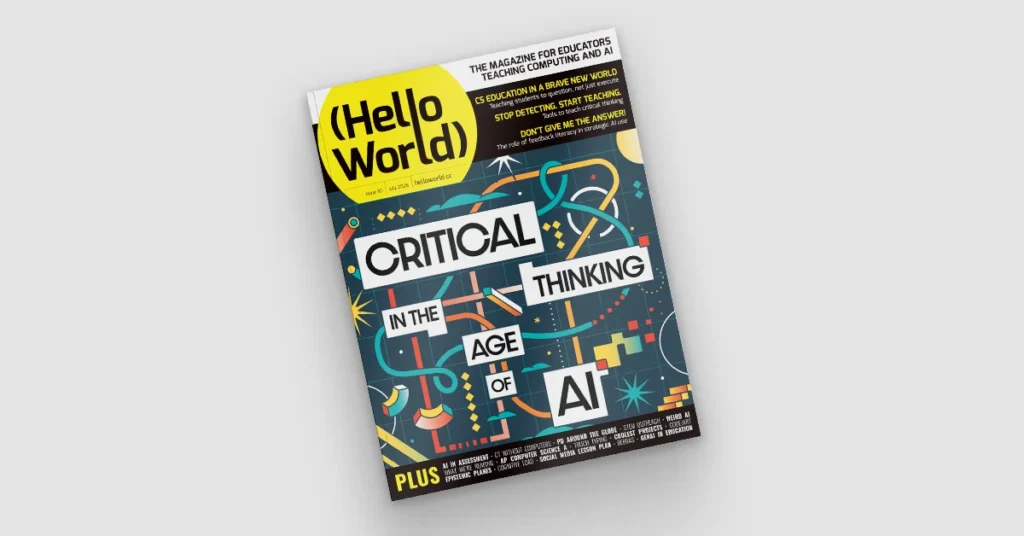
The Raspberry Pi Foundation has officially announced the release of the 30th issue of Hello World, a landmark publication dedicated to computer science educators, which arrives alongside a new podcast mini-series focused on the preservation and cultivation of critical thinking in the era of generative artificial intelligence. This milestone edition serves as a response to the rapid integration of data-driven tools into daily life, addressing a growing concern among pedagogues and technologists alike: the "outsourcing" of human cognition to automated systems. As AI-powered predictive text, recommendation algorithms, and large language models (LLMs) become ubiquitous, the educational community is pivoting toward a curriculum that emphasizes the evaluation of machine output over the mere utilization of the technology itself.
The Cognitive Shift: From Creation to Curation
The modern digital landscape is defined by convenience, offering users the ability to bypass traditional decision-making processes through predictive features. These tools, while increasing efficiency in drafting messages and selecting entertainment, have introduced a subtle yet profound shift in how individuals engage with information. When users rely on AI chatbots for definitive answers or use predictive text to finish their thoughts, they are essentially offloading the cognitive labor of word choice, taste formation, and problem-solving to an algorithm.
The latest issue of Hello World argues that while these tools are beneficial, they risk eroding the critical thinking skills developed through "non-AI-assisted acts." Historically, tasks such as navigating a city using physical maps, selecting personalized gifts without algorithmic prompts, or manually comparing complex documents like insurance policies served as incidental exercises for the brain. In a world where AI promises to eliminate these "frictions," the magazine posits that educators must intentionally reintroduce complexity and skepticism into the learning process to ensure that the next generation remains the director of the technology, rather than its passive subject.
Chronology of the AI Educational Revolution (2022–2024)
The release of Issue 30 marks a significant point in a timeline of rapid technological disruption within the education sector. The trajectory began in late 2022 with the public release of ChatGPT, which prompted an immediate and often defensive reaction from school districts worldwide, leading to temporary bans in several major jurisdictions. However, by mid-2023, the narrative shifted from prohibition to "AI literacy."
Throughout late 2023 and early 2024, organizations like the Computer Science Teachers Association (CSTA) and the Raspberry Pi Foundation began synthesizing research to create frameworks for responsible AI use. This culminated in the recent rewrite of the CSTA K–12 Standards, featured prominently in the new issue of Hello World. This timeline reflects a move away from the "black box" approach to technology—where students simply see the output—toward a "glass box" model, where the underlying logic, biases, and limitations of AI are scrutinized in the classroom.
Redefining Standards: The CSTA K–12 Framework
A central pillar of the new issue is the contribution from the CSTA team in the United States. Amanda O’Mara, Smita Kolhatkar, and Tiffany Jones highlight the necessity of the newly rewritten CSTA K–12 Standards, which are designed to prepare students for a future that is arriving at "supersonic speed." The standards move beyond coding proficiency to encompass a holistic understanding of how AI systems interact with society.
The authors emphasize that while AI can generate answers instantly, the capacity to understand, evaluate, and verify those answers remains a uniquely human requirement. This shift in the CSTA standards represents a fundamental change in computer science education; the focus is no longer just on how to build a program, but on how to judge the ethical and practical implications of the programs that already exist. This "new balance" aims to empower students to direct AI through sophisticated prompting and rigorous fact-checking, ensuring that human judgment remains the final arbiter of truth.
Supporting Data: The Rising Influence of AI in Pedagogy
Recent data underscores the urgency of the themes explored in Hello World Issue 30. According to a 2023 survey by the Walton Family Foundation, nearly one-third of K–12 teachers reported using ChatGPT for lesson planning or creating creative displays, while over half of students aged 12 to 17 reported using AI tools for schoolwork. Furthermore, research from the UNESCO International Institute for Higher Education suggests that while AI can personalize learning, it also risks creating "echo chambers" if students are not taught to question the sources of the data used to train these models.
Additional data from the World Economic Forum’s Future of Jobs Report 2023 identifies analytical thinking and creative thinking as the two most important skills for workers in the next five years. The report suggests that as routine tasks are automated, the value of "human-centric" skills—such as ethical reasoning and complex problem-solving—will increase. This statistical backdrop validates the Raspberry Pi Foundation’s focus on critical thinking as a survival skill in the modern workforce.
Deep Dives into Professional Learning and Cognitive Load
Issue 30 of Hello World provides a comprehensive suite of resources for educators, ranging from theoretical research to practical classroom applications. Key articles include:
Professional Learning and Teacher Confidence
The publication argues that AI professional development for teachers should go beyond technical tutorials. Instead of merely teaching educators how to use a specific tool, the goal should be to build their "critical confidence." This involves understanding the provenance of the data shaping AI models and recognizing the inherent biases that may be present in automated assessment systems.
Managing Cognitive Load
A significant challenge in the age of AI is "cognitive load"—the amount of mental effort being used in the working memory. Educators contribute insights on how to manage this load so that students can engage in "deeper thinking" rather than being overwhelmed by the sheer volume of AI-generated information. By structuring lessons to focus on one complex concept at a time, teachers can help students develop the stamina required for critical analysis.
The Role of "Flatgames" and Cross-Disciplinary Projects
To keep students engaged, the issue introduces "Flatgames," a simplified game-making process that encourages storytelling and artistic expression without the need for complex coding. Additionally, a "physics meets technology" project demonstrates how computer science can be integrated with other sciences to foster a multidisciplinary approach to problem-solving.
Official Responses and Collaborative Efforts
The release of this issue has been met with support from major industry players and educational bodies. Oracle, the sponsor of the issue, has reiterated its commitment to supporting computer science education that prioritizes logical reasoning. Educational leaders have noted that the "Hello World" podcast mini-series is a vital tool for reaching teachers who may not have time to read long-form research but are seeking actionable advice for their classrooms.
The consensus among contributors, including those from the CSTA, is that the rapid pace of AI development requires a collaborative, global response. By sharing articles from educators who are already experimenting with AI in various cultural and socioeconomic contexts, the magazine serves as a global clearinghouse for best practices.
Broader Impact and Long-term Implications
The implications of the shift toward AI-assisted living extend far beyond the classroom. As Hello World Issue 30 suggests, the "outsourcing" of personal taste and decision-making could lead to a homogenization of culture and a decline in individual agency. If recommendation engines dictate what we listen to, read, and watch, the diversity of human experience may be narrowed.
Furthermore, there is a risk of a "critical thinking divide." Students who are taught to use AI critically will be better positioned for high-level leadership and creative roles, while those who use it as a crutch may find themselves relegated to roles that are easily replaceable by the next iteration of automation. By providing these resources for free, the Raspberry Pi Foundation is attempting to democratize access to high-level digital literacy, ensuring that all students, regardless of their background, have the opportunity to master the tools of the future.
The focus on "whose knowledge is shaping AI" also touches on the geopolitical and social aspects of technology. As AI models are primarily trained on Western, English-language datasets, the critical thinking skills advocated in Issue 30 are essential for identifying and correcting the cultural biases inherent in these systems.
Conclusion and Call to Action
Issue 30 of Hello World serves as a call to action for educators to reclaim the narrative of the classroom. It moves the conversation from a fear of AI-assisted cheating to an opportunity for AI-assisted thinking. The Raspberry Pi Foundation encourages teachers to download the issue for free and engage with the community on social media to share their experiences with the resources provided.
As the world moves at "supersonic speed," the fundamental goal of education remains unchanged: to produce individuals who can think for themselves. In the age of AI, this goal is more challenging—and more necessary—than ever before. Through Issue 30, educators are provided with the framework to ensure that technology serves as a bridge to deeper understanding rather than a shortcut that bypasses it.