The allure of the five-star hotel experience, with its curated ambiance of soft piano melodies, hushed conversations, and the gentle chime of elevators, has long been a draw for discerning travelers. This sensory tapestry, woven with the clinking of teacups, the rhythmic cadence of dress shoes on marble, and the smooth glide of luggage wheels, creates an atmosphere of refined leisure. Within this luxurious setting, the private sanctuary of a hotel room offers a unique respite, where one can contemplate the day ahead enveloped in plush robes, indulge in the meticulous care of turndown service, or savor the convenience of room service. The ubiquitous presence of landlines, and the comforting embrace of monstrously fluffy pillows, further contribute to this sense of elevated comfort. Yet, for many, the ultimate indulgence lies in the poolside, a space that not only offers relaxation but also serves as an unexpected stage for observing a distinct facet of luxury: the pool watch.
The Genesis of the Pool Watch Phenomenon
The concept of the "pool watch" is intrinsically linked to a specific era and milieu, one characterized by overt displays of wealth and a particular appreciation for horological artistry. The author’s early recollections of poolside gatherings in Dubai paint a vivid picture of this phenomenon. During his youth, the observation of timepieces poolside was not merely a casual glance but a deliberate act of appreciating the sartorial choices and financial standing of fellow guests. This period, often described as a "simpler time," was marked by an absence of modern digital devices and a prevalence of high-grade mechanical watches, signaling a distinct cultural shift in how luxury was perceived and showcased.
In this environment, an eclectic array of luxury timepieces adorned the wrists of the hotel’s clientele. The author recalls spotting a diverse collection, from the ubiquitous Rolex Day-Dates favored by the "fat cats" to the more contemporary and ostentatious Hublot Big Bangs on Russian playboys. Young Khaleeji princes were observed sporting the robust Audemars Piguet Royal Oak Offshores, while their elders often opted for the understated elegance of the Patek Philippe Nautilus. British expatriates were noted for their flamboyant Breitlings, and the presence of a "yuppie" in a Corum Admiral Cup suggested a broader demographic engagement with luxury watches. Even the more enigmatic figures were not without their horological statements, with Panerai Radiomirs and the practical Rolex GMTs favored by airline pilots. The scene was a "cornucopia of gilt, glam, and excess," a stark contrast to the more subdued or "stealth wealth" trends that would emerge later. The absence of Apple Watches and the deliberate avoidance of wearing watches "ironically" underscored a direct and unadulterated appreciation for the craftsmanship and status these timepieces represented.
The Evolving Relationship with Luxury Timepieces
The author’s personal journey with luxury watches mirrors this broader evolution. As a young man on the cusp of adulthood, the acquisition of a single luxury watch was an ambitious, almost unattainable, aspiration. This dream has since materialized into the ownership of several timepieces, each cherished upon its acquisition. However, this personal collection has not been without its challenges, most notably with the Rolex Milgauss in the "Z Blue" configuration.
The Milgauss, originally conceived to withstand magnetic fields for scientists at CERN, represents a significant achievement in watchmaking. Yet, for the author, its appeal has waned due to practical considerations. The watch’s dimensions—its perceived size and thickness—have become a point of contention, particularly on his 16-centimeter wrist. The ill fit, characterized by a top-heavy feel and a tendency to flap, has led to a sense of self-consciousness, diminishing the wearer’s confidence in pulling off the piece. While the adage "these things are meant to be worn" has kept it in rotation, the accumulation of scuffs and scratches on its polished surfaces has further dampened the ownership experience.
Adding to this disillusionment is the financial aspect. Upon purchasing the Milgauss in 2019 for over $7,000, the author anticipated its value would appreciate, outperforming its peers. This expectation, however, has not been met, contributing to a less than ideal ownership sentiment. Consequently, the watch is now worn with less "sprezzatura," often concealed beneath a cuff, a far cry from the bold displays of the past and a tacit acknowledgment of security concerns. The initial excitement has dissipated, leaving a sense of detachment.
The Rediscovery: The Pool Watch Reimagined
The narrative takes a significant turn with the author’s rediscovery of the Milgauss’s potential, not in its intended scientific context, but in the relaxed and vibrant setting of a hotel pool. This re-evaluation is prompted by a specific scenario: a leisurely afternoon at a Four Seasons pool during "magic hour." The act of immersing oneself in the water, escaping the day’s heat, becomes a catalyst for a renewed appreciation of the timepiece.
Floating in the pool, the author’s gaze drifts to his Milgauss. The visual distortion of a water droplet on the crystal, reminiscent of a cyclops lens, triggers a moment of contemplation. The watch, no longer viewed solely through the lens of its retail price or its perceived flaws, begins to re-engage him. The interplay of warm sunlight filtering through palm trees, a gentle breeze, and the ambient sounds—perhaps a subtly playing Lana Del Rey track—create an almost cinematic backdrop.
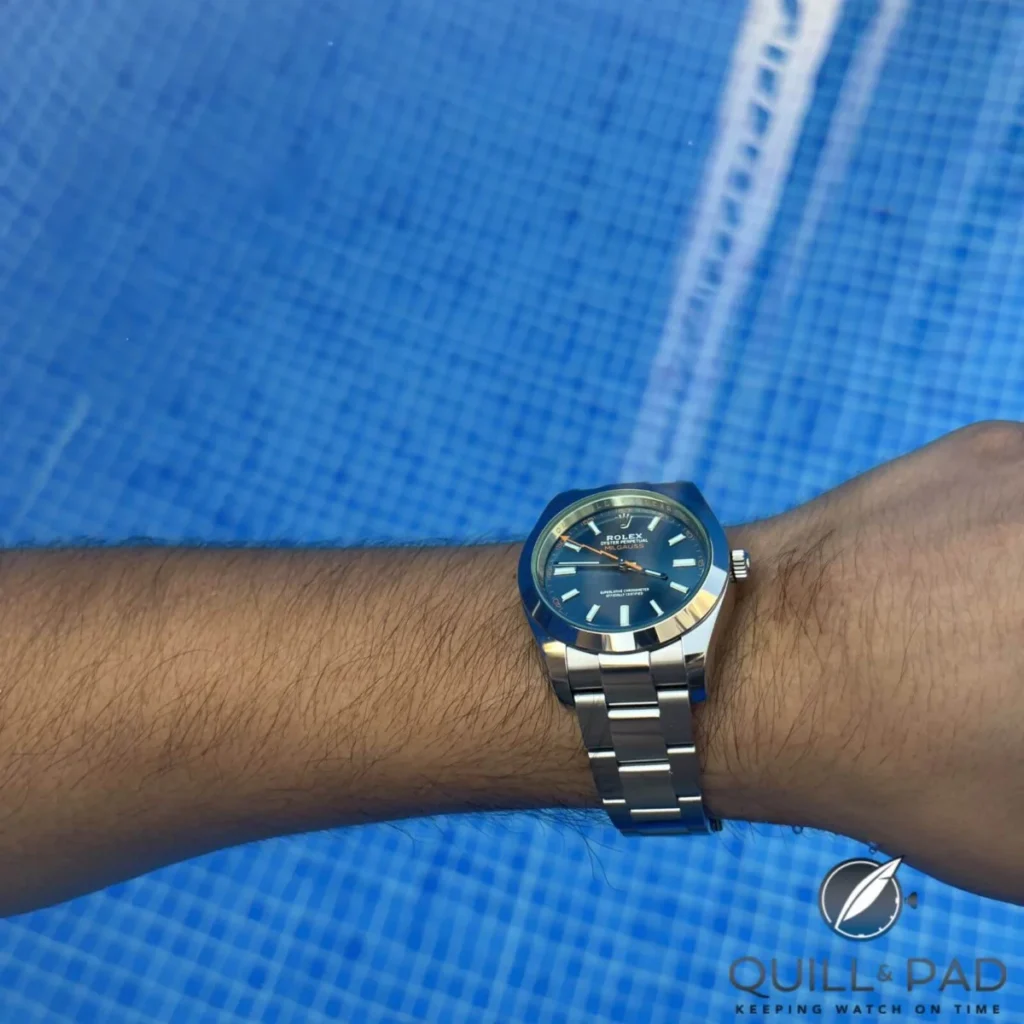
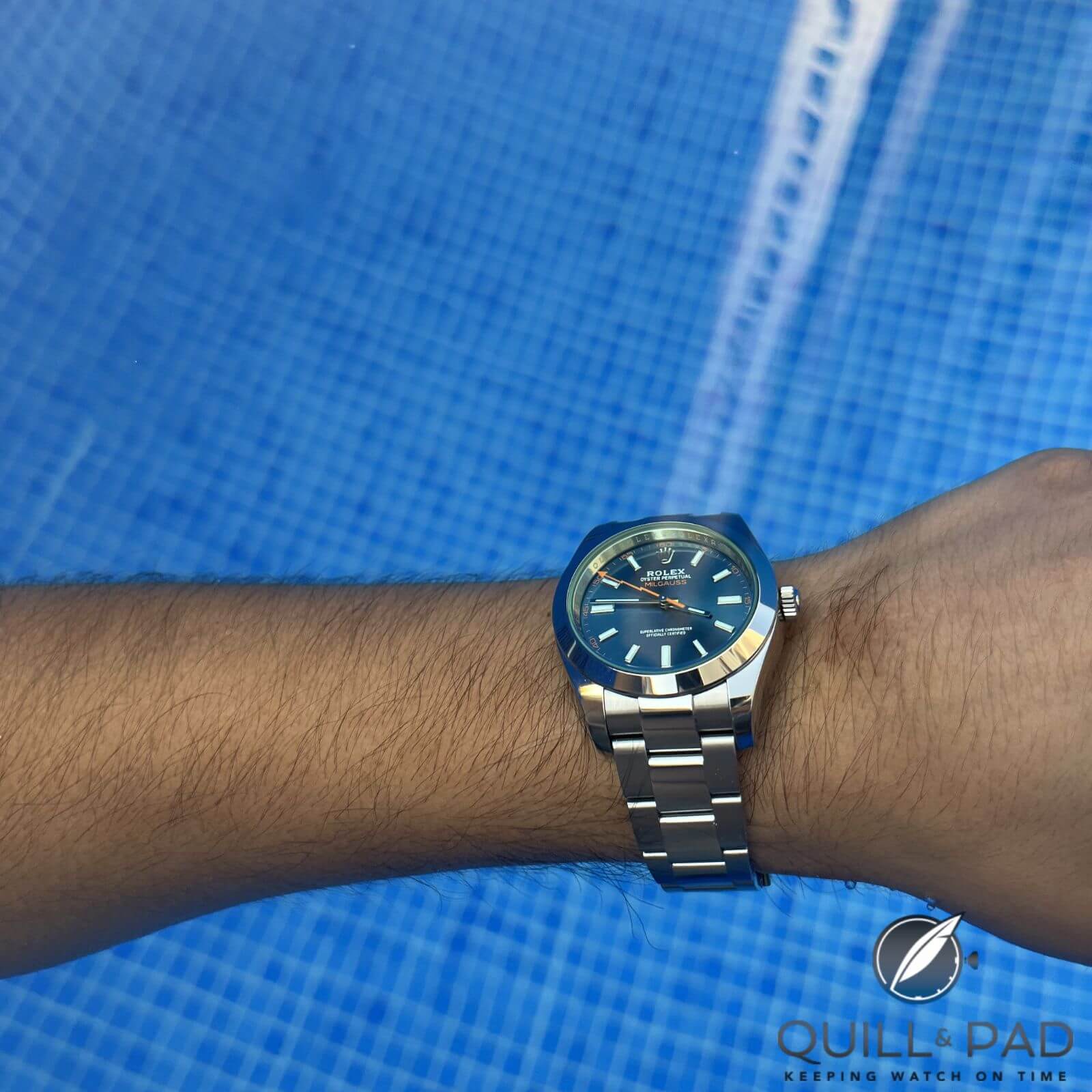
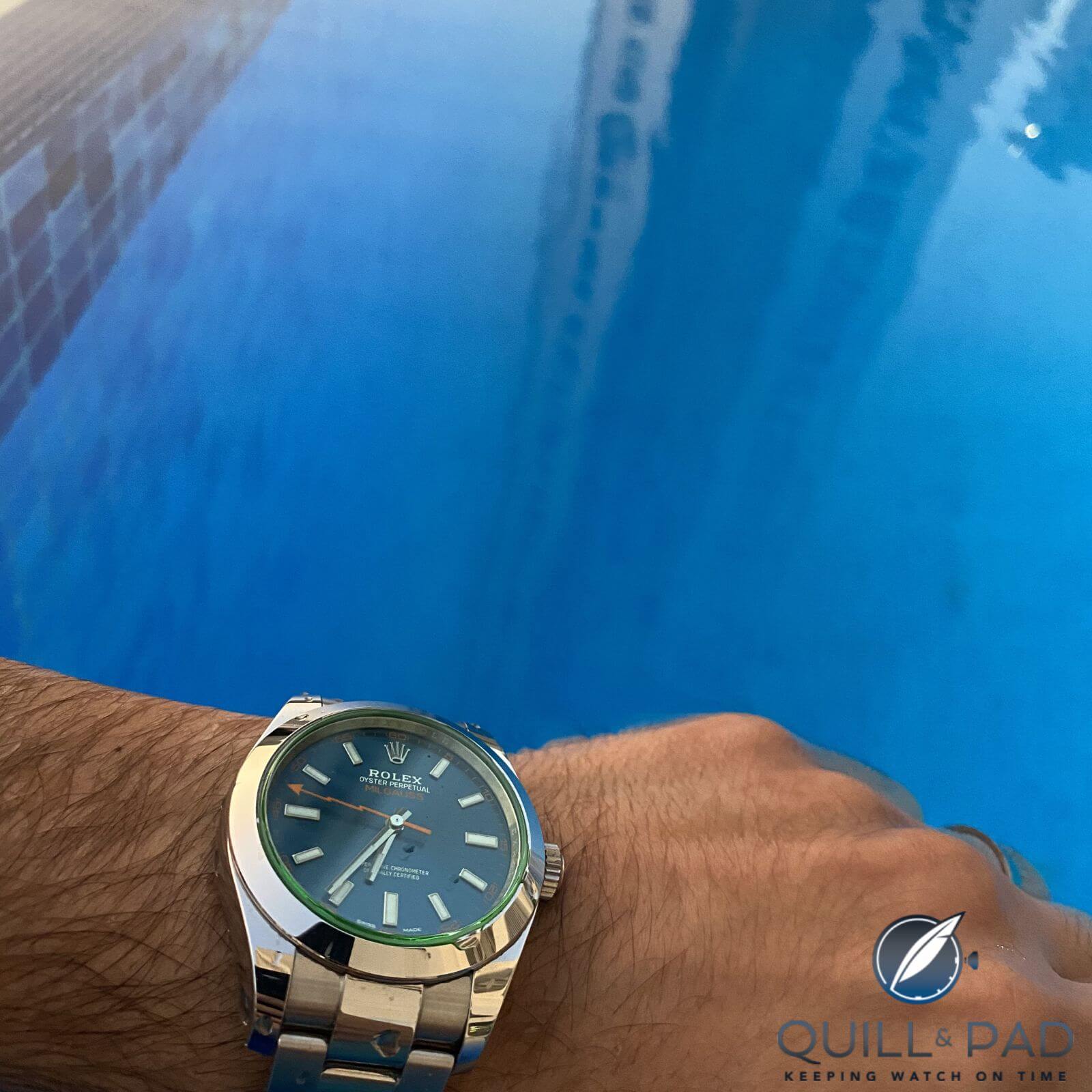
It is within this aquatic environment that the Z Blue Milgauss truly comes alive. The dial, with its vivid jade and aquamarine hues, bursts with color against the rippling blue of the water. This visual spectacle evokes a sense of nostalgia, recalling childhood memories of skateparks, aquariums, and simple pleasures. The green crystal, a distinctive feature of the Milgauss, transforms the watch into a striking visual element, its angled surfaces catching the light and contrasting with the surrounding mosaic tiling. From a direct view, the crystal creates a "radioactive halo" effect, while the dial beneath, a prism-lit disc, shimmers with iridescent blues, akin to the wings of a dragonfly. The bright orange seconds hand, shaped like a lightning bolt, adds a dynamic, almost electric, accent.
The act of plunging the watch into clear, sun-dappled water, the author suggests, injects a current of energy into it. In this context, the scratches and imperfections that had previously detracted from its appeal seem to fade when wet. The watch’s fit also improves when worn with swimwear, creating a more harmonious balance on the wrist. The wearer, liberated from the constraints of everyday attire and the anxieties of potential theft, experiences a sense of contentment and detachment from market values. In this environment, "all’s right with the world."
The Dichotomy of the Pool Watch
However, this idyllic immersion is transient. As the author dries off, the watch’s luster diminishes, and its perceived flaws re-emerge. The transition from the vibrant poolside to the confines of an indoor hotel setting, particularly under artificial light, highlights the Milgauss’s dependence on its optimal environment. The dim lighting renders the dial and crystal timid, unable to fully express their visual dynamism. The seconds hand, no longer a vibrant accent, becomes "jagged and jarring." The watch, "bone dry" and indoors, is perceived as being "out of its element," in need of water and sunlight to truly shine.
This experience leads to a broader philosophical point about the "natural habitat" of watches. While the Milgauss was engineered for the scientific rigor of CERN, its Z Blue configuration, the author argues, is inherently a "pool watch." This concept extends beyond the Milgauss to other iconic timepieces. The author posits that watches designed for specific environments—like the Breitling Cosmonaut for space exploration or the Omega Speedmaster Moonwatch for lunar missions—often find their most visually compelling and enjoyable setting outside of these original contexts.
The analogy is drawn to other objects whose aesthetic appeal is amplified in contexts different from their utilitarian origins. A peacock, while naturally inhabiting forests, is most striking on a manicured lawn. Timberland boots, designed for construction sites, gain a certain sartorial cachet when worn by a rapper in Manhattan. Similarly, blue jeans, originally practical workwear for gold prospectors, have found their most iconic presentation on figures like Sydney Sweeney. This suggests that the "natural habitat" of a watch does not always translate to its most aesthetically pleasing or contextually appropriate presentation.
The Poolside Spectacle: A Stage for Statement Pieces
The hotel pool, therefore, emerges as a unique stage for timepieces, a place where status symbols and statement pieces are not only accepted but expected. It’s a venue that favors "glitzy icons" with significant brand recognition, where more understated or avant-garde pieces might fall flat. The author humorously dismisses the appeal of brands like Parmigiani, Czapek, Bremont, Carl F. Bucherer, and Sinn in this setting, suggesting they disrupt the desired ambiance. Even the ubiquitous Apple Watch is deemed inappropriate, as the pool is positioned as a place for leisure and display, not for functional tracking of laps.
The author advocates for playing to the crowd in this environment, likening it to attending a concert where one expects to hear the hits, not obscure deep cuts. While in other contexts, the author embraces the "snob and geek" in him, actively seeking out quirky and "slept-on" watches, he concedes that the hotel pool calls for a different approach. This is the domain of "starter-kit luxury," "old school staples," and timepieces that embody a sense of unpretentious indulgence, akin to a "Beef Wellington in watch form."
This category includes models like the Audemars Piguet Royal Oak Offshore and Vacheron Constantin Overseas, as well as pre-Kern Breitling B01 Chronomats. The Speedmaster Moonwatch, particularly in yellow gold, is acceptable if it can handle water, and the Rolex Daytona, especially in yellow gold, is a prime candidate. Most Rolex sports models, including two-tone Bluesys, are well-suited for the poolside. High-water-resistance Richard Mille watches and most Hublot Big Bang models are also considered fitting choices.
Interestingly, virtually any Patek Philippe Nautilus works, with the Aquanaut following at a slight distance. The author makes a poignant observation: many watches that might attract unwanted attention in urban centers like London or Paris are perfectly at home by the hotel pool, provided they possess adequate water resistance. The suggestion is to keep these valuable pieces secured in the hotel safe when not in use, taking them for a dip when the mood strikes, and returning them before venturing out for dinner, thereby dispelling any notion that one shouldn’t travel with a Rolex. The hotel pool, in essence, becomes a sanctuary where the ostentatious can be enjoyed without the usual social or security anxieties, a place where the watch’s visual spectacle can be fully appreciated in its element.