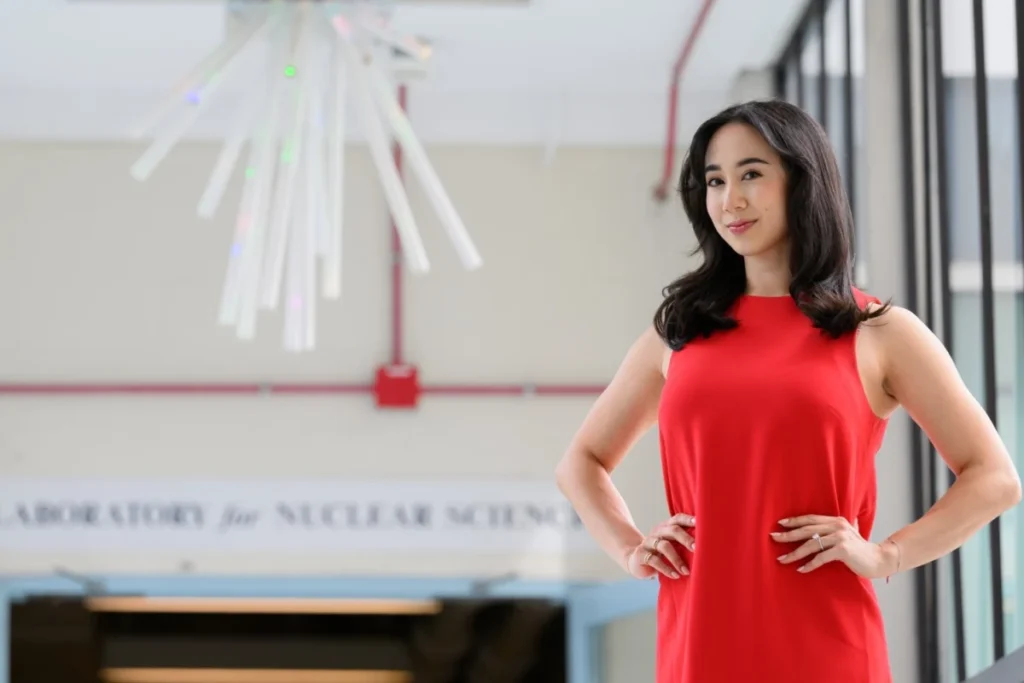
The pursuit of the unseen is perhaps the most daunting challenge in modern science, yet for Jessica Fry, a fifth-year physics PhD candidate at the Massachusetts Institute of Technology (MIT), it is a daily reality. Working within the prestigious Laboratory for Nuclear Science (LNS), Fry is part of an international cohort of physicists attempting to identify dark matter—a mysterious substance that constitutes approximately 85 percent of all matter in the universe. Despite its ubiquity, dark matter has never been directly detected, remaining one of the most significant "missing links" in our understanding of the cosmos. Fry’s journey to the forefront of particle physics is as unconventional as the particles she hunts, involving a high-stakes transition from the Broadway stage to some of the world’s most advanced laboratories.
The Mystery of the Invisible Universe
To understand the significance of Jessica Fry’s work, one must first grasp the scale of the dark matter problem. For nearly a century, astrophysicists have observed that the visible matter in the universe—stars, planets, gas, and dust—does not possess enough gravitational pull to hold galaxies together. Based on the laws of Newtonian gravity and General Relativity, galaxies should fly apart unless there is a massive amount of invisible matter providing additional gravitational "glue."
Supporting data from the European Space Agency’s Planck mission suggests that the universe’s composition is roughly 68% dark energy, 27% dark matter, and a mere 5% "normal" or baryonic matter. This means that everything humans have ever seen or touched represents only a tiny fraction of existence. Dark matter does not emit, absorb, or reflect light, making it invisible to traditional telescopes. It interacts with normal matter almost exclusively through gravity, leading scientists to propose various hypothetical particles to explain its existence. Among these, the axion has emerged as a leading candidate, and it is this particle that occupies the center of Fry’s research.
A Chronology of Dual Passions: From the Bay Area to Broadway
Jessica Fry’s path to MIT was paved by a relentless drive that manifested early in her childhood. Raised in the San Francisco Bay Area, she grew up in the shadow of the SLAC National Accelerator Laboratory, a hub of high-energy physics. However, her first discipline was not science, but dance. By elementary school, she was competing on a national level, developing a work ethic characterized by a "total immersion" philosophy.
The intersection of her artistic and scientific interests occurred during high school. When a teacher provided her with two defunct particle detectors from SLAC, Fry did not merely treat them as curiosities. She researched 1960s-era experimental papers, replicated a complex experiment, and documented her findings. This experience provided her first glimpse into the "philosophical questions" of time and space, grounded in physical hardware.
Fry later enrolled at Stanford University, where she pursued a demanding double major in physics and theater and performance studies. Her career took a dramatic turn during her sophomore year when she was cast in a Broadway revival of David Henry Hwang’s "M. Butterfly." The timing was precarious, coinciding with her midterm exams. In a display of the stamina that would later define her graduate research, she flew across the country for auditions and returned immediately to complete her academic requirements.
After a summer research stint at CERN (the European Organization for Nuclear Research) in Switzerland, Fry moved to New York City. She took a two-year hiatus from Stanford to perform on Broadway, a period during which she mastered diverse movement styles ranging from classical ballet to Peking opera and stage combat. However, the professional theater world presented psychological challenges. Fry noted that the constant cycle of external judgment in auditions began to erode her self-confidence, leading to a period of deep reflection.
The Return to Science and the MIT Laboratory for Nuclear Science
The decision to leave professional dance and return to academia was a pivotal moment in Fry’s life. She returned to Stanford to complete her degrees before applying to top-tier graduate programs. Her choice of MIT was driven by the unique atmosphere of the Laboratory for Nuclear Science. The LNS is a massive research enterprise, often compared in scale to entire physics departments at other universities. For Fry, the "scientific energy" of the lab mirrored the intensity she had experienced at CERN.
At MIT, Fry joined the Neutrino and Dark Matter Group under the mentorship of Professor Lindley Winslow. Winslow, a prominent figure in experimental nuclear physics, noted that Fry’s background in performance contributed to her excellence in the lab. According to Winslow, the "fearlessness to deliver" when the "curtain rises"—whether that curtain is a theatrical one or a critical experimental run—is a quality that sets Fry apart from her peers.
Hunting the Axion: ABRACADABRA and DMRadio
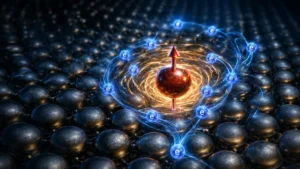
Fry’s current research focuses on the detection of the axion, an ultralight particle originally proposed to solve the "Strong CP Problem" in quantum chromodynamics. If axions exist, they would be billions of times lighter than an electron. Rather than behaving like individual "bullets," these particles would behave like a massive, coherent wave flowing through the galaxy.
Fry is currently instrumental in two major experimental efforts:
- ABRACADABRA (A Broadband/Resonant Approach to Cosmic Axion Detection with a Bayesian B-Ring Apparatus): This MIT-based experiment utilizes a toroidal (donut-shaped) magnet. The theory suggests that when an axion passes through a strong magnetic field, it should produce a tiny, oscillating magnetic field of its own. This field can then be detected as a faint electric current.
- DMRadio (Dark Matter Radio): A collaborative effort currently being constructed at Stanford, this experiment operates on similar principles but aims for even greater sensitivity.
The methodology is often compared to tuning a car radio. Because the exact mass (and thus the frequency) of the axion is unknown, physicists must slowly "sweep" through different frequencies, looking for a specific signal that stands out against the background noise.
"Think about two waves in the ocean—when they collide, they create a rip current. We are looking for that rip current," Fry explained in a recent summary of her work. The technical challenge is immense: the signal Fry is looking for is incredibly faint, often buried under thermal noise and environmental interference. To combat this, the experiments use quantum amplifiers and extreme cooling to near absolute zero to minimize "thermal chatter."
Data Analysis and Theoretical Implications
The search for the axion is not merely a "fishing expedition"; it is guided by rigorous theoretical frameworks. While the mass of the axion remains a variable, its "shape" or signal profile is predicted to be highly distinctive. This distinctiveness allows Fry and her team to use Bayesian statistical methods to differentiate potential signals from random electronic noise.
If Fry’s team successfully detects the axion, the implications for physics would be revolutionary. It would:
- Confirm the identity of dark matter, solving a century-old mystery.
- Validate the Peccei-Quinn theory, which explains why certain symmetries are observed in the strong nuclear force.
- Provide a new window into the early universe, as axions would have been produced in the first moments after the Big Bang.
Recognition and the Path Forward
Jessica Fry’s contributions to the field have not gone unnoticed. She was recently named to the Forbes 30 Under 30 Science list for 2026, a testament to her impact on the physics community before even completing her PhD. Her work on DMRadio is currently entering a critical phase of data analysis, a process that requires the same precision and discipline she once applied to her choreography.
Despite the prestige associated with her research, Fry remains grounded. She continues to dance at a studio near Harvard, viewing it as a necessary physical counterpoint to the intense intellectual labor of particle physics. "At the end of a long day of using my brain, I love just being in my body," she says.
Conclusion: A Lifetime Quest
The search for dark matter is a marathon, not a sprint. While many experiments have come and gone without finding a definitive signal, the scientific community remains optimistic about the next generation of detectors like DMRadio. Fry herself is convinced that a discovery is on the horizon. Her confidence is rooted in the refinement of detection technology and the increasing clarity of theoretical models.
As Fry nears the completion of her doctoral program, she looks toward a future that may include postdoctoral research, leading her own lab, or designing entirely new classes of detectors. Having already navigated a career at the highest levels of the performing arts, she approaches the challenges of physics with a unique perspective on success and failure. For Jessica Fry, the quest for the axion is more than just a scientific project; it is a search for the fundamental truths of the universe, conducted with the grace of a dancer and the rigor of a world-class physicist. The scientific world now waits to see if the "radio" she is tuning will finally catch the signal that changes our understanding of reality forever.