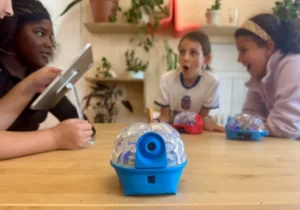
Backyard Brains, a pioneer in accessible neuroscience tools, has introduced SpikerBot, an innovative educational robot designed to demystify the complexities of engineering and brain science by allowing users to program "life-like" behaviors through virtual neurons rather than traditional code. This groundbreaking development, spearheaded by Co-Founder & CEO Greg Gage and Designer Alex Hatch, aims to bridge significant gaps in current science education, offering an intuitive and engaging platform for learners of all ages to explore the fundamental principles of neural networks and emergent behavior.
The Genesis of an Intuitive Approach
Backyard Brains has long been dedicated to making neuroscience approachable, having developed a range of tools that allow individuals to experiment with real neural signals. SpikerBot represents a significant evolution of this mission, tackling the often daunting initial hurdle of coding in robotics. Traditional robotics education frequently begins with abstract concepts of computer logic, such as "if-then" statements and loops, which can quickly disengage beginners. SpikerBot, however, bypasses this steep learning curve by introducing a programming paradigm rooted in biological principles.
The philosophy underpinning SpikerBot is deeply inspired by Valentino Braitenberg’s seminal 1984 book, Vehicles: Experiments in Synthetic Psychology. Braitenberg’s work explored how remarkably complex, seemingly intelligent behaviors could emerge from surprisingly simple connections between sensors and motors. SpikerBot embodies this ethos, allowing users to construct virtual neural circuits where "there’s no code, no LLMs, just neurons, synapses, and behavior emerging from a circuit a kid designed." This approach transforms robot programming into an exploration of synthetic biology, where users observe how basic sensory inputs, processed through a network of virtual neurons, translate into dynamic and adaptive movements. The robot responds directly to its environment through integrated sensors, fostering a direct, experiential understanding of cause and effect in a biological context.

Bridging the Neuroscience Education Gap
One of the most compelling aspects of SpikerBot is its potential to revolutionize neuroscience education. The current educational landscape often presents a significant chasm in understanding how the brain functions. Students might learn about the basic structure and function of a single neuron in elementary school, but the progression often halts until college, where advanced courses delve into the intricate workings of millions of interconnected neurons. This creates a conceptual void, akin to learning what a transistor is without understanding basic circuits or programming languages before jumping directly to complex Python applications.
This educational discontinuity contributes to what Backyard Brains terms "neuroscience illiteracy." In an era increasingly shaped by artificial intelligence, neurotechnology, and a growing awareness of mental health, a foundational understanding of the brain is more critical than ever. SpikerBot directly addresses this by providing a tangible, interactive model for understanding how neural circuits generate behavior. By designing and experimenting with virtual neurons, users can grasp concepts like excitation, inhibition, and synaptic plasticity in a hands-on manner, filling the educational gap between micro-level neuronal function and macro-level brain activity. This early exposure to network-level neuroscience can foster a deeper appreciation for the brain’s complexity and inspire future generations to pursue careers in neuroscience, robotics, and related STEM fields.
A Paradigm Shift in Programming
The core of SpikerBot’s innovation lies in its intuitive programming interface. Instead of writing lines of text-based code, users interact with a graphical application that allows them to drag and drop virtual neurons and axons onto a digital canvas, effectively building a brain on screen. This visual, spatial approach to programming more closely resembles connecting cables on an analog synthesizer or designing a circuit diagram, offering a holistic "overview" where the entire neural network is visible at once.

This design choice facilitates a unique learning experience. Changes made to the virtual neural circuit—such as altering a neuron from excitatory to inhibitory, or adjusting synaptic strength—are reflected instantaneously in the robot’s behavior. There’s no compilation time, no lengthy upload process; the feedback loop is immediate, mimicking the rapid-fire experimentation inherent in scientific discovery. This real-time interaction encourages iterative design, active experimentation, and a deep understanding of how subtle changes in neural connections can profoundly alter a robot’s actions.
Interestingly, this neural-network-centric programming introduces a fascinating inversion of complexity. Behaviors traditionally considered challenging for beginner robotics, such as a robot following a person or chasing an object, become remarkably simple to implement with just a few virtual neurons. For instance, a creature that chases objects can be created with only two neurons. Conversely, tasks that are trivial for traditional computer logic, like making a robot count in binary, can become surprisingly intricate webs of connections within the neural programming environment. This distinction highlights the fundamental differences between algorithmic, deterministic programming and the emergent, adaptive behaviors characteristic of biological systems. The focus on natural, intuitive behaviors is expected to sustain engagement, allowing users to gradually build complex, dog-like responses from simpler, foundational interactions.
The SpikerBot app itself is a testament to extensive development and refinement, demonstrating a commitment to user experience often seen in groundbreaking technologies. Its polished design and seamless functionality ensure that the novelty of the approach is matched by its usability and aesthetic appeal. The app includes a library of sample brain models, allowing users to deconstruct, modify, and learn from pre-built neural circuits. These samples are not arbitrary; they are designed to illustrate real neuroscience principles such as recurrent pairs (feedback loops), lateral inhibition (contrast enhancement), and the mechanisms underlying working memory. This educational content was developed with input from both child educators and professional neuroscientists, ensuring pedagogical soundness and scientific accuracy. Furthermore, SpikerBot supports peripherals, including Backyard Brains’ existing Spiker:bit board, enabling advanced users to control the robot using their own muscle signals, blurring the lines between biological and artificial intelligence.
The Hardware: A Brain on Wheels
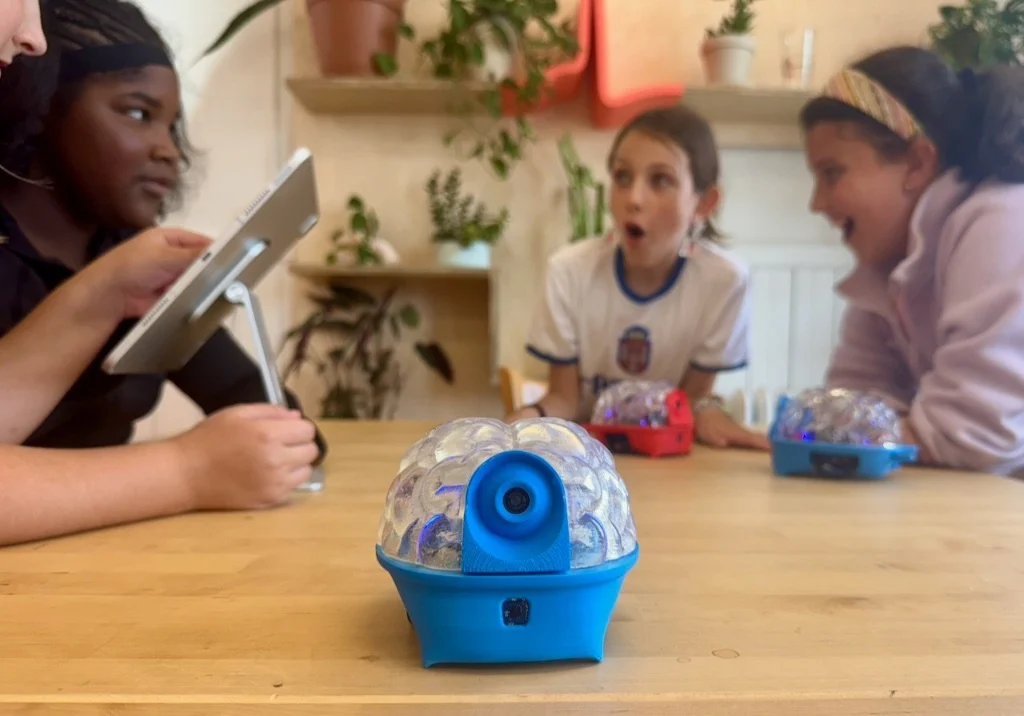
Underpinning this innovative software is a thoughtfully designed hardware platform. The SpikerBot robot itself is distinctive, shaped like Backyard Brains’ brain logo, immediately conveying its core purpose. This chassis is not merely decorative; it is packed with an array of sensors that allow it to perceive and interact with its environment. These include a camera for visual input, a microphone for auditory processing, and a distance sensor for spatial awareness.

The robot’s outputs are equally considered. Its lights are crafted to "pop on and fade out like bioluminescent cells," providing a more organic and responsive visual feedback than typical LEDs. The sound effects are described as "charming and quirky," adding to the robot’s personality and making its responses feel more natural and engaging. Beyond its integrated features, the SpikerBot chassis also includes connection points for 3D-printed attachments, encouraging owners to customize their bot and imbue it with a unique personality, transforming it from a mere educational tool into a personalized companion. This blend of sophisticated sensing, naturalistic outputs, and customizable form factor enhances the immersive learning experience.
Beyond STEM: Broader Societal Implications
The educational value of SpikerBot extends far beyond traditional STEM applications. An often-overlooked statistic is that approximately 1 in 5 people live with a neurological condition, ranging from ADHD and autism to anxiety and depression. A fundamental understanding of brain function and the underlying neural patterns that govern behavior can foster a more empathetic and informed public discourse around these conditions. By providing a "shared language and understanding of building-block brain patterns," SpikerBot can help individuals conceptualize and discuss what is happening within various neurological conditions, reducing stigma and promoting greater societal understanding and support.
This accessible approach to neuroscience education can empower individuals to better understand themselves and others, equipping them with a framework to appreciate the diverse ways brains function. In an increasingly complex world, fostering neuroscience literacy is not just an academic pursuit; it is a vital step towards building a more compassionate and understanding society.
A Commitment to Longevity and Accessibility

Backyard Brains’ commitment to the user experience and long-term viability is evident in SpikerBot’s design philosophy. The companion app is free to use and does not require cloud-based authentication, ensuring accessibility and eliminating potential barriers to entry or future obsolescence due to server shutdowns. This stands in contrast to many contemporary tech products that rely on subscriptions or online connectivity, making SpikerBot a truly self-contained and enduring educational tool.
Furthermore, the robot is powered by easily swappable AA batteries, eschewing the trend of non-replaceable, constantly decaying lithium-ion cells. Recognizing the environmental and practical benefits of rechargeable options, Backyard Brains also offers its own custom, high-performance NiMh AA batteries, promoting sustainability and cost-effectiveness for users. This thoughtful design choice underscores a commitment to practical utility and environmental responsibility.
SpikerBot’s journey to market is currently supported by a Kickstarter campaign, which concludes on June 14. Early pledges offer the robot at $219, a significant discount from its eventual retail price of $299. Backyard Brains’ successful track record with previous crowdfunding campaigns instills confidence in their ability to deliver on their promises, mitigating some of the inherent risks associated with crowdfunding. The team has a history of bringing innovative, high-quality educational tools to fruition, making SpikerBot a highly anticipated addition to the educational robotics landscape.
Looking ahead, Backyard Brains envisions an evolving platform. While SpikerBot already boasts a rich set of pre-programmed behaviors and capabilities, much of its potential remains untapped, waiting for the creative input of its users. As Alex Hatch aptly stated, "a lot we haven’t seen because you guys haven’t built anything yet." This open-ended invitation to discovery positions SpikerBot not just as a product, but as a collaborative tool for exploring the vast, uncharted territories of synthetic intelligence and emergent behavior, promising a future where anyone can program a brain on wheels and unlock new insights into the very nature of thinking.