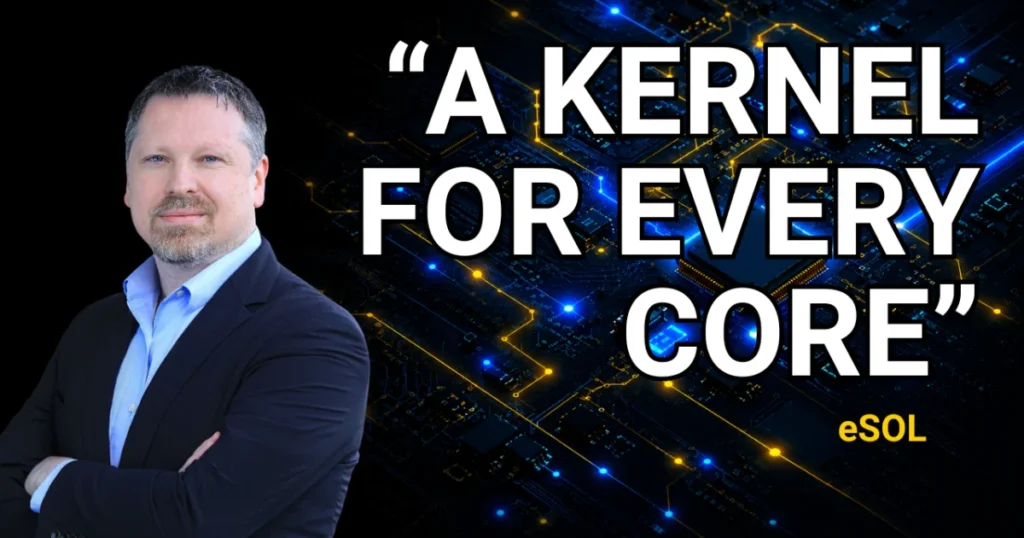
Real-time operating systems (RTOS) have long formed the bedrock of embedded system design, providing the deterministic performance and resource management crucial for devices ranging from consumer electronics to critical industrial control systems. However, the landscape of embedded computing is undergoing a profound transformation. As silicon manufacturers integrate an increasing number of processing cores onto single chips, and as applications demand unprecedented levels of safety, isolation, and reliability, traditional RTOS architectures face significant challenges. This paradigm shift necessitates innovative approaches to software design and operating system technology, a topic thoroughly explored in a recent Electropages Podcast featuring Robin Mitchell and Philipp Viktorin, Director of Business Development at eSOL. Their discussion delved into how RTOS technology is adapting to these complex demands, particularly highlighting eSOL’s eMCOS platform as a pivotal solution for the future of embedded computing.
The Multi-Core Imperative and Emerging Challenges
The transition from single-core to multi-core processors in embedded systems, mirroring a trend seen earlier in general-purpose computing, has brought forth a host of opportunities and complexities. Multi-core architectures offer substantial increases in computational power, enabling more sophisticated functionalities, advanced sensor fusion, and on-device artificial intelligence (AI) processing. However, harnessing this power effectively in real-time, safety-critical environments is far from trivial.
Traditional RTOS designs, often optimized for single-core or basic symmetric multiprocessing (SMP) environments, struggle with the intricacies of managing numerous cores simultaneously. Issues such as cache coherence, inter-core communication overhead, resource contention (e.g., shared memory, peripherals), and the inherent difficulty in achieving deterministic scheduling across multiple, tightly coupled cores can lead to unpredictable performance, increased latency, and a heightened risk of software defects. Moreover, the growing demand for mixed-criticality systems – where applications with varying safety integrity levels (e.g., non-safety-critical infotainment alongside safety-critical braking systems) must coexist on the same hardware – introduces a paramount need for robust isolation. A fault in a low-criticality component must not be allowed to propagate and compromise a high-criticality function. This necessitates stringent resource partitioning and fault containment mechanisms that go beyond what conventional RTOS platforms typically offer.
eMCOS: A Novel Approach to Multi-Core RTOS Architecture
At the heart of eSOL’s response to these challenges lies the eMCOS platform, distinguished by its innovative multicore architecture. Unlike conventional RTOS models where a single, monolithic kernel is responsible for managing all processes and resources across multiple cores, eMCOS employs a distributed microkernel approach. In this architecture, the operating system can effectively "spawn" an independent kernel for each processor core. These individual kernels operate largely independently, managing their respective core’s tasks and resources, yet possess the capability to communicate and synchronize when necessary.
This unique design offers several profound advantages. Firstly, it inherently provides greater isolation between tasks. By confining task execution and resource management to individual kernel instances, the potential for interference between different applications or tasks running on separate cores is significantly minimized. This "spatial partitioning" is critical for achieving the fault containment required in safety-critical systems. If one kernel or the tasks it manages encounters an issue, the impact is largely localized, preventing a cascade failure across the entire system.
Secondly, the eMCOS architecture exhibits superior scalability. As the number of cores on a processor increases, the RTOS can scale linearly by deploying more kernel instances. This contrasts sharply with traditional SMP RTOS, where the single kernel can become a bottleneck as core counts rise, leading to diminishing returns in performance and increased complexity in scheduling and synchronization. The distributed nature of eMCOS allows for more efficient utilization of hardware resources, facilitating higher overall system throughput and responsiveness, which is essential for demanding applications like advanced driver-assistance systems (ADAS) and autonomous driving platforms.
Chronology of Embedded System Evolution and RTOS Adaptation
The journey of embedded systems and RTOS development has been marked by continuous evolution, largely driven by advancements in semiconductor technology and increasing application demands.
- 1980s-1990s: Early RTOS platforms emerge, primarily for single-core microcontrollers. Focus on determinism, small footprint, and efficient interrupt handling. Examples include VxWorks, pSOS, RT-kernel.
- Early 2000s: Multi-core processors begin to appear in high-performance computing. Embedded systems, initially slower to adopt, start to see dual-core processors for specific applications. Basic SMP RTOS implementations attempt to manage multiple cores, often facing scalability issues.
- Mid-2000s: The rise of consumer electronics (smartphones, digital cameras) drives demand for more powerful embedded processors. Embedded Linux gains traction for less critical applications, while traditional RTOS continues to dominate safety-critical domains.
- Late 2000s – Early 2010s: Multi-core processors become more common in automotive, industrial, and aerospace. The automotive industry, in particular, begins to standardize functional safety with the publication of ISO 26262 in 2011, establishing Automotive Safety Integrity Levels (ASIL). This creates a pressing need for RTOS solutions that can provide strong isolation and certification evidence.
- Mid-2010s: Increasing complexity of ADAS, infotainment, and industrial IoT systems pushes core counts higher. Hypervisors emerge as a way to virtualize and isolate different operating systems (e.g., Linux for infotainment, RTOS for safety-critical functions) on multi-core SoCs. However, hypervisors introduce their own overhead and complexity.
- Late 2010s – Present: The era of highly integrated SoCs with 8, 16, or even more cores. Autonomous driving and AI at the edge demand unprecedented computational power alongside extreme safety and reliability. Solutions like eSOL’s eMCOS, with its native multi-kernel architecture, gain prominence as a more efficient and deterministic alternative to traditional SMP RTOS or hypervisor-only approaches for achieving true mixed-criticality partitioning and scalable real-time performance. eMCOS’s development and subsequent ISO 26262 certification underscore this trajectory.
Functional Safety and Certification: The ISO 26262 Imperative
One of the most critical aspects Philipp Viktorin discussed was eMCOS’s ISO 26262 certification. ISO 26262 is a globally recognized functional safety standard for electrical and electronic systems in road vehicles. It defines a comprehensive framework for managing functional safety throughout the entire product lifecycle, from concept and development to production, operation, and decommissioning. The standard specifies Automotive Safety Integrity Levels (ASIL A through D), with ASIL D representing the highest level of safety criticality.
Achieving ISO 26262 certification for an RTOS like eMCOS is a monumental undertaking, requiring rigorous development processes, extensive documentation, and thorough validation and verification activities. For eMCOS, this certification signifies that the platform has been developed to the highest safety standards, making it suitable for deployment in the most critical automotive applications, such as autonomous driving control units, electric power steering systems, and advanced braking systems. The inherent isolation provided by eMCOS’s multi-kernel architecture naturally aligns with the partitioning requirements of ISO 26262, simplifying the safety argumentation for system developers.
This certification is not merely a badge; it is a critical enabler for automotive OEMs and Tier 1 suppliers. By utilizing a pre-certified RTOS component, these companies can significantly reduce the complexity, cost, and time associated with achieving system-level safety certification. It provides a foundational layer of trust and compliance, allowing developers to focus their efforts on the application-specific safety requirements. While ISO 26262 is specific to automotive, the principles of functional safety and the architectural benefits of eMCOS extend to other safety-critical domains, including IEC 61508 for industrial automation, DO-178C for avionics, and various standards for medical devices. The ability to guarantee real-time performance and isolation in mixed-criticality systems is universally valuable across these sectors.
Supporting Data: The Expanding Landscape of Embedded and RTOS Markets
The market trends underscore the increasing relevance of advanced RTOS solutions like eMCOS.
- Global RTOS Market: According to various market research reports, the global RTOS market is projected to grow significantly. For instance, reports often indicate a compound annual growth rate (CAGR) of 6-8% from 2023 to 2030, with market valuations expected to exceed several billion USD by the end of the decade. This growth is primarily fueled by the proliferation of IoT devices, industrial automation, and the automotive sector’s transition to software-defined vehicles.
- Automotive Embedded Systems: The automotive embedded systems market is a key driver. With the rise of ADAS, autonomous vehicles, and sophisticated in-vehicle infotainment (IVI) systems, the complexity and computational demands on embedded software are skyrocketing. The average number of ECUs (Electronic Control Units) in a high-end vehicle can exceed 100, and the lines of code can easily surpass 100 million.
- Multi-Core Processor Adoption: Chip manufacturers like NXP, Renesas, Infineon, and Texas Instruments are continuously releasing embedded SoCs with increasing core counts, integrating powerful ARM Cortex-A and Cortex-R cores alongside specialized accelerators. This hardware evolution directly necessitates RTOS platforms capable of efficiently managing these complex heterogeneous architectures.
- Functional Safety Market: The market for functional safety solutions, including certified software components, is also experiencing robust growth. The increasing regulatory pressure and the inherent risks associated with advanced systems make functional safety a non-negotiable requirement, driving demand for pre-certified software and tools.
Official Responses and Industry Perspectives
While specific direct quotes from industry analysts beyond the podcast are not provided in the original text, it is logical to infer the sentiment and strategic direction from eSOL’s Philipp Viktorin and the broader industry.
Philipp Viktorin’s insights, as conveyed in the Electropages Podcast, underscore eSOL’s commitment to addressing the future of embedded computing. He implicitly highlights that traditional RTOS models, while foundational, are reaching their limits in the face of modern multi-core, safety-critical requirements. His emphasis on eMCOS’s multicore architecture, its isolation capabilities, scalability, and ISO 26262 certification serves as a clear statement of eSOL’s vision: to provide a robust, performant, and certifiable foundation for next-generation embedded applications. His discussion about creating a "consistent route from early prototypes through to production-ready systems" further indicates eSOL’s understanding of the full development lifecycle challenges faced by their customers. This implies comprehensive toolchain support, robust documentation, and expert professional services to guide developers through complex safety and reliability requirements.
From a broader industry perspective, embedded systems engineers and development teams are actively seeking solutions that simplify the development of complex, multi-core systems while simultaneously meeting stringent safety and security standards. The challenges of integrating diverse software components, managing real-time deadlines across multiple cores, and demonstrating compliance for functional safety are significant pain points. Therefore, an RTOS like eMCOS, which natively addresses these architectural and certification complexities, is likely to be viewed as a highly valuable offering. Industry experts widely agree that efficient resource management, strong isolation, and proven safety certifications are paramount for accelerating the development and deployment of advanced embedded applications, particularly in the automotive and industrial sectors.
Broader Impact and Implications
The emergence and adoption of advanced RTOS platforms like eSOL’s eMCOS carry significant implications across the embedded systems landscape:
-
Enabling Next-Generation Applications: By providing a reliable and scalable foundation, eMCOS empowers developers to build more sophisticated applications. This includes higher levels of autonomous driving (Level 3, 4, and 5), advanced robotics with complex motion control and AI capabilities, sophisticated industrial automation systems, and high-performance edge computing devices that require real-time data processing. The ability to safely run diverse workloads on a single SoC streamlines hardware design and reduces bill-of-materials costs.
-
Accelerated Development and Reduced Time-to-Market: The availability of a pre-certified, robust RTOS significantly reduces the development burden for OEMs and Tier 1s. They can leverage the architectural advantages of eMCOS to simplify their software design, focus on application-specific logic, and accelerate the safety certification process. This translates directly into faster time-to-market for innovative products, providing a crucial competitive edge.
-
Enhanced System Reliability and Security: The strong isolation capabilities of eMCOS not only contribute to functional safety but also enhance overall system reliability and security. By partitioning critical and non-critical components, the impact of software bugs or even malicious attacks on less critical parts of the system can be contained, preventing them from compromising safety-critical functions. This is increasingly important as embedded systems become more connected and vulnerable to cyber threats.
-
Shaping the RTOS Competitive Landscape: eSOL’s innovative approach positions it as a key player in the evolving RTOS market. As multi-core processors become standard, traditional RTOS vendors will need to adapt their offerings or risk being left behind. The focus on native multi-core support, isolation, and safety certification sets a new benchmark for what embedded developers expect from their foundational software.
-
Future Trends and Integration: The principles embodied in eMCOS are highly relevant to future trends in embedded computing. This includes tighter integration with machine learning frameworks for AI inferencing at the edge, the growing need for over-the-air (OTA) update capabilities for software-defined vehicles, and the continuous demand for enhanced security features. An RTOS that can flexibly support these evolving requirements while maintaining real-time determinism and safety will be indispensable. Furthermore, the discussion around hypervisors and their role in mixed-criticality systems highlights the complementary nature of eMCOS. While a hypervisor might virtualize entire operating systems, eMCOS provides fine-grained, real-time partitioning within an OS instance, offering a powerful combination for truly complex heterogeneous systems.
In conclusion, the Electropages Podcast conversation with Philipp Viktorin from eSOL serves as a timely and insightful exploration into the critical evolution of real-time operating systems. As embedded systems become more complex, powerful, and integral to safety-critical applications, the need for innovative RTOS platforms that can effectively manage multi-core processors, ensure robust isolation, and meet stringent safety standards like ISO 26262 is paramount. eSOL’s eMCOS platform, with its unique multi-kernel architecture, stands out as a pioneering solution addressing these demands, setting a new trajectory for the development and deployment of future-generation embedded systems across automotive, industrial, and other high-reliability sectors.