In a significant advancement for industrial automation, machine-tool provider CNC Solutions has unveiled a groundbreaking "Technology Package" that seamlessly integrates advanced software, robust robotics from Stäubli, and sophisticated motion control from Beckhoff. This innovative solution addresses the growing demand for high-precision, robot-driven manufacturing processes that transcend the limitations of traditional teach-in methods, particularly for complex CNC-class workloads such as multi-axis milling, abrasive sanding, and laser or plasma cutting. The collaboration marks a pivotal step towards blurring the lines between the flexibility of industrial robots and the uncompromising precision of Computer Numerical Control (CNC) machines.
The Evolving Landscape of Industrial Automation and the Need for a New Paradigm
For decades, industrial automation has seen a distinct division: traditional CNC machines excelled at intricate, high-precision tasks requiring continuous path control, while industrial robots offered unparalleled flexibility, primarily for repetitive pick-and-place operations. However, the modern manufacturing landscape, driven by demands for mass customization, complex geometries, and higher material removal rates across various industries—from aerospace and automotive to medical and mold & die—has rendered this traditional separation increasingly inadequate.
CNC Solutions, with its deep-rooted experience spanning decades in supporting increasingly complex projects, recognized that the established "teach-in" approach, while effective for simpler tasks, fundamentally struggled with the sheer complexity of today’s advanced manufacturing. Processes like precision milling, intricate trimming, and advanced sanding necessitate the management of millions of motion points. Manually teaching a robot such a trajectory is not only prohibitively time-consuming but also prone to inconsistencies, making it unsuitable for applications demanding micron-level accuracy and repeatable quality. This often resulted in significant robot idle time, extended project timelines, and variable product quality, hindering the adoption of robots in high-value, high-precision applications. The challenge was clear: how to imbue industrial robots with the precision, control, and programming ease of a CNC machine.
CNC Solutions’ Vision: Bridging the Gap with the "Technology Package"
Driven by the imperative to overcome these limitations, CNC Solutions embarked on developing a workflow that would fundamentally redefine robot programming and execution for complex tasks. Their vision culminated in the "Technology Package," a comprehensive solution designed from the ground up to integrate Computer-Aided Manufacturing (CAM) at its core, allowing for precise offline simulation of the entire manufacturing cell, and ultimately, controlling a robot with true CNC-level precision and speed.

"Our goal was to eliminate the compromises traditionally associated with using robots for high-precision machining," stated a representative from CNC Solutions, emphasizing the transformative potential of the package. "We wanted to empower integrators and manufacturers to leverage the inherent flexibility of robots without sacrificing the accuracy and repeatability expected from a CNC machine. This required a holistic approach, meticulously integrating software intelligence with robust hardware."
The development process for this integrated stack was iterative and rigorous. Over time, the CNC Solutions team painstakingly refined the robot axis motions, gradually perfecting the commissioning process until it achieved the unwavering consistency characteristic of a dedicated CNC machine. This methodical approach ensured that the final solution was not merely a collection of components but a truly standardized, integrated system capable of reliable, high-performance operation.
The Three Pillars of Precision: Software, Robotics, and Motion Control
At its heart, the "Technology Package" is built upon three core, synergistic components that work in unison to deliver unprecedented capabilities:
-
ENCY Robot: The Offline Programming and Simulation Brain:
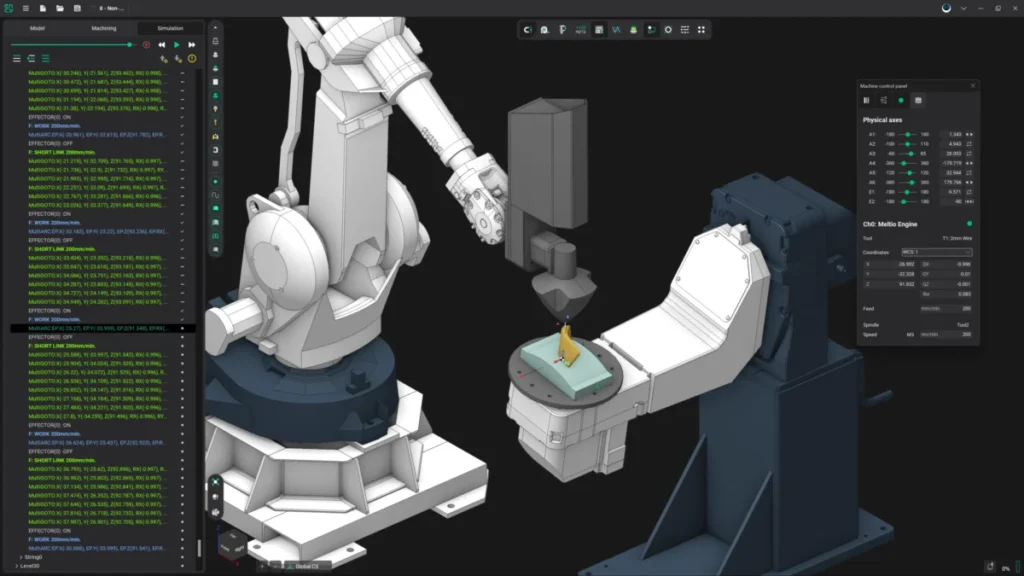
The foundation of the solution’s intelligence is ENCY Robot, a state-of-the-art offline programming (OLP) software. Recognizing that traditional online programming methods keep valuable robots idle for hours, ENCY provides a comprehensive, all-in-one environment for design, technology setup, toolpath calculation, and simulation. It allows users to create and optimize robot programs without occupying the physical robot, drastically reducing downtime and accelerating project timelines.
ENCY’s capabilities extend far beyond simple path generation. It performs meticulous simulation of the entire manufacturing cell, offering critical features such as real-time collision detection, singularity avoidance, and checks against axis limits. This proactive approach converts what would typically be commissioning time into productive time, ensuring that programs are validated and optimized before ever reaching the shop floor. Its "zero-code digital-twin builder" and extensive libraries streamline the programming process, making complex tasks more accessible. Crucially, ENCY translates trusted CAM strategies directly into reliable robot instructions, ensuring that the precision envisioned in the design phase is accurately executed by the robot. The software’s broad functionality, capable of managing both simple two-axis tasks and highly complex multi-axis cells, along with its transparent internal management of code paths and models, made it the ideal choice for CNC Solutions. This allows teams to focus on process optimization rather than grappling with vendor-specific robot languages. -
Beckhoff Motion Controller: The CNC-Style Command Center:
Serving as the central nervous system, a Beckhoff motion controller is integral to the package. Beckhoff Automation is renowned for its open, PC-based control architecture, particularly its TwinCAT software platform, which integrates PLC, motion control, robotics, HMI, and communication functionalities into a single environment. In this solution, the Beckhoff controller operates the Stäubli robot with standard CNC commands, effectively transforming the robot into a multi-axis CNC machine. This means operators can utilize familiar CNC paradigms, including feeds, modes, and frames (akin to G-code and M-code), simplifying the transition for those accustomed to traditional machine tools.
The Beckhoff controller’s high-speed processing capabilities and deterministic real-time performance are critical for executing the complex, continuous paths generated by ENCY with the necessary precision and smoothness. Its open architecture also allows for seamless integration with other plant networks and communication interfaces (like OPC UA), fitting perfectly into modern Industry 4.0 environments. -
Stäubli Robot: The Precision Executioner:
The final, indispensable component is the Stäubli robot, responsible for the physical execution of the meticulously planned trajectories. Stäubli robots are highly regarded in the industry for their exceptional precision, repeatability, and robust construction. These characteristics are paramount for the abrasive and high-demand applications targeted by the "Technology Package," such as grinding, deburring, polishing, and precision milling. The robots’ sealed construction effectively resists dust and debris, a crucial feature in harsh manufacturing environments where contaminants can degrade performance and shorten lifespan.
Moreover, Stäubli provides seamless integration of a CNC-style motion layer for trajectory execution, working in perfect harmony with the Beckhoff controller. This synergy ensures that the robot can accurately follow the complex paths generated by ENCY, maintaining tight tolerances and consistent surface finishes. A representative from Stäubli might observe, "Our robots are engineered for demanding industrial environments, and this collaboration showcases their capability to deliver CNC-level performance, pushing the boundaries of what’s achievable with robotic automation."
Operational Advantages and a Seamless User Experience
The "Technology Package" is engineered for ease of implementation and operation, offering a suite of features designed to streamline the integration process and enhance day-to-day use:
- Plug-and-Play Simplicity: A significant design achievement is the single-cable connection that links the Stäubli robot to the Beckhoff controller, dramatically simplifying wiring and installation. The package also includes predefined and machine-tuned processes for common applications such as milling, welding, sanding, and laser cutting, providing integrators with a validated starting point and reducing setup time.
- Intuitive CNC-Style Operation: The system features a CNC-style Human-Machine Interface (HMI) and a handheld pendant, offering familiar operational modes (Auto, Manual, Home), feed overrides, and integrated emergency-stop logic. Support for manual moves using encoder-wheel controls further enhances usability, making it accessible to operators already familiar with traditional CNC machines.
- Real-World Adaptability: Recognizing that real-world manufacturing cells often deviate from theoretical specifications, the package incorporates advanced features that typically require extensive setup time. These include absolute, TCP (Tool Center Point), and frame calibration, crucial for maintaining accuracy in dynamic environments. It also manages singularity issues, offers OPC UA connectivity for robust plant network integration, enables real-time path adjustments, and includes tool-wear compensation—all critical for maintaining consistent quality and uptime in demanding applications.
- Focus on Core Expertise: By eliminating the need for tedious online robot teaching and providing a robust CNC-like motion layer, the "Technology Package" allows integrators and their teams to redirect their focus. Instead of mastering vendor-specific robot languages or complex kinematic programming, they can concentrate on their core competencies: designing optimal fixtures, selecting appropriate tools, and fine-tuning the process parameters for superior results. Expertise can remain centered on PLCs, safety systems, fixturing, end-effectors, and profound process knowledge.
Broader Impact and Future Implications
The commercial availability of CNC Solutions’ "Technology Package" signals a significant shift in the industrial automation landscape, promising profound implications for manufacturers and integrators alike.
- Democratization of Advanced Robotics: This solution effectively democratizes high-precision robot applications. Previously, tasks requiring such exacting standards were often the exclusive domain of highly specialized and expensive CNC machine tools, or required extensive, custom robot programming expertise. By providing a standardized, integrated, and user-friendly platform, the "Technology Package" enables a broader range of integrators to tackle complex, higher-value applications like precision milling, intricate trimming, and advanced sanding, which many previously avoided due to the limitations of traditional teach-in methods.
- Enhanced Productivity and Return on Investment (ROI): The immediate benefits are tangible. The reduction in "time to first good part" is a key metric, directly attributable to the elimination of online robot teaching and the efficiency of offline programming. This leads to significantly less robot idle time, faster project commissioning, and more predictable production cycles. Manufacturers can expect higher throughput, improved quality consistency, and a faster return on their automation investments.
- Expansion of Robot Applications: The solution opens new frontiers for industrial robots. By providing CNC-level accuracy and control, robots can now reliably perform tasks that were once considered too demanding for them, extending their utility across a wider spectrum of manufacturing processes and industries. This agility allows companies to adapt more quickly to changing product designs and market demands.
- Reduced Project Risk and Warranty Exposure: The reuse of predefined processes and validated system elements, rather than developing every component from scratch, inherently reduces delivery risk and warranty exposure for integrators. The standardized nature of the solution ensures greater reliability and predictability in project outcomes.
- Alignment with Industry 4.0 Principles: The integrated stack, with its emphasis on digital twins (via ENCY), robust connectivity (OPC UA), and data-driven process optimization, aligns perfectly with the principles of Industry 4.0. It facilitates the creation of smarter, more interconnected manufacturing environments capable of greater efficiency, flexibility, and responsiveness.
- Workforce Evolution: As robots take on the more tedious and complex programming tasks, human operators can shift their focus to higher-level process management, supervision, and continuous improvement initiatives. This elevates the role of the human workforce, fostering innovation and problem-solving.
In conclusion, CNC Solutions’ "Technology Package," powered by the synergistic capabilities of ENCY software, Stäubli robotics, and Beckhoff control technology, represents a robust, commercially available solution poised to transform manufacturing processes. By enabling industrial robots to operate with the precision and predictability of CNC machine tools, it not only enhances productivity and quality but also unlocks new possibilities for automation across diverse industries, marking a significant milestone in the journey towards fully integrated, intelligent manufacturing.