The field of quantum materials science is currently undergoing a transformative shift as researchers at the City College of New York (CCNY) establish a comprehensive framework for understanding how light and magnetism interact within substances only a few atoms thick. Led by physicist Vinod M. Menon and his team at the Laboratory for Nano and Micro Photonics (LaNMP), this research focuses on a specific class of materials known as van der Waals (vdW) magnetic semiconductors. Unlike traditional electronic components where light, electricity, and magnetism are treated as distinct and often independent phenomena, these two-dimensional systems demonstrate a deep, intrinsic coupling where one property can be used to seamlessly control the others.
The findings, recently synthesized in a high-impact review published in the journal Nature Materials under the title "Excitons in van der Waals magnetic materials," signal a departure from classical optoelectronics toward a new era of quantum technologies. The study details how light-generated excitations, known as excitons, interact with magnetic order and collective magnetic excitations, called magnons. This synergy suggests a future where information can be processed and transmitted using the combined power of photons and electron spins, potentially leading to computers and communication networks that are orders of magnitude faster and more energy-efficient than current silicon-based systems.
The Convergence of Excitons and Magnons
To understand the significance of the CCNY research, one must first look at the fundamental particles—or quasiparticles—at play. When light hits a semiconductor, it can energize an electron, kicking it to a higher energy level and leaving behind a "hole," which acts as a positive charge. The electrostatic attraction between the negative electron and the positive hole binds them together into a neutral entity called an exciton. Excitons are the workhorses of modern optoelectronics, responsible for the light emission in LEDs and the light absorption in solar cells.
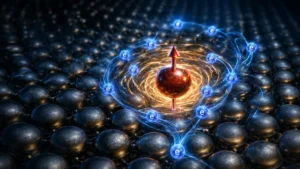
Parallel to this is the world of magnetism, which is driven by "spin"—an intrinsic form of angular momentum carried by electrons. In magnetic materials, these spins align in specific patterns. When this alignment is disturbed, the disturbance can travel through the material like a wave. These collective oscillations of electron spins are known as magnons. Historically, excitons (the domain of optics) and magnons (the domain of magnetism) were studied in isolation. The breakthrough highlighted by Menon’s team is that in van der Waals magnetic semiconductors, these two worlds are inextricably linked because they originate from the same electronic orbitals.
In these specific crystals, the same electrons that form the magnetic backbone of the material are also the ones that respond to light to form excitons. This shared ancestry allows an exciton to act as a highly sensitive probe of the magnetic environment. As Pratap Chandra Adak, a postdoctoral researcher at CCNY and the lead author of the review, noted, the exciton is no longer a passive observer. It can sense the underlying spin order and, crucially, influence the magnetic state of the material when stimulated by light.
A Chronology of Two-Dimensional Material Science
The path to this discovery has been built over two decades of intense research into low-dimensional physics. The timeline of this field provides essential context for why the current focus on vdW magnetic semiconductors is considered the "next frontier."
- 2004: The Graphene Revolution. Researchers Andre Geim and Konstantin Novoselov successfully isolated graphene, a single layer of carbon atoms. This proved that stable, two-dimensional materials could exist, sparking a global race to find other 1D and 2D substances.
- 2010–2015: Transition Metal Dichalcogenides (TMDs). Scientists began focusing on TMDs like molybdenum disulfide ($MoS_2$). While graphene was a conductor, TMDs were semiconductors, making them ideal for transistors and light-emitting applications. They were found to host exceptionally strong excitons.
- 2017: The Discovery of 2D Magnetism. For decades, the Mermin-Wagner theorem suggested that long-range magnetic order could not exist in two dimensions at finite temperatures. However, in 2017, independent teams discovered that materials like chromium triiodide ($CrI_3$) and iron germanium telluride ($Fe_3GeTe_2$) could maintain magnetism even when thinned down to a single layer.
- 2020–Present: The Integration Phase. The focus shifted from merely proving magnetism exists in 2D to exploring how that magnetism interacts with light. This is the phase currently being led by researchers like Vinod Menon.
Analyzing the Material Platforms
The review in Nature Materials categorizes several key materials that are serving as the laboratories for these quantum interactions. Each offers a unique set of properties that researchers are currently exploiting to build the foundations of magneto-photonics.
Chromium Triiodide ($CrI_3$)
$CrI_3$ was one of the first materials to demonstrate that magnetism could persist in a monolayer. In this material, researchers have observed that the way it reflects or absorbs light is tied directly to its magnetic orientation. By applying a small magnetic field, scientists can flip the spin of the atoms, which in turn causes a massive change in the light’s polarization—an effect amplified by the presence of excitons.
Nickel Phosphorus Trisulfide ($NiPS_3$)
This material belongs to a class of antiferromagnets, where neighboring electron spins point in opposite directions, resulting in no net external magnetic field. Despite having no macroscopic magnetism, $NiPS_3$ hosts "spin-correlated" excitons. These particles are so sensitive to the internal magnetic arrangement that they can be used to "see" the hidden magnetic order that traditional sensors would miss.
Chromium Sulfur Bromide ($CrSBr$)
$CrSBr$ is praised for its robustness and relatively high magnetic transition temperatures. It has become a favorite for studying the interaction between excitons and magnons at gigahertz frequencies. This material allows for the creation of "exciton-polaritons"—hybrid particles that are part-light and part-matter—which can carry information across the material’s surface at incredible speeds while being controlled by magnetic gates.
Implications for Quantum Computing and Data Storage
The marriage of light and magnetism at the atomic scale has profound implications for the future of technology. One of the most significant potential applications discussed by the CCNY team is the development of quantum transducers. In the burgeoning field of quantum networking, information is often stored in superconducting qubits that operate at microwave frequencies. However, to send that information over long distances via fiber optics, it must be converted into optical frequencies. Van der Waals magnetic semiconductors could serve as the bridge, converting magnetic (microwave) signals into optical signals with minimal loss of quantum coherence.
Furthermore, the research points toward the realization of all-optical logic and magneto-photonic memory. Currently, hard drives use magnetic heads to read and write data, a process that is mechanically limited and energy-intensive. If data could be read and written using laser pulses that interact directly with the magnetic excitons of a 2D material, the speed of data centers could increase while their energy footprint shrinks. This "spintronic" approach to computing uses the spin of the electron rather than just its charge, potentially bypassing the heating issues that currently limit the miniaturization of traditional silicon chips.
Official Responses and Collaborative Frameworks
The research conducted at CCNY is not an isolated effort but part of a global scientific push. The review co-authored by Menon and Adak includes contributions from prestigious institutions, including the Technical University of Munich, the National Laboratory of the Rockies, the University of Washington, and the Rheinland-Pfälzische Technische Universität Kaiserslautern-Landau.
Professor Vinod Menon emphasized that the field is moving out of the discovery phase and into the engineering phase. "Over the past few years, this field has moved from detecting magnetism in atomically thin crystals to actively exploring how magnetic order can control light-matter interactions," Menon stated. He noted that the primary goal of the review was to provide a roadmap for the scientific community to transition these laboratory observations into functional devices.
The work has received significant backing from the Defense Advanced Research Projects Agency (DARPA) and the Gordon and Betty Moore Foundation. These organizations view the mastery of 2D magnetic materials as a critical component of national security and economic competitiveness in the quantum era. The involvement of DARPA, in particular, highlights the potential dual-use nature of this technology, ranging from ultra-secure quantum communications for the military to next-generation consumer electronics.
Remaining Scientific Challenges
Despite the optimism, the CCNY researchers are transparent about the hurdles that remain. One of the primary challenges is the "temperature gap." Many of the most interesting effects in vdW magnetic semiconductors currently occur only at cryogenic temperatures (near absolute zero). For these materials to be used in smartphones or everyday computers, researchers must find ways to sustain these quantum interactions at room temperature.
Additionally, there is a need for more sophisticated theoretical modeling. When excitons, magnons, and phonons (lattice vibrations) all interact simultaneously, the physics becomes incredibly complex. Current mathematical models struggle to predict these interactions with high precision. The next generation of research will likely involve "Moiré physics," where two layers of 2D materials are twisted at specific angles to create interference patterns that can trap excitons and magnons in predictable grids, offering even finer control over the material’s properties.
Conclusion: A New Paradigm for Material Science
The review published by the City College of New York researchers serves as a definitive guide to a field that is redefining the boundaries of physics. By demonstrating that light and magnetism are not separate channels but a unified system within van der Waals materials, they have opened the door to a new class of "smart" materials.
As the industry moves forward, the focus will remain on identifying new material candidates and refining the ability to manipulate these quantum states with precision. The transition from classical semiconductors to magnetic van der Waals systems represents a fundamental shift in how we understand the building blocks of technology. While significant engineering challenges remain, the roadmap provided by Menon and his colleagues suggests that the future of quantum technology will be written in layers of atoms, where light and magnetism dance in perfect synchronization.