In a significant development for the field of high-energy physics, researchers at the European Organization for Nuclear Research (CERN) have announced a new measurement that further strains the prevailing framework of subatomic understanding. Using data from the Large Hadron Collider beauty (LHCb) experiment, physicists have identified a four-standard deviation discrepancy in the angular distribution of particles resulting from the decay of B mesons. This finding, published in Physical Review Letters, suggests that the Standard Model—the bedrock theory of particle physics for over half a century—may be incomplete, potentially pointing toward the existence of previously unknown particles or forces.
The Standard Model has long been hailed as one of the most successful theories in science, accurately predicting the behavior of quarks, leptons, and the bosons that carry the fundamental forces. However, despite its successes, the model remains silent on several of the universe’s greatest mysteries, including the nature of dark matter, the prevalence of matter over antimatter, and the integration of gravity at the quantum level. To resolve these gaps, scientists look for "cracks" in the model through rare decay processes, where the presence of heavy, undiscovered particles might reveal themselves through subtle quantum fluctuations.
The Nature of the Discrepancy
The focus of the recent LHCb analysis is the decay of a "beauty quark" (or b quark) into a "strange quark" (s quark) via the transformation of a B meson into a K meson and a pair of muons ($B to K^ mu^+ mu^-$). In the Standard Model, this specific decay is considered rare, occurring only through complex, higher-order quantum loops. Because the process is so infrequent, it provides an ideal "clean room" for observing New Physics. If unknown particles exist, they can enter these quantum loops as "virtual" particles, altering the trajectory and angular distribution of the resulting decay products.
The current findings indicate a four-sigma deviation from the predictions of the Standard Model. In the lexicon of particle physics, "sigma" represents the statistical significance of a result. A four-sigma result indicates a probability of approximately 0.003 percent—or 3 in 100,000—that the observed data is a mere statistical fluke. While the gold standard for claiming a definitive discovery is five sigma, a four-sigma tension is considered highly significant and warrants intense scrutiny.
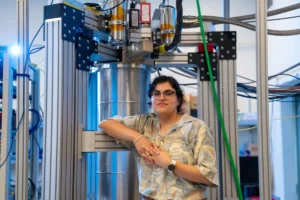
Professor Eluned Smith, an assistant professor of physics at MIT and a lead researcher on one of the two independent teams that conducted the analysis, notes that the overall angular pattern of the decay products does not align with theoretical expectations. This discrepancy suggests that either the Standard Model is missing a component, such as a new gauge boson or a leptoquark, or that the current mathematical methods for calculating strong-interaction dynamics (Quantum Chromodynamics or QCD) require refinement.
A Decade of Intrigue: The Chronology of Flavor Anomalies
This latest result does not exist in a vacuum; it is the most recent entry in a decade-long saga of "flavor anomalies" observed at the LHCb. The timeline of these observations highlights why the physics community remains cautiously optimistic about the possibility of a major breakthrough.
- 2013–2015: Early measurements of $B to K^* mu^+ mu^-$ angular distributions first showed signs of tension with the Standard Model. These early "hints" were noted in specific observables known as $P_5’$, which describes the angular relationship between the muons and the kaon.
- 2017–2019: Further analyses of lepton universality—the principle that electrons, muons, and tau particles should behave identically under the Standard Model’s forces—showed discrepancies. Measurements of $RK$ and $RK^*$ suggested that B mesons might decay into electrons more often than muons, a direct violation of the Standard Model.
- 2020–2022: While some later updates to lepton universality measurements moved closer to Standard Model predictions after more rigorous background checks, the angular distribution anomalies in $B to K^* mu^+ mu^-$ persisted.
- 2024: The current open-access analysis, involving more sophisticated data processing and independent verification by two separate teams (including the MIT-led group), confirms that the four-sigma tension remains robust despite more precise measurements and larger datasets.
The consistency of these tensions over a ten-year period, across different decay modes governed by similar underlying physics, provides a compelling case that the observations are not merely errors in data collection but signals of a deeper physical reality.
Supporting Data and Experimental Rigor
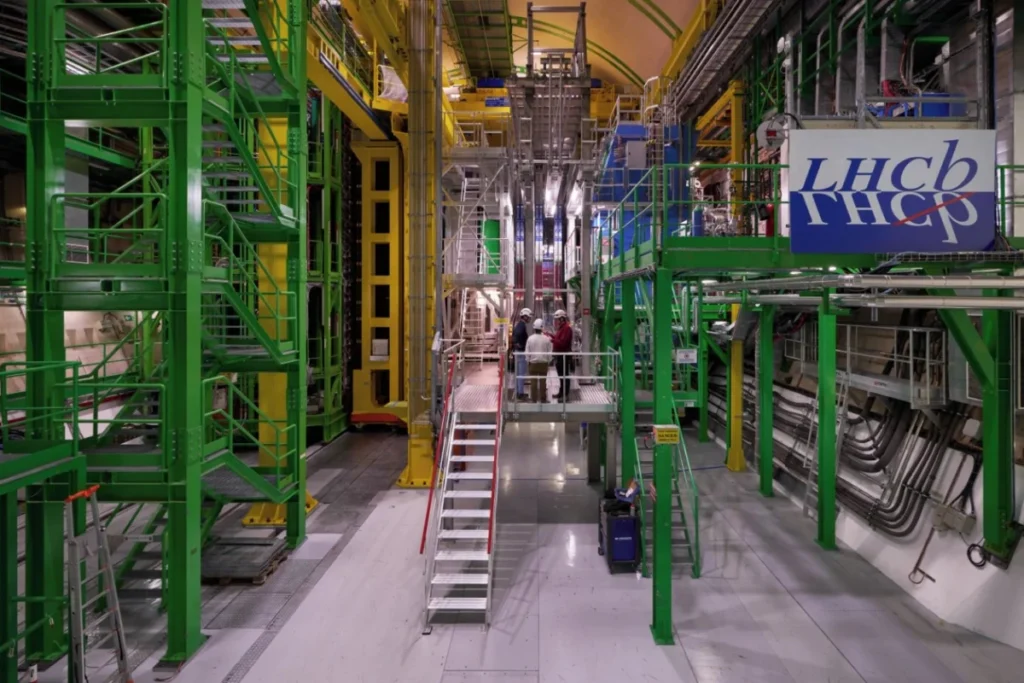
The LHCb detector is a specialized "forward spectrometer" at the Large Hadron Collider, designed specifically to study particles containing the beauty quark. Because b quarks are relatively heavy and have a long lifetime compared to other unstable particles, they travel a measurable distance before decaying. This allows the LHCb to reconstruct their decay vertices with extreme precision.
In the study published in Physical Review Letters, the teams employed a "blind" analysis technique. This involves masking the data or the results during the processing phase to prevent researcher bias. The work was performed independently by two teams to ensure that the findings were not the result of a specific software error or an idiosyncratic interpretation of the data.
One of the key challenges in this analysis is accounting for "hadronic uncertainties." The quarks involved in the decay are bound by the strong force, and calculating how they interact at low energies is notoriously difficult. Some theorists argue that the observed four-sigma discrepancy could be explained by "charm loops"—interactions where virtual charm quarks affect the decay. However, the specific angular patterns observed in this latest measurement are harder to reconcile with charm loop theories than previous measurements, making the "New Physics" explanation more viable.
Potential Theoretical Implications
If the four-sigma discrepancy is confirmed to be New Physics, it would necessitate a radical expansion of the Standard Model. Two primary theoretical candidates are often cited as potential culprits:
- Z’ Bosons: These are hypothetical, heavy versions of the Z boson (which mediates the weak force). A Z’ boson could interact differently with different "generations" of quarks, explaining why the beauty quark (third generation) shows more sensitivity to these effects than the up or down quarks (first generation).
- Leptoquarks: These are theoretical particles that would bridge the gap between quarks and leptons. They would carry both color charge (like quarks) and lepton number (like electrons and muons). Leptoquarks are a common feature in many Grand Unified Theories (GUTs) that attempt to merge the fundamental forces.
The fact that beauty quarks are significantly heavier than the quarks that make up everyday matter (protons and neutrons) is crucial. Most theoretical models suggest that potential new forces or particles would couple more strongly to heavier generations of matter, making the LHCb’s focus on the beauty quark a high-priority search area.
The Path Forward: AI and Technological Upgrades
The search for the elusive "fifth force" or new particle is now entering a high-velocity phase. The LHC is currently in its third run (Run 3), operating at higher energies and higher luminosity than ever before. To handle the deluge of data, the LHCb experiment has undergone a massive upgrade.
A central component of this upgrade is a fully software-based real-time event selection system, or "trigger." In previous runs, the experiment used hardware triggers that discarded a significant amount of potentially useful data to keep up with the collision rate. The new system allows for a much higher retention rate of beauty-hadron decays, which will significantly reduce statistical uncertainties in the coming years.
Professor Smith and her colleagues are already looking toward the future with "LHCb Upgrade II." This phase will involve developing low-latency Artificial Intelligence (AI) systems capable of performing real-time data processing and compression directly within the detector’s front-end electronics. These AI systems are essential for managing the radiation-intense environment and the massive data flow, which is expected to increase by a factor of 40 compared to the original detector. Such advancements will allow physicists to observe rare decays with a level of sensitivity that was previously thought impossible.
Official Responses and Scientific Consensus
The reaction from the global physics community has been one of "guarded excitement." While the four-sigma result is powerful, physicists are mindful of the "Look-Elsewhere Effect," where searching through many different variables can occasionally produce a statistical outlier.
In statements regarding the find, researchers at CERN emphasized the importance of the independent verification process. By having two teams—including the MIT-Laboratory for Nuclear Science group—reach the same conclusion using different methodologies, the LHCb collaboration has demonstrated a high level of confidence in the robustness of the measurement.
The scientific consensus is that the next three to five years will be decisive. As the Run 3 data is analyzed, the statistical significance will either climb toward the five-sigma discovery threshold or regress toward the Standard Model mean. Simultaneously, theoretical physicists are working to improve the precision of their QCD calculations to ensure that the "Standard Model expectations" are as accurate as possible.
Conclusion: A New Era of Discovery
The discovery of a four-sigma discrepancy in beauty quark decays represents a pivotal moment in modern physics. Whether it ultimately leads to the discovery of a new particle or a profound revision of how we calculate the behavior of quarks, it highlights the limits of our current understanding of the universe.
The work led by Professor Eluned Smith and the LHCb collaboration underscores the importance of precision measurement in the search for the unknown. In the vast, high-energy collisions of the Large Hadron Collider, the most significant secrets of the universe may not be found in the loudest explosions, but in the subtle, angular shifts of the rarest subatomic dances. As data continues to accumulate and AI-driven technologies refine our view of the quantum world, the "cracks" in the Standard Model may soon open the door to a new era of physics.