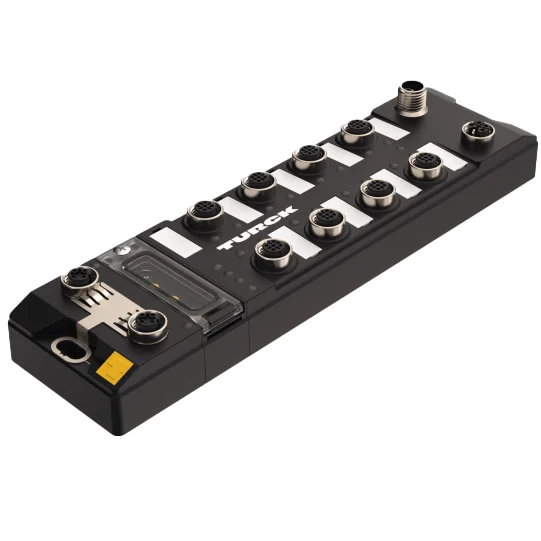
TURCK, a global leader in industrial automation, has provided a comprehensive preview of its latest innovation, the TBEN-LLH-4RMC, a compact multiprotocol Ethernet I/O module specifically engineered for the sophisticated control and seamless integration of conveyor roller motors. This groundbreaking module is poised to significantly enhance material handling and intralogistics applications across various industrial sectors. Scheduled for its official launch in the United States during the second quarter of 2026, the TBEN-LLH-4RMC represents a strategic advancement in decentralized automation, promising to streamline operations, reduce complexity, and bolster system flexibility for manufacturers and system integrators.
The TBEN-LLH-4RMC is meticulously designed to address the evolving demands of modern conveyor systems, which are foundational to efficiency in intralogistics, packaging, and diverse manufacturing environments. These sectors increasingly require robust motor control, adaptable system architectures, and exceptional durability to withstand rigorous operational conditions. TURCK’s new module offers a compelling solution by combining onboard logic, a comprehensive suite of I/O functions, and a ruggedized housing, enabling powerful field-level control directly at the point of application. This approach minimizes the traditional reliance on centralized Programmable Logic Controllers (PLCs) and dramatically simplifies wiring infrastructures, leading to substantial reductions in both installation time and ongoing maintenance requirements.
The Imperative for Decentralized Automation in Modern Intralogistics
The global intralogistics market, estimated to be worth hundreds of billions of dollars and growing at a significant CAGR (Compound Annual Growth Rate), is undergoing a profound transformation driven by the explosion of e-commerce, the imperative for faster supply chains, and the widespread adoption of Industry 4.0 principles. This transformation places immense pressure on traditional material handling systems to become more agile, scalable, and resilient. Centralized control architectures, while historically reliable, often present bottlenecks in terms of wiring complexity, commissioning time, and vulnerability to single points of failure. A malfunction in a central PLC can bring an entire production line or distribution center to a halt, incurring significant financial losses and operational disruptions.
Decentralized automation, championed by solutions like the TBEN-LLH-4RMC, offers a compelling alternative. By distributing intelligence and control closer to the field devices—in this case, individual conveyor roller motors—systems gain inherent modularity and fault tolerance. Each module can manage a localized segment of the conveyor, operating semi-autonomously while still communicating with higher-level control systems. This paradigm shift not only reduces the complexity of the main PLC program but also simplifies troubleshooting, as issues can often be isolated to specific modules or sections of the conveyor. Furthermore, it enables more granular control over individual motor behavior, optimizing energy consumption and throughput.

Key Features and Technical Specifications of the TBEN-LLH-4RMC
The TBEN-LLH-4RMC stands out with a suite of features engineered to meet the stringent requirements of industrial automation:
- Compact Multiprotocol Ethernet I/O: At its core, the module supports leading industrial Ethernet protocols, including EtherNet/IP, PROFINET, and Modbus TCP. This multiprotocol capability is critical for system integrators, providing unparalleled flexibility to deploy the module in diverse network environments without needing protocol-specific hardware. This significantly reduces inventory complexity and simplifies system design across various customer requirements. The compact form factor ensures easy integration even in space-constrained applications, a common challenge in dense conveyor layouts.
- Onboard Logic for Edge Control: The inclusion of onboard logic is a defining feature, transforming the module from a simple I/O device into an intelligent edge controller. This allows for localized decision-making and control functions to be executed directly within the module, reducing latency and offloading processing demands from the central PLC. For instance, the module can manage start/stop sequences, speed adjustments, and error handling for individual roller motors based on local sensor inputs, without constant communication with the main controller. This "intelligence at the edge" capability is a cornerstone of modern Industry 4.0 architectures.
- Integrated I/O Functions: While specific I/O types were not fully detailed in the preview, it can be inferred that the module will offer a comprehensive range of inputs and outputs necessary for conveyor motor control. This typically includes digital inputs for connecting sensors (e.g., photo-electric sensors for product detection, emergency stop buttons), and digital outputs for controlling motor contactors or integrated motor drives. The ability to integrate these functions directly within a single module further consolidates hardware, reduces wiring, and simplifies system architecture.
- Ruggedized Housing: Designed for the harsh realities of industrial environments, the TBEN-LLH-4RMC features a robust housing that provides protection against dust, moisture, vibration, and temperature fluctuations. This durability ensures reliable operation and a long service life, minimizing the need for costly replacements and reducing downtime in critical material handling applications. The industrial-grade construction is essential for maintaining operational integrity in logistics hubs, manufacturing floors, and packaging lines where environmental conditions can be challenging.
- Simplified Wiring and Installation: One of the most significant operational benefits is the reduction in wiring complexity. By integrating multiple functions into a single, compact module, and supporting decentralized control, the TBEN-LLH-4RMC drastically cuts down on the amount of cabling required between field devices and the central control cabinet. This simplification not only reduces material costs but also slashes installation labor, leading to faster commissioning times and fewer potential points of failure due to wiring errors.
A Phased Introduction: Preview to Q2 2026 U.S. Launch
The preview of the TBEN-LLH-4RMC signals TURCK’s commitment to continuous innovation and its responsive approach to market needs. This strategic preview allows potential customers, system integrators, and industry partners to gain early insight into the module’s capabilities, facilitating preliminary design considerations and integration planning well in advance of its commercial availability.
The decision to target a Q2 2026 U.S. launch suggests a well-structured product rollout strategy. Typically, after a preview, manufacturers engage in further refinement based on initial feedback, conduct extensive field testing to ensure robust performance under real-world conditions, and prepare their supply chain and sales channels for a smooth market entry. The U.S. market, with its vast logistics infrastructure and advanced manufacturing sector, represents a critical demographic for this type of technology. A phased global rollout often follows, leveraging lessons learned from initial deployments.
Inferred Industry Reactions and Expert Analysis
The announcement of the TBEN-LLH-4RMC is expected to generate positive reactions across the industrial automation landscape. Industry analysts are likely to highlight the module as a testament to the ongoing trend towards distributed intelligence and the practical application of Industrial Internet of Things (IIoT) principles.
"TURCK’s TBEN-LLH-4RMC is a timely response to the increasing demand for smarter, more flexible conveyor systems," stated Dr. Alistair Finch, a senior analyst specializing in industrial automation. "By embedding logic and multiprotocol capabilities directly into the I/O module, TURCK is empowering system integrators to build highly modular and scalable material handling solutions. This move away from purely centralized control architectures is critical for achieving the agility and resilience required in today’s fast-paced supply chains."

A representative from a leading system integration firm, preferring to remain anonymous due to competitive reasons, commented, "Solutions that simplify wiring and offer decentralized control are invaluable to our projects. The promise of reduced installation time and easier maintenance with a robust, multiprotocol module like the TBEN-LLH-4RMC is very appealing. It could significantly cut down on project lead times and operational costs for our clients in warehousing and manufacturing."
From TURCK’s perspective, this module reinforces their position as a forward-thinking provider of industrial connectivity and automation solutions. A hypothetical statement from a TURCK spokesperson might emphasize the customer-centric design: "The TBEN-LLH-4RMC embodies our commitment to delivering cutting-edge solutions that directly address our customers’ operational challenges. We understand the pressures on efficiency and flexibility in material handling, and this module is engineered to provide a powerful, yet simple, pathway to optimized conveyor systems. We are excited about its potential to revolutionize intralogistics applications and look forward to its U.S. launch in Q2 2026."
Broader Implications and Future Outlook
The introduction of the TBEN-LLH-4RMC carries significant implications for the future of material handling and industrial automation:
- Accelerated Adoption of Industry 4.0: This module facilitates the practical implementation of Industry 4.0 concepts by bringing intelligence closer to the machines. It enables more granular data collection, local processing, and responsive control, forming a critical component of smart factories and intelligent warehouses.
- Enhanced System Modularity and Scalability: The decentralized nature of the TBEN-LLH-4RMC means that conveyor systems can be designed and expanded with greater ease. New sections can be added or reconfigured without overhauling the entire control architecture, offering unparalleled flexibility to adapt to changing production needs or warehouse layouts.
- Cost Reduction and ROI: The combined benefits of simplified wiring, reduced installation time, lower maintenance requirements, and decreased reliance on expensive central PLCs translate into tangible cost savings and a faster return on investment for end-users. Improved operational efficiency and reduced downtime further contribute to a more profitable operation.
- Sustainability and Energy Efficiency: By enabling more precise control over individual motors, the module can contribute to optimized energy consumption. Motors can be run only when necessary or at the most efficient speed for the current load, aligning with broader industry goals for sustainable manufacturing.
- Competitive Landscape: This advanced I/O module positions TURCK strongly in a competitive market segment. By offering a comprehensive solution that combines connectivity, control, and ruggedness, TURCK differentiates itself and provides a compelling value proposition to industries heavily reliant on conveyor technology.
As industries continue to grapple with labor shortages, supply chain disruptions, and the constant pressure for increased efficiency, intelligent automation solutions like the TURCK TBEN-LLH-4RMC will become indispensable. Its forthcoming launch in the U.S. in Q2 2026 will mark a significant milestone in the evolution of conveyor control, setting a new standard for decentralized intelligence and operational excellence in material handling and intralogistics applications. For further details on this innovative product and TURCK’s broader portfolio, interested parties are encouraged to visit turck.us.