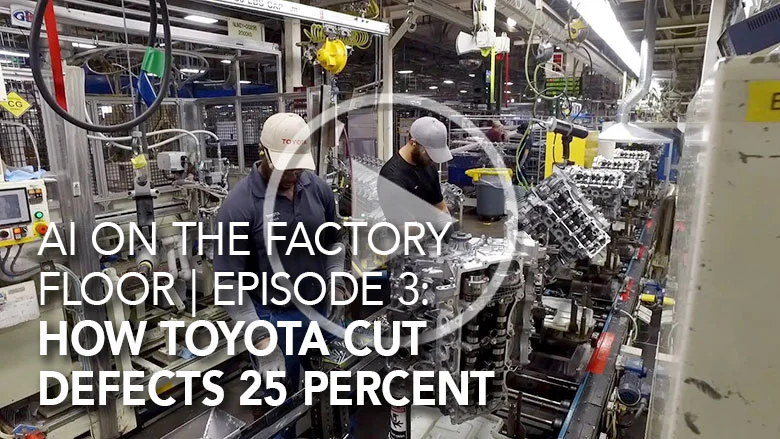
BIRMINGHAM, Mich. – Even manufacturers with decades of unparalleled quality expertise are discovering significant, previously hidden production improvements through the strategic application of artificial intelligence (AI) to well-organized factory data. This transformative potential was recently underscored by Toyota Industries Corporation, a global leader synonymous with manufacturing excellence, which demonstrated a remarkable 25% reduction in paint defects by leveraging AI-ready manufacturing data. This landmark achievement, detailed in a case study published in collaboration with Microsoft and Sight Machine, highlights a pivotal shift in how even the most established industrial giants approach continuous improvement.
The revelation comes from Jon Sobel, co-founder and CEO of Sight Machine, a company specializing in manufacturing data platforms. Sobel emphasized the profound significance of this accomplishment, stating, "This is from the company that established modern quality. They are very, very good at making cars, and very, very good at understanding quality." This commendation is not merely anecdotal; Toyota Industries, a member of the broader Toyota Group, has a long-standing legacy of pioneering manufacturing methodologies such as the Toyota Production System (TPS), which includes foundational concepts like "Jidoka" (automation with a human touch) and "Kaizen" (continuous improvement). For such a quality-driven organization to find substantial, quantifiable improvements through AI speaks volumes about the technology’s capacity to push boundaries thought to be impenetrable.
The Pinnacle of Quality Meets AI: Toyota’s Enduring Legacy
Toyota Industries Corporation’s reputation for quality is not merely an industry standard; it is an economic phenomenon. Tracing its roots back to Sakichi Toyoda’s invention of the automatic loom in 1924, the company evolved to become a diversified manufacturing powerhouse, producing everything from engines and car air-conditioning compressors to materials handling equipment like forklifts, alongside automotive components. Its contributions to the automotive sector, while often overshadowed by Toyota Motor Corporation, are fundamental, encompassing critical components and manufacturing processes that uphold the brand’s global renown for reliability and durability.
The Toyota Production System (TPS), developed post-World War II, revolutionized global manufacturing with its focus on eliminating waste (Muda), overburden (Muri), and unevenness (Mura), alongside principles like Just-in-Time production and autonomation. These principles have been meticulously refined over decades, leading to consistently high product quality that has become a benchmark across industries. Given this deeply ingrained culture of precision and relentless pursuit of perfection, the notion that AI could still unearth substantial improvements in a process as refined as automotive paint application is a testament to the technology’s analytical power. It suggests that even the most optimized human-driven systems possess layers of complexity that conventional observation and statistical process control might miss.
Unveiling Hidden Relationships: How AI Works in the Paint Shop
The core of AI’s effectiveness in the Toyota Industries case study lies in its ability to identify intricate relationships within massive datasets—relationships that are virtually impossible for human observation or traditional statistical methods to detect. Jon Sobel explained that while experienced engineers often develop strong instincts and hypotheses about the causes of manufacturing problems, AI offers an unprecedented capacity to validate these intuitions and, critically, uncover entirely new insights.
In the complex environment of Toyota Industries’ paint shop, AI was deployed to analyze thousands of production variables. This included not only direct process parameters like spray pressure, paint viscosity, and curing temperatures, but also a myriad of environmental conditions such as temperature, humidity, and crucially, air ionization levels. The AI models, fed with vast quantities of real-time and historical data, identified a direct correlation between specific environmental conditions, particularly air ionization, and the incidence of paint defects.
This finding was revolutionary. While engineers might have suspected the influence of environmental factors, quantifying their precise impact and identifying specific triggers like air ionization levels, which can affect static charge on surfaces and particle adhesion, was beyond the scope of manual analysis. The AI acted as a super-detective, sifting through noise to pinpoint causal links that were too subtle or multi-faceted for human cognition alone. As Sobel articulated, "A lot of experienced operators and engineers intuitively have these hypotheses and understand things. But there’s nothing like having the data confirm that hypothesis or tell you a new thing that you might not have thought about." This discovery not only allowed Toyota Industries to validate existing hypotheses but also to uncover additional, previously unknown factors contributing to defects, thereby enabling targeted interventions that led to the significant 25% reduction.
A Collaborative Triumph: Sight Machine and Microsoft’s Role
The success of this initiative was a result of a powerful collaboration. Sight Machine provided its specialized manufacturing data platform, which is designed to ingest, standardize, and contextualize data from disparate factory systems—a critical step in making data "AI-ready." Factories are notoriously complex, featuring a patchwork of operational technology (OT) systems (PLCs, SCADA, sensors) and information technology (IT) systems (MES, ERP). Sight Machine’s platform acts as the bridge, harmonizing this diverse data into a unified, analyzable format.
Microsoft, through its Azure cloud platform and AI services, provided the scalable computing infrastructure and advanced analytics capabilities necessary to process and derive insights from this colossal dataset. Azure’s robust ecosystem of AI tools, machine learning algorithms, and data analytics services enabled the rapid development and deployment of the predictive models that identified the defect causes. This partnership underscores a growing trend where specialized industrial AI firms leverage hyperscale cloud providers to deliver powerful, scalable solutions to complex manufacturing challenges. Microsoft’s vision for industrial IoT and AI centers on empowering manufacturers to accelerate their digital transformation, and the Toyota Industries case study serves as a compelling validation of this strategy.
The Data Challenge in Manufacturing: Paving the Way for AI Adoption
One of the significant hurdles in deploying AI in manufacturing has historically been the fragmented and unstructured nature of factory data. Operational technology (OT) systems, designed for real-time control, often lack the connectivity and standardization required for enterprise-wide analytics. Sensors generate vast streams of raw data, but without proper context and integration, this "dark data" remains untapped. The concept of "AI-ready manufacturing data" is therefore crucial. It involves:
- Data Ingestion: Connecting to a multitude of factory devices, sensors, and legacy systems.
- Data Normalization and Contextualization: Standardizing disparate data formats, adding timestamps, and linking data points to specific products, batches, and processes.
- Data Lake/Warehouse: Storing this integrated data in a scalable and accessible manner.
- Feature Engineering: Transforming raw data into meaningful features that AI models can learn from.
The ability of Sight Machine’s platform to streamline this complex data pipeline was instrumental. It transformed raw, disparate factory data into a cohesive, intelligent data fabric, allowing Microsoft’s AI algorithms to perform sophisticated pattern recognition and causal analysis. This infrastructure work is often the unsung hero of industrial AI projects, laying the groundwork for the impressive results seen at Toyota Industries.
Beyond Instinct: Augmenting Human Expertise, Not Replacing It

A common apprehension surrounding AI’s integration into traditional industries is the fear of job displacement. However, Jon Sobel firmly refutes this notion, positioning AI not as a replacement for human manufacturing expertise but as a powerful augmentation tool. "Rather than replacing manufacturing expertise," Sobel stated, "AI serves as another analytical tool for experienced engineers."
This perspective aligns with the concept of "augmented intelligence," where AI enhances human capabilities rather than substituting them. In the Toyota Industries paint shop, AI did not replace the engineers; instead, it provided them with deeper, more granular insights that allowed them to make more informed decisions and implement more effective solutions. The engineers’ deep domain knowledge was essential for interpreting the AI’s findings, validating hypotheses, and designing the practical interventions. AI acted as an extension of their senses, allowing them to perceive relationships and patterns that were invisible to the unaided human mind, even one honed by decades of experience.
"We think of data and AI as being another next-generation tool in the hands of experts that lets them go deeper and farther than they could with their own senses," Sobel elaborated. This synergy between human intuition and AI’s analytical power represents the future of manufacturing, fostering new roles such as "AI-savvy engineers" or "manufacturing data scientists" who can bridge the gap between operational excellence and advanced computational analysis.
The Broader Landscape of Industrial AI: A New Era for Manufacturing
The success at Toyota Industries is not an isolated incident but a powerful indicator of a broader trend: the accelerating adoption of AI in manufacturing. The global industrial AI market, valued at approximately $2 billion in 2022, is projected to grow exponentially, reaching an estimated $16 billion by 2030, driven by the compelling benefits it offers across various facets of production.
Beyond quality control, AI is being deployed for:
- Predictive Maintenance: Analyzing sensor data from machinery to predict equipment failures before they occur, reducing downtime and maintenance costs.
- Supply Chain Optimization: Improving demand forecasting, inventory management, and logistics to enhance efficiency and resilience.
- Generative Design: AI algorithms generate multiple design options for parts and products, optimizing for factors like material usage, strength, and manufacturability.
- Robotics and Automation: Enhancing the intelligence and adaptability of robots, enabling them to perform more complex tasks and collaborate more effectively with humans.
- Process Optimization: Continuously tuning production parameters in real-time to maximize throughput and minimize energy consumption.
The automotive industry, in particular, is a fertile ground for AI due to its high volume, complex processes, and stringent quality demands. Companies worldwide are investing heavily in AI to maintain competitiveness, improve efficiency, and respond more rapidly to market changes. The Toyota Industries case serves as a beacon, illustrating the tangible, bottom-line benefits that even the most advanced manufacturers can reap.
Implications for the Automotive Sector: Reshaping Quality and Efficiency
The 25% reduction in paint defects achieved by Toyota Industries carries significant implications for the broader automotive sector. Paint defects, while seemingly minor, are a major source of rework, waste, and customer dissatisfaction in vehicle manufacturing. They can lead to:
- Increased Production Costs: Rework requires additional labor, materials, and energy.
- Extended Production Cycles: Defect rectification adds time to the manufacturing process.
- Material Waste: Defective parts often need to be scrapped or repainted, leading to material waste.
- Environmental Impact: Repainting processes consume more energy and generate additional volatile organic compounds (VOCs).
- Reputational Damage: Even minor cosmetic defects can negatively impact a brand’s perception of quality.
A 25% reduction directly translates to substantial cost savings, improved throughput, and a reduction in environmental footprint. More importantly, it demonstrates a pathway for the entire industry to elevate its quality standards to unprecedented levels. As AI becomes more sophisticated and accessible, it is poised to become a standard tool in every automotive plant, driving a new era of manufacturing precision and efficiency. This could lead to faster product launches, more consistent quality across global manufacturing sites, and ultimately, greater customer satisfaction.
Economic and Environmental Impact: A Dual Benefit
The economic benefits of AI-driven defect reduction are clear: less rework, lower material costs, and increased operational efficiency directly boost profitability. For an industry operating on tight margins, these improvements are not just incremental; they can be transformative. The ability to identify and rectify issues proactively, rather than reactively, fundamentally changes the cost structure of manufacturing.
Beyond economics, there’s a significant environmental impact. Reduced defects mean less waste—fewer materials consumed for rework, less energy expended in reprocessing, and a smaller carbon footprint associated with production. In an era of increasing focus on sustainability and corporate social responsibility, AI offers a powerful tool for manufacturers to meet their environmental goals while simultaneously enhancing their bottom line. The Toyota Industries example illustrates how technological advancement can drive both economic prosperity and environmental stewardship, aligning business objectives with broader societal values.
The Future of Manufacturing: A New Paradigm
The success story from Toyota Industries, Microsoft, and Sight Machine marks a significant milestone in the ongoing digital transformation of manufacturing. It demonstrates that even companies at the zenith of operational excellence can find new frontiers of improvement through advanced technologies like AI. This isn’t about replacing the human touch that has defined Toyota’s quality for decades; it’s about augmenting it with an analytical capacity that transcends human limitations.
As factories become increasingly digitized and interconnected, the volume and velocity of data will only grow. The ability to harness this data with AI will be a defining characteristic of leading manufacturers in the 21st century. The future of manufacturing lies in this sophisticated blend of traditional craftsmanship, lean principles, and cutting-edge artificial intelligence, creating a new paradigm where continuous improvement is driven by both human ingenuity and machine intelligence, pushing the boundaries of what is possible in quality, efficiency, and innovation.