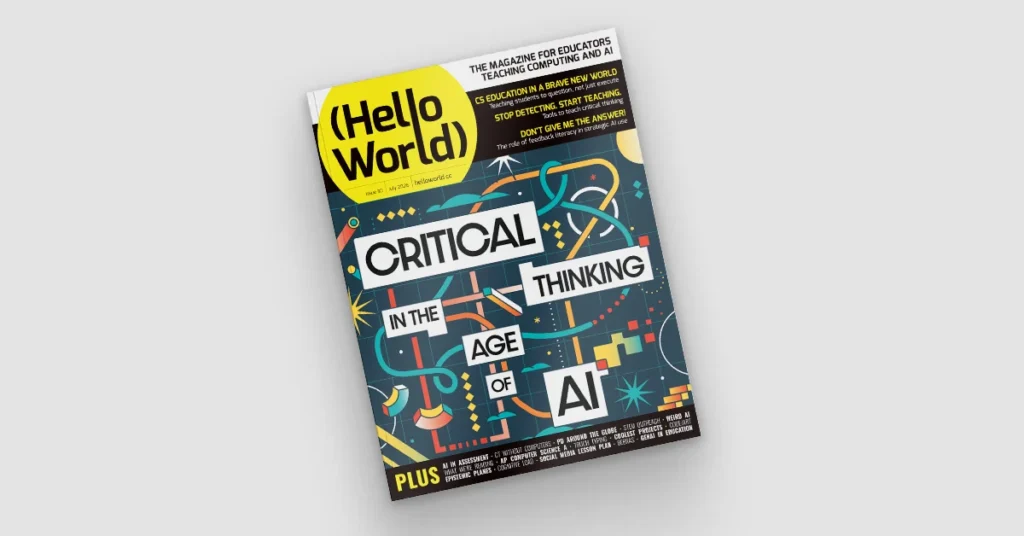
The rapid proliferation of generative artificial intelligence has fundamentally altered the landscape of modern education and personal decision-making, prompting a renewed focus on the preservation of human critical thinking. As data-driven tools become increasingly integrated into daily life, from predictive text in communications to algorithmic recommendations in entertainment and finance, the Raspberry Pi Foundation has released the 30th issue of Hello World magazine to address the growing concern of "cognitive outsourcing." This latest installment, accompanied by a new podcast mini-series, provides a comprehensive framework for educators and individuals to navigate a world where AI systems often prioritize efficiency over deep understanding. The publication asserts that while AI can provide instant answers, the responsibility for evaluating the accuracy, ethics, and context of those answers remains a uniquely human endeavor.
The evolution of digital tools has moved from simple automation to complex decision-making support, creating a paradox of convenience. While predictive features allow for faster messaging and curated content feeds reduce the effort required to discover new media, they also risk atrophying the mental muscles required for independent thought. The Raspberry Pi Foundation’s latest initiative highlights that the "accidental delights" of manual exploration—such as navigating a city without a GPS or the meticulous process of comparing insurance policies—are not merely nostalgic activities but essential exercises in critical thinking. In the context of the classroom, the challenge for educators has shifted from teaching students how to find information to teaching them how to scrutinize the information that is now delivered to them instantaneously by AI chatbots.
A Chronology of AI Integration in the Educational Sector
The journey toward the current state of AI in education has been marked by several key milestones over the last decade. In the early 2010s, the focus was primarily on "digital literacy," which involved basic competency in using computers and navigating the internet. By 2017, the rise of machine learning began to influence educational software, offering personalized learning paths for students. However, the landscape shifted dramatically in late 2022 with the public release of large language models (LLMs) like ChatGPT. This sparked an immediate debate within the academic community regarding academic integrity and the future of assessment.
By 2023, educational bodies worldwide began moving from a stance of prohibition to one of integration. Organizations like the Computer Science Teachers Association (CSTA) in the United States and the National Centre for Computing Education (NCCE) in the United Kingdom started developing guidelines for the ethical use of AI. The release of Hello World issue 30 in mid-2024 represents a pivotal point in this chronology, moving beyond the technical mechanics of AI to focus on the pedagogical implications of living in an AI-saturated society. This timeline reflects a transition from seeing AI as a tool for "coding" to viewing it as a fundamental shift in how humans process knowledge and make decisions.
Supporting Data on AI Adoption and the Literacy Gap
Recent data underscores the urgency of the themes explored in Hello World. According to a 2023 survey by the Pew Research Center, roughly 19% of employed U.S. adults reported that AI had a major impact on their jobs, a number that is expected to rise as generative AI becomes more sophisticated. In the educational sector, a report by Forbes Advisor indicated that 60% of educators use AI in the classroom, yet a significant gap remains in formal training. Many teachers report feeling confident in using the tools but less certain about how to teach the underlying logic or the ethical pitfalls of algorithmic bias.
Furthermore, research into "cognitive load theory" suggests that while AI can reduce the effort required for mundane tasks, it can also lead to "cognitive offloading." A study published in the journal Nature Human Behaviour found that reliance on digital reminders and search engines can reduce the likelihood of long-term memory formation. This data supports the argument made in Hello World that educators must manage cognitive load carefully—using AI to remove "busy work" while ensuring that the "desirable difficulties" of learning remain intact to foster deeper thinking.
The CSTA K-12 Standards and Professional Development
A centerpiece of the new discourse in Hello World is the contribution from the Computer Science Teachers Association (CSTA) regarding their newly rewritten K–12 Standards. These standards are research-backed and designed to prepare students for a future where AI is ubiquitous. The framework emphasizes that computer science education must find a new balance; students need to learn to direct AI rather than be directed by it. Amanda O’Mara, Smita Kolhatkar, and Tiffany Jones, contributors to the issue, argue that understanding and evaluating answers generated by AI requires a higher level of human judgment than traditional information retrieval.
The publication also tackles the critical issue of professional learning for teachers. It argues that AI training for educators should not merely focus on the technical proficiency of using new platforms. Instead, it must build a teacher’s ability to critically analyze the tools themselves. This includes understanding "whose knowledge" is shaping the AI—addressing the inherent biases in the datasets used to train these models. By empowering teachers with this critical lens, they can better guide students in identifying misinformation and understanding the socio-economic implications of automated systems.
Official Responses and Expert Perspectives
The educational community has responded with a mixture of caution and optimism to the themes presented in the latest Raspberry Pi Foundation initiatives. Educational theorists have noted that the role of the teacher is evolving from a "source of knowledge" to a "facilitator of critical inquiry." In the issue, educators share insights on what they "bring to the table" when teaching with digital technologies, emphasizing that the human element of empathy, ethics, and contextual understanding cannot be replicated by silicon.
Oracle, the sponsor of the issue, has also signaled its support for initiatives that bridge the gap between technical skill and critical evaluation. Industry leaders generally agree that the future workforce will require "AI fluency"—not just the ability to prompt a machine, but the ability to audit the machine’s output for accuracy and fairness. This sentiment is echoed by the team at Hello World, who suggest that computing education is uniquely situated to cultivate a mindset of thoughtful engagement with daily-use AI tools.
Broader Impact and Global Implications
The implications of "outsourcing our thinking" extend far beyond the classroom. In a democratic society, the ability to think critically is a foundational requirement for informed citizenship. If individuals rely on AI to curate their news, write their correspondence, and form their opinions, the risk of algorithmic echo chambers and the spread of automated propaganda increases. The Raspberry Pi Foundation’s focus on critical thinking serves as a grassroots effort to mitigate these risks by starting with the next generation of digital citizens.
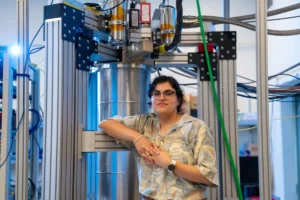
The issue also explores diverse applications of technology that encourage active rather than passive engagement. For instance, the inclusion of articles on "Flatgames" and "predictive classroom systems" shows how technology can be used as a medium for creative expression and administrative efficiency without sacrificing human agency. A featured project combining physics and technology illustrates how AI and digital tools can be used to model the physical world, provided the user understands the underlying scientific principles.
In conclusion, the release of Hello World issue 30 and its accompanying podcast series marks a significant contribution to the global conversation on AI. By advocating for a "human-in-the-loop" approach, the Raspberry Pi Foundation and its partners are asserting that the value of education in the 21st century lies not in the speed of information acquisition, but in the depth of information evaluation. As AI systems continue to move at "supersonic speed," the need for a deliberate, slow, and critical approach to learning has never been more vital. The resources provided in this issue—ranging from research-backed articles to practical classroom strategies—offer a roadmap for educators to ensure that while students may use AI to write more quickly or find information faster, they never outsource the fundamental act of thinking.