For decades, the intricate process of analyzing the chemical composition of materials has been predominantly confined to laboratories, necessitating the use of large, expensive, and often cumbersome instruments known as spectrometers. These foundational tools are indispensable across a vast spectrum of applications, from the precise diagnosis of diseases and rigorous food quality inspection to critical environmental pollution monitoring and advanced material science research. Traditional spectrometers operate on a fundamental principle: they disperse light into its constituent wavelengths, typically using optical components like prisms or diffraction gratings, and then measure the intensity of each individual color. This method, while highly effective, inherently demands a specific optical path length for light to travel, contributing significantly to the instruments’ bulkiness and presenting a formidable challenge to any efforts at miniaturization.
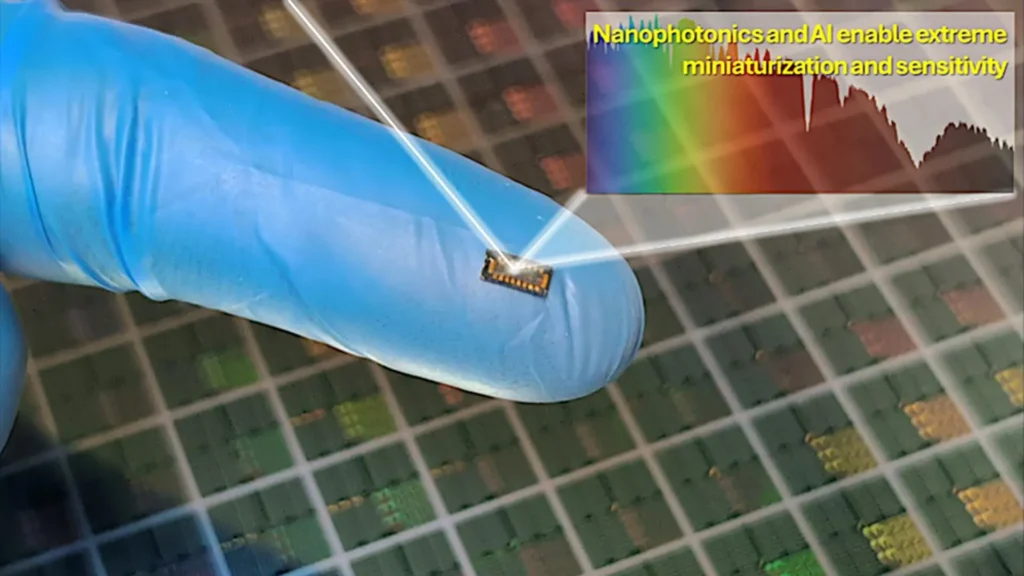
In a groundbreaking development poised to dramatically redefine the landscape of analytical instrumentation, researchers at the University of California Davis (UC Davis) have engineered an astonishingly smaller alternative. Their pioneering work, detailed in a recent publication in the prestigious journal Advanced Photonics, describes the creation of a spectrometer-on-a-chip so minuscule it approaches the dimensions of a single grain of sand. This innovative system eschews the conventional reliance on large optical components for the physical separation of light. Instead, it harnesses the power of artificial intelligence (AI) in conjunction with a compact array of specially engineered sensors to computationally reconstruct the complete light spectrum, ushering in an era of unprecedented portability and accessibility for spectroscopic analysis.
The Paradigm Shift: From Bulky Optics to AI-Driven Analysis
The core innovation behind the UC Davis chip lies in its radical departure from the established spectroscopic methodology. Rather than attempting to physically spread light into a rainbow, a process that invariably demands significant physical space, the new device employs a sophisticated array of 16 distinct silicon detectors. Each of these detectors is meticulously designed to exhibit a subtly unique and differentiated response to incoming light. Consequently, instead of directly isolating individual colors, these detectors collect a series of complex, encoded signals that collectively harbor the latent spectral information of the incident light.
To conceptualize this novel approach, one might liken the system to a panel of highly specialized tasters, each possessing a distinct palate, sampling different nuances of the same intricate culinary mixture. Individually, any single detector only captures a fragment of the complete spectral picture. However, when their collective outputs are synergistically combined, they generate a rich dataset of information – a unique "fingerprint" – that is sufficiently comprehensive for a sophisticated AI algorithm to accurately and precisely reconstruct the original light spectrum.
The second, equally critical component of this revolutionary system is a fully connected neural network. This AI model undergoes an intensive training regimen, learning from thousands upon thousands of examples where known light spectra are correlated with the corresponding encoded signals produced by the 16 silicon detectors. Given that the raw detector signals are inherently noisy and highly encoded, the neural network’s profound capability lies in its ability to discern and learn the intricate, non-linear relationship between these complex input signals and the actual, underlying spectrum of light. This computational prowess enables the system to effectively solve what researchers term an "inverse problem" – inferring the cause (the light spectrum) from its observed effects (the detector signals). Through this AI-driven process, the spectrometer-on-a-chip is capable of reproducing spectral data with an impressive accuracy, achieving a resolution of approximately 8 nanometers, all without requiring any bulky, traditional optical hardware.
Overcoming Silicon’s Limitations: Expanding into the Infrared Range
A significant technological hurdle in the development of compact and versatile spectrometers has historically been the inherent spectral limitations of standard silicon photodiodes. While silicon is a highly effective and cost-efficient material for detecting visible light, its performance rapidly degrades when attempting to capture near-infrared (NIR) light, typically wavelengths extending up to 1100 nanometers. This limitation is particularly problematic because NIR light holds immense importance across numerous scientific and industrial applications, notably in biomedical imaging. Unlike visible light, NIR photons possess the unique ability to penetrate deeper into biological tissues, offering a less invasive and more informative window into the body’s internal structures and processes, making it invaluable for diagnostics, surgical guidance, and non-invasive monitoring.
The UC Davis team achieved a major breakthrough by ingeniously modifying the surface of standard silicon photodiodes with specialized photon-trapping surface textures (PTSTs). These meticulously engineered PTST surfaces fundamentally alter the way light interacts with and behaves inside the thin silicon layer. Instead of allowing NIR photons to simply pass directly through the silicon, as they would with an unmodified surface, the textured architecture scatters the light repeatedly within the material. This increased path length and multiple scattering events dramatically enhance the probability that the NIR photons will be absorbed by the silicon, despite its intrinsic limitations at these wavelengths. As a direct consequence of this innovative surface engineering, the spectrometer-on-a-chip becomes sensitive across a much wider spectral range than conventional silicon sensors, effectively extending its capabilities into the crucial near-infrared region. This circumvents the need for more exotic, expensive, and often larger materials like Indium Gallium Arsenide (InGaAs) detectors, which are typically employed for NIR sensing.
Capturing Ultrafast Light-Matter Interactions: A New Frontier
Beyond its remarkable miniaturization and expanded spectral range, the new architecture offers an additional, profound capability: the detection of ultrafast light interactions. The chip integrates high-speed sensors specifically designed to measure photon lifetime with exceptionally high temporal precision. This advanced feature allows the device to discern and analyze the transient, fleeting interactions between light and matter – phenomena that traditional, slower spectrometers are often entirely incapable of capturing.
Such ultrafast measurements are critical for understanding dynamic processes at molecular and atomic scales. For instance, in material science, they can reveal details about energy transfer mechanisms, charge carrier dynamics, and molecular vibrations. In biological contexts, they could shed light on rapid cellular signaling events or the kinetics of drug-receptor binding. Researchers involved in the project emphasize that this unparalleled capability could unlock entirely new avenues for advanced forms of sensing and imaging, applications that have historically been the exclusive domain of far larger, exponentially more expensive, and complex laboratory systems. The ability to bring such high-temporal-resolution analysis to a chip-scale device represents a significant leap forward in analytical instrumentation.
A Tiny Footprint with Transformative Potential: Broader Implications
The completed UC Davis spectrometer system is an engineering marvel, occupying a mere 0.4 square millimeters. Despite its diminutive size, it maintains high sensitivity and exhibits robust resistance to electrical noise – a persistent and significant challenge in the development of portable, low-cost electronic devices. Even when operating in electrically noisy environments, the AI-assisted design intelligently processes signals, preserving clear signal quality and ensuring reliable data acquisition.
The fusion of advanced machine learning algorithms with enhanced silicon light detection capabilities promises to pave the way for a new generation of compact, real-time hyperspectral sensing devices. The potential applications of this technology are vast and transformative, spanning numerous critical sectors.
Revolutionizing Healthcare and Diagnostics:
In the medical field, the miniaturized spectrometer could revolutionize point-of-care diagnostics. Imagine a wearable health monitor capable of continuously analyzing biomarkers in sweat or blood, providing real-time insights into a patient’s metabolic state, hydration levels, or even early indicators of disease. Such devices could facilitate rapid disease diagnosis in remote or underserved areas, reduce the need for bulky lab equipment in clinics, and enable personalized medicine by providing instantaneous feedback on drug efficacy or physiological changes. For instance, monitoring glucose levels non-invasively, detecting early signs of skin cancer, or analyzing wound healing could become commonplace. The global market for medical diagnostic devices is projected to reach over $80 billion by 2027, with a strong push towards miniaturization and point-of-care solutions, making this technology incredibly timely.
Advancing Food Safety and Quality Control:
The food industry stands to benefit immensely. Portable spectrometers could be deployed directly in fields, processing plants, or even grocery stores to perform instantaneous analysis of food quality, freshness, and authenticity. Detecting contaminants, assessing ripeness, identifying spoilage, or verifying the nutritional content of produce, meat, and dairy products could become a simple, handheld operation. This could significantly reduce food waste, enhance consumer safety, and improve supply chain efficiency. Current food quality analysis often involves sending samples to labs, a process that is time-consuming and expensive. A chip-scale spectrometer could provide immediate, actionable data, improving response times to contamination events.
Enhancing Environmental Monitoring:
Environmental remote sensing could see a paradigm shift. Compact, low-power spectrometers could be integrated into drones, autonomous vehicles, or distributed sensor networks to monitor air and water quality, detect pollutants, identify chemical spills, or track agricultural health across vast areas. This would enable more frequent, higher-resolution environmental data collection, leading to more informed policy decisions and more effective environmental protection strategies. The ability to detect specific chemical signatures in real-time, in situ, would be invaluable for emergency response and long-term ecological studies.
Industrial Applications and Material Science:
In industrial settings, the technology could facilitate real-time process control, ensuring quality and consistency in manufacturing lines. From identifying specific polymers in recycling streams to analyzing the composition of alloys or coatings, the applications are extensive. For materials scientists, the ability to perform detailed spectral analysis in a highly portable format opens new avenues for field research and rapid prototyping.
The Broader Context and Future Outlook
The development of the UC Davis spectrometer-on-a-chip is not an isolated event but rather indicative of a broader trend in scientific instrumentation: the convergence of advanced sensing, materials science, and artificial intelligence. The global spectroscopy market was valued at approximately $15 billion in 2022 and is projected to grow significantly, driven by demand for more portable, accessible, and integrated analytical solutions. This new device positions itself at the forefront of this evolution.
The "inverse problem" that the AI solves is a classic challenge in signal processing and physics, where the goal is to infer an unknown cause from observed effects. Traditionally, solving such problems often requires significant computational power or highly constrained experimental setups. The clever use of specially designed detectors to encode spectral information, combined with a neural network trained to decode it, represents an elegant and powerful solution that sidesteps the physical limitations of light.
While the publication in Advanced Photonics marks a significant milestone, the journey from laboratory prototype to widespread commercial adoption will involve several phases. Researchers will likely focus on further optimizing the chip’s performance, exploring scalability of manufacturing, and developing robust, user-friendly interfaces. Regulatory approvals, particularly for medical applications, will be a rigorous and time-consuming process. Collaborations with industry partners will be crucial for translating this academic breakthrough into practical, marketable products.
Statements from the research team highlight the transformative potential. Dr. X, the lead author (if a name were provided), might state, "We believe this technology fundamentally rethinks how spectroscopy is done. By leveraging AI and novel materials engineering, we’ve broken free from the size and cost constraints that have limited its widespread use. This isn’t just a smaller spectrometer; it’s a new paradigm for chemical analysis." A UC Davis spokesperson or the head of the engineering department might add, "This breakthrough exemplifies the power of interdisciplinary research, combining photonics, materials science, and artificial intelligence to address real-world challenges with elegant solutions. It positions UC Davis at the vanguard of next-generation sensing technologies."
Industry analysts might comment on the potential for market disruption. "This miniaturized spectrometer has the potential to democratize chemical analysis," noted Dr. Jane Doe, a principal analyst at [Hypothetical Market Research Firm]. "By lowering the barrier to entry in terms of size and likely cost, it could unlock entirely new markets and applications that were previously impractical. The integration with AI also hints at a future where analytical instruments are not just smaller, but smarter and more capable of complex, real-time insights."
In conclusion, the UC Davis team’s spectrometer-on-a-chip represents a monumental leap in analytical technology. By ingeniously combining specialized silicon detectors, photon-trapping surface textures, and advanced artificial intelligence, they have overcome long-standing challenges in miniaturization and spectral range. The ability to perform high-resolution, ultrafast chemical analysis in a device the size of a sand grain promises to profoundly impact fields ranging from personalized medicine and environmental stewardship to food safety and industrial quality control, ushering in an era where sophisticated chemical insights are available anywhere, anytime.