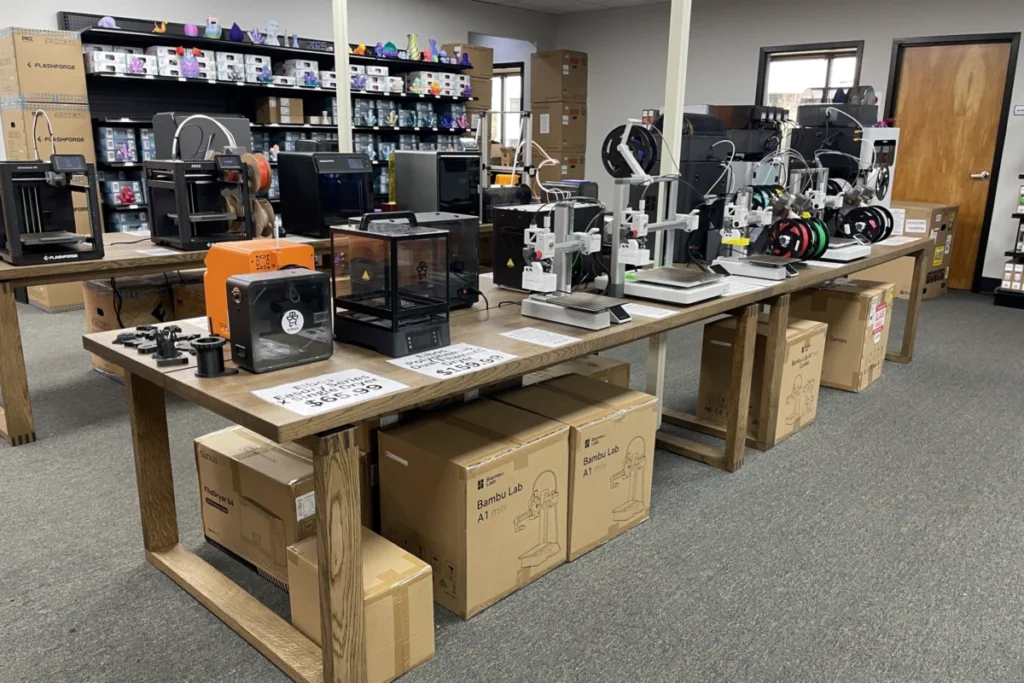
The crisp, sunny Monday morning in St. Charles, Missouri, offered an unusual backdrop for a site visit, deviating from the typical industrial parks that dot the landscape for AM Media’s investigative reporting. Instead of nondescript warehouses and the hum of machinery typically confined to specialized industrial applications, the destination was 3DSHQ, or "3D Supply Headquarters," a brick-and-mortar retail and training facility designed not just to sell equipment, but to cultivate a vibrant community around 3D printing. This public space welcomes everyone from the 3D printing curious and CAD novices to seasoned hobbyists, engineers pursuing side hustles, students, and educators, positioning itself as an accessible resource for all levels of engagement with additive manufacturing.
The establishment of 3DSHQ represents a strategic evolution for its parent company, Jamplast, a seasoned plastics recycler and processor. Recognizing the burgeoning potential of additive manufacturing at prominent industry trade shows like NPE, Jamplast launched 3DSHQ as its dedicated additive manufacturing arm. While Jamplast excels in recycling and material science, 3DSHQ adopts a more multifaceted approach to the 3D printing ecosystem. The company offers a comprehensive suite of services, including the sale of machines and equipment, robust service support—such as fulfilling warranty repairs for Bambu machines—and extensive training programs.
From Hobbyists to the Future of Industry: The Genesis of 3DSHQ

The journey of 3DSHQ began with a keen observation of industry trends. At major trade expositions, the increasing prominence of additive manufacturing technologies did not go unnoticed by Jamplast. This realization spurred the creation of 3DSHQ, aiming to bridge the gap between established plastic processing and the rapidly advancing world of 3D printing. Unlike its parent company, which focuses on recycling and material specialization, 3DSHQ has positioned itself as a versatile player in the 3D printing landscape.
The facility itself embodies this inclusive philosophy. Upon arrival, it’s common to encounter individuals like a recent convert to hobbyist 3D printing, perhaps grappling with a technical issue on their Creality 3D printer. Such encounters highlight 3DSHQ’s core mission: to be an accessible hub for troubleshooting and knowledge sharing, offering guidance on repairs and potential solutions. This hands-on, community-centric approach is fundamental to 3DSHQ’s operational ethos.
A Comprehensive Ecosystem for Additive Manufacturing
The St. Charles location, which officially opened its doors to the public on September 6, 2025, is not the company’s first foray into a physical retail space. It represents a significant expansion from a previous, smaller location within a local mall. This evolution underscores the value 3DSHQ places on a tangible presence. A physical storefront allows for direct engagement with local makers, facilitates hands-on training, and provides a welcoming entry point for individuals new to 3D printing. The mall location proved instrumental in generating foot traffic and introducing the technology to a broader local audience who might not have otherwise discovered it.

While large retailers like Best Buy and Micro Center have begun stocking desktop 3D printers, their offerings are often limited, and their staff may lack the specialized knowledge required for in-depth support. 3DSHQ distinguishes itself by offering a more extensive inventory, allowing customers to physically interact with machines, materials, and sample prints before making a purchase. Crucially, this is complemented by a knowledgeable staff and a burgeoning customer base eager to share expertise, fostering a unique learning environment.
Andrew Kramer, General Manager of 3DSHQ, emphasizes the passion that drives the team: "3D printing is the hobby and the passion of everyone on staff." This dedication translates into daily interactions where employees assist customers in selecting their first 3D printers, choosing appropriate materials, and troubleshooting print issues. These spontaneous customer interactions have been a key driver behind the company’s expansion and the integration of classroom-style education into its service portfolio.
Expanding Horizons: Education and Community Engagement
The St. Charles facility boasts a spacious classroom area designed for immersive learning experiences. Equipped with 30 laptops and an equal number of associated printers, the space is optimized for large groups to engage in hands-on practice with the equipment. The curriculum offered by 3DSHQ is diverse, encompassing over 15 distinct classes. These range from foundational courses like "Intro to 3D Printing" and "Troubleshooting and Maintaining Your 3D Printer" to advanced instruction in slicing techniques and design software such as Tinkercad and Blender.

Beyond formal education, 3DSHQ actively fosters community engagement through various events. The facility serves as a venue for birthday parties, outings for youth organizations like Boy Scouts and Girl Scouts, and themed holiday classes that allow participants to personalize pre-selected objects. This multi-pronged approach to education and community building is central to 3DSHQ’s mission of democratizing access to 3D printing technology.
Bridging Local and National Educational Initiatives
While deeply rooted in the St. Louis community, 3DSHQ’s educational impact extends far beyond Missouri’s borders. The company has recently forged a partnership with The Society of Plastics Engineers (SPE) to enhance the latter’s grant program for classroom educators. As a testament to this collaboration, Akron Public Schools in Ohio will be the inaugural recipient of FlashForge 3D printers, materials, and dedicated support from 3DSHQ.
To bolster these educational endeavors, Dr. Laura Holt-Hovis, an expert in pedagogical studies, has joined the 3DSHQ team to lead courses and develop comprehensive 3D printing curricula. An initial objective is to create state-aligned curricula for Missouri, with plans to expand to other states by aligning coursework with each state’s educational standards for credit.

The emphasis on education is intrinsically linked to 3DSHQ’s physical presence. In contrast to the often impersonal nature of online retail, 3DSHQ cultivates a more personal introduction to 3D printing, fostering a sense of community. "We don’t want to spread bad word of mouth about 3D printing," states Kramer. "The worst thing is for someone to start 3D printing and have a bad experience." Such negative experiences can have a ripple effect, influencing perceptions within personal networks, communities, and professional circles, potentially hindering broader industry adoption. Therefore, ensuring user success is paramount for 3DSHQ and for the advancement of 3D printing as a whole. "The education needs to be there to welcome all these people," Kramer reiterates.
Serving the Industry: From Hobbyists to Industrial Applications
While 3DSHQ’s most visible impact is on new users and hobbyists, its operations are also significantly geared towards serving industrial clients. The company supplies industrial-grade equipment and materials to professional additive manufacturing users. Furthermore, 3DSHQ functions as a contract manufacturer, offering services that include Design for Additive Manufacturing (DFAM)—which involves creating blueprints and plans to transition from additive to traditional manufacturing processes as demand scales—Printing as a Service (PaaS), and product development to assist clients in evolving their ideas into additive-ready products.
In close proximity to the retail storefront, 3DSHQ is developing a substantial print farm within a warehouse space. The initial phase plans for 100 3D printers, with the capacity to accommodate several hundred more as demand increases. This strategic expansion positions 3DSHQ to meet growing production needs for both its own services and for clients requiring large-scale additive manufacturing capabilities.

The integrated nature of 3DSHQ’s business model is striking. Every facet of its operation, from retail to education to contract manufacturing, is designed to support different stages of the additive manufacturing adoption pipeline. An individual with no prior manufacturing experience can enter the store, take an introductory class, and potentially develop a passion for 3D printing, leading to the purchase of equipment and materials. This initial engagement can blossom into the invention of new products or the inception of a 3D printing-based business. As their needs grow, customers may return for advanced equipment, additional materials, or utilize 3D printing services.
This trajectory also offers a pathway for established manufacturers to integrate additive manufacturing through a less direct approach. "We have Boeing here in town, and many small and medium engineering firms," Kramer observes. This presence of major aerospace companies and numerous engineering firms in the St. Louis area translates into a substantial pool of engineers who are interested in 3D printing, even if primarily as a hobby. "These are engineers who might not run a 3D printer at work, but have one at home or have an interest in it," he adds.
This personal interest can readily translate into adoption within an engineering department or on a factory floor. An engineer who is already familiar and comfortable with 3D printing in a personal capacity is more inclined to leverage the technology to solve workplace challenges, sometimes even initially using their own equipment. "And that becomes justification for a company to purchase a 3D printer," Kramer explains. "An engineer doing 3D printing as a hobby is kind of the greatest thing." This organic integration, driven by individual passion and expertise, serves as a powerful catalyst for broader industrial adoption of additive manufacturing.