A New Era of High-Performance DIY Engineering
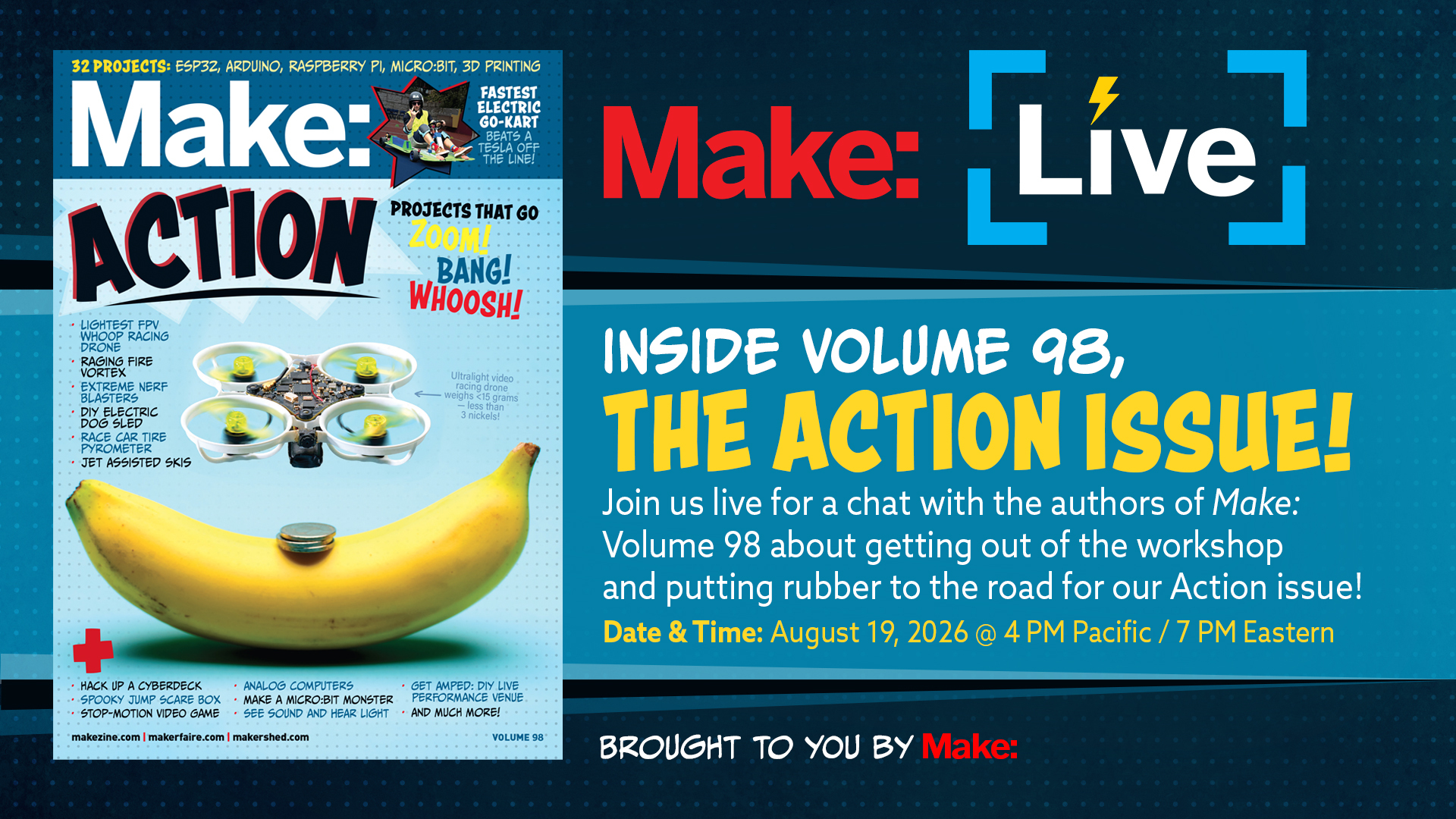
The centerpiece of the upcoming Make: Live event is the exploration of how individual makers are now rivaling commercial industrial standards in specialized niches. Leading the discussion is Saul Griffith, a renowned inventor and MacArthur "Genius" Fellow, whose latest project—an all-wheel-drive (AWD) electric go-kart—serves as the flagship feature of Volume 98. Griffith’s contribution highlights a significant trend in the maker community: the democratization of high-torque electric vehicle (EV) technology. While traditional hobbyist carts often relied on small internal combustion engines, the shift toward lithium-ion battery arrays and brushless DC motors has allowed individual creators to build vehicles that, in specific performance metrics such as off-the-line acceleration, can theoretically outperform high-end commercial vehicles like those produced by Tesla.
Griffith’s work underscores a broader movement within the maker ecosystem toward "electrification of everything." His AWD go-cart is not merely a recreational vehicle but a demonstration of power density and efficient energy management. During the live session, Griffith is expected to provide technical specifications regarding motor controllers, torque distribution, and the chassis stress tests required to handle the instantaneous power delivery characteristic of electric drivetrains.
The Intersection of Aeronautics and Personal Mobility
Continuing the theme of "Action," the live event will feature Alex from Methodical Maker, an engineer who has pushed the boundaries of personal propulsion. His project involves the development of handheld jet turbines designed for use on ski slopes. This project represents a complex intersection of fluid dynamics, thermal management, and safety engineering. Handheld turbines require a precise balance between thrust-to-weight ratios and the structural integrity of the housing to ensure user safety under high RPM (revolutions per minute) conditions.
The inclusion of jet-powered skiing projects in Volume 98 reflects a growing interest in "micro-aviation" and turbine technology among DIY enthusiasts. Historically, jet turbines were the exclusive domain of military and commercial aerospace sectors due to the high cost and complexity of manufacturing. However, the advent of sophisticated 3D printing in metals and high-strength polymers, combined with open-source telemetry data, has allowed makers to experiment with thrust-based mobility. The discussion will likely cover the fuel systems, ignition sequences, and the physics of directional thrust that make such high-speed skiing possible.
Competitive Engineering in Foam-Based Combat
The Maker movement has always had a strong connection to play and recreational combat, but Volume 98 elevates this through the work of Ryan Cho of Bay Area Foam Tag. Cho’s segment will focus on the engineering behind custom Nerf-style blasters, a field that has evolved from simple spring-loaded toys into high-precision instruments of competitive sport. These "pro-level" blasters often utilize custom-machined aluminum parts, high-draw springs, or flywheel systems powered by LiPo (Lithium Polymer) batteries to achieve muzzle velocities that far exceed retail standards.
This hobby, often referred to as "Nerf modding" or "foam flinging," has created a secondary market for specialized components. Cho will discuss the CAD (Computer-Aided Design) processes used to optimize dart flight paths and the mechanical triggers required for rapid-fire capabilities. This segment highlights how the maker community takes mass-produced consumer goods and re-engineers them for high-performance "action" scenarios, often involving complex electrical circuitry and pneumatic systems.
Theatrical Engineering and Interactive Scare Tactics
Rounding out the technical showcase is Bizzaro, a professional magician and escape room creator, who brings a different perspective to the "Action" theme. His contribution to Volume 98 is a Halloween-themed treasure box that utilizes sensors and mechanical actuators to deliver a "surprise scare." While Griffith and Alex focus on velocity and propulsion, Bizzaro’s work focuses on haptics, timing, and the psychology of interaction.
The engineering behind escape rooms and "haunted" artifacts involves a sophisticated blend of microcontrollers (such as Arduino or ESP32), infrared sensors, and solenoid-driven mechanisms. These projects must be robust enough to withstand repeated use by the public while maintaining the "magic" of a hidden mechanism. Bizzaro’s segment will offer insights into how makers can use technology to create immersive, responsive environments, particularly in the lead-up to the Halloween season.
Chronology and Evolution of the Maker Movement
To understand the significance of Volume 98 and the Make: Live event, it is necessary to view it within the timeline of the global Maker Movement. Make: Magazine was founded in 2005, a time when the "Do-It-Yourself" (DIY) ethos was beginning to merge with the digital revolution.
- 2005–2010: The early years focused on basic electronics, "circuit bending," and the introduction of the Arduino microcontroller. Projects were often stationary and focused on learning the fundamentals of coding and hardware.
- 2011–2018: This era saw the explosion of 3D printing and desktop CNC milling. Makers began to create more complex physical structures, leading to the rise of drone technology and basic robotics.
- 2019–Present: The current era, exemplified by Volume 98, is defined by "High-Performance Making." The availability of advanced materials (carbon fiber, aerospace-grade aluminum) and sophisticated power systems (high-density batteries) has allowed makers to move into the realms of high-speed vehicles, jet propulsion, and professional-grade competitive equipment.
The August 19 event represents a culmination of this 20-year evolution, where the distinction between "hobbyist" and "professional engineer" continues to blur.
Data and Economic Impact of DIY Innovation
The projects featured in "The Action Issue" are not isolated experiments; they are part of a massive economic and educational ecosystem. According to industry reports, the global "Maker Market" (including 3D printing, microcontrollers, and DIY tools) was valued at approximately $15 billion in the early 2020s and is projected to continue growing as more individuals seek personalized technological solutions.
Data from STEM (Science, Technology, Engineering, and Mathematics) education initiatives suggest that "action-oriented" making is one of the most effective ways to engage students in complex physics and math. When a student builds a go-cart like Saul Griffith’s, they are performing practical applications of Ohm’s Law, Newton’s Laws of Motion, and structural calculus. The "Action Issue" serves as a curriculum of sorts for this advanced, hands-on learning.
Official Responses and Community Implications
The announcement of the Volume 98 live stream has generated significant traction within the global maker community, particularly on platforms like Discord and specialized engineering forums. Community leaders have noted that the focus on "Action" is a timely response to a post-pandemic world where there is a renewed desire for outdoor, physical engagement with technology.

"The shift from ‘screen-time’ making to ‘road-time’ making is palpable," noted one commentator on the Make: Discord server. "Volume 98 isn’t just about building things; it’s about building things that take you somewhere or do something in the physical world."
Industry analysts suggest that the innovations seen in Make: Magazine often serve as a precursor to commercial products. For instance, the early drone hobbyists featured in Make: a decade ago paved the way for the multi-billion dollar commercial drone industry today. Similarly, the DIY electric vehicle components discussed by Griffith may influence the next generation of light-electric vehicle (LEV) startups.
Broader Impact: The Democratization of Advanced Technology
The broader implication of the "Action Issue" is the continued decentralization of innovation. When an individual like Alex from Methodical Maker can develop a functional jet turbine in a home workshop, it challenges the traditional monopoly that large corporations and well-funded research institutions have held over advanced engineering.
This democratization is driven by three factors:
- Access to Information: Open-source libraries and video tutorials provide the knowledge base.
- Access to Tools: Affordable desktop manufacturing (3D printers, laser cutters) provides the means.
- Access to Components: Global supply chains allow individuals to purchase specialized sensors, motors, and batteries that were once only available in bulk to industrial buyers.
Make: Live – Inside Volume 98, The Action Issue is more than a promotional event for a magazine; it is a status report on the current state of human ingenuity. It highlights a world where the barrier to entry for creating high-performance technology is lower than ever, and where the next breakthrough in transportation or robotics is just as likely to come from a garage in the Bay Area as it is from a corporate laboratory.
As the event approaches on August 19, the maker community remains focused on the "Action" ahead. Whether it is through the roar of a handheld jet turbine or the silent, high-torque acceleration of an electric go-cart, Volume 98 proves that the workshop is no longer the destination—it is merely the starting line.