In a significant advancement for high-precision manufacturing, CNC Solutions, a prominent machine-tool provider, has unveiled a groundbreaking integrated solution designed to tackle the escalating complexity of modern CNC-class workloads. This innovative "Technology Package" seamlessly integrates advanced software, robust robotics from Stäubli, and sophisticated motion control systems from Beckhoff, establishing a new paradigm for robotic automation in demanding industrial applications. The initiative directly addresses the limitations of traditional teach-in methods, which have proven inadequate for managing the intricate, multi-million motion point trajectories required for tasks such as complex milling, abrasive sanding, high-speed trimming, and precision laser or plasma cutting.
The Evolving Landscape of CNC and the Limitations of Traditional Methods
For decades, industrial automation has relied on teach-in programming for robots, a method where an operator manually guides a robot through a sequence of desired movements, recording each point. While effective and straightforward for simple, repetitive pick-and-place operations, this approach becomes prohibitively cumbersome and imprecise when confronted with the demands of modern CNC-level manufacturing. Tasks like contour milling or intricate sanding require robots to follow paths defined by millions of discrete motion points, far exceeding the capacity for manual teaching. The inherent inaccuracies and inconsistencies of human-guided programming lead to extended setup times, variable product quality, and significant robot idle periods, directly impacting productivity and profitability.
CNC Solutions, with its long history of supporting increasingly complex projects, recognized this growing chasm between traditional robotic capabilities and the requirements of advanced manufacturing. Their portfolio, which includes multi-axis milling, abrasive sanding, and high-speed trimming, continually pushed the boundaries of what conventional controller-centric methods could achieve. The imperative was clear: a new workflow was needed that could bridge the gap, starting with sophisticated computer-aided manufacturing (CAM) processes, simulating the entire production cell, and ultimately controlling a robot with the precision and speed historically associated with dedicated CNC machine tools. This demand for a CNC-level motion layer, integrated directly into robotic operations, became the driving force behind the development of their new Technology Package.
A Strategic Alliance for Next-Generation Automation
The development of this advanced solution was not an overnight endeavor but rather the culmination of extensive research, engineering, and collaboration. CNC Solutions embarked on a strategic partnership, bringing together best-in-class technologies to forge a truly integrated system. The core components of this innovative package are:
- ENCY Robot Offline Programming Software: As the intellectual backbone, ENCY Robot calculates precise toolpaths and provides a comprehensive digital twin environment for simulating the entire cell, optimizing processes before any physical operation begins.
- Beckhoff Motion Controller: Serving as the central nervous system, a Beckhoff motion controller translates standard CNC commands (including feeds, modes, and frames) into real-time robot movements, ensuring high-speed, synchronized operation.
- Stäubli Industrial Robots: The muscular arm of the solution, Stäubli robots were chosen for their exceptional precision, repeatability, and robust, sealed construction, which makes them ideal for demanding industrial environments prone to dust and debris, particularly in abrasive applications like grinding and milling.
This synergistic combination allows the robot to operate fundamentally like a machine tool, shifting the operator’s focus from intricate manual intervention to process optimization and production oversight.
The Development Journey: From Concept to Commercial Reality
The evolution of the Technology Package at CNC Solutions was an iterative process, marked by continuous refinement and rigorous testing. The engineering team dedicated significant effort to meticulously calibrate and refine robot axis motions, ensuring that the commissioning process could consistently achieve the precision and reliability typically found in dedicated CNC machines. This gradual, detail-oriented approach was crucial to transforming a collection of advanced components into a cohesive, standardized solution that integrators could readily implement across diverse applications.

A key challenge was to ensure that the robot’s trajectory execution, especially in high-speed and abrasive scenarios, mirrored the performance of a conventional CNC machine. This required deep integration between the motion control layer, the robot’s kinematics, and the offline programming software. The team worked to eliminate the inherent discrepancies that often arise when adapting industrial robots for CNC-grade tasks, achieving a level of consistency that sets this package apart. The result is a system where predefined and machine-tuned processes—such as milling, welding, sanding, and laser cutting—provide integrators with a validated and optimized starting point, significantly reducing development time and project risk.
ENCY Robot: Revolutionizing Offline Programming and Simulation
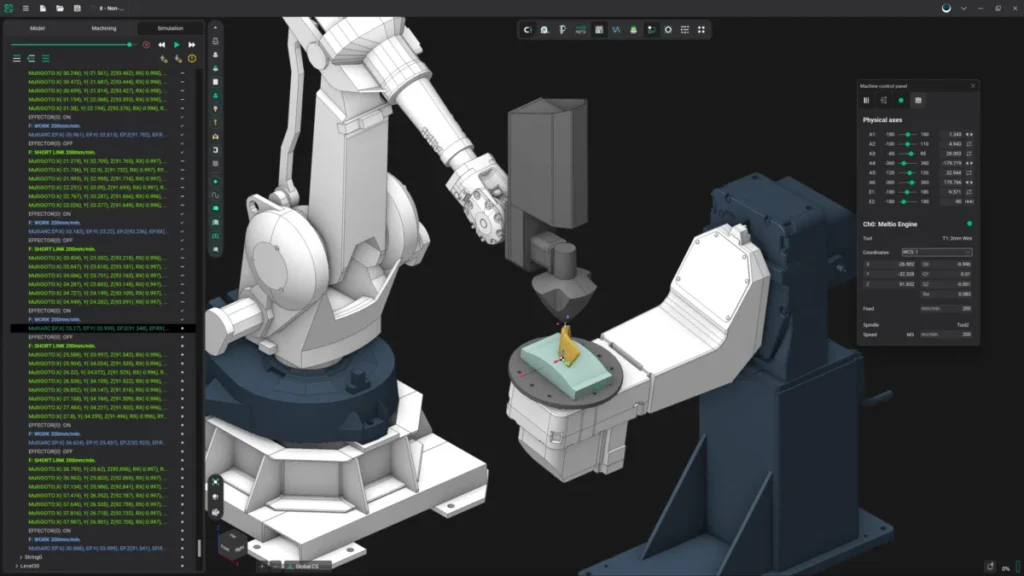
At the heart of the software layer is ENCY, a powerful offline programming platform specifically chosen for its extensive functionality and ability to manage complex multi-axis cells alongside simpler two-axis tasks. ENCY fundamentally transforms the project timeline by shifting programming from the shop floor to the virtual environment. Instead of spending valuable hours on online programming, which renders the robot idle, ENCY simulates the entire cell in a digital twin, performing critical checks:
- Axis Limit Verification: Ensuring all robot movements stay within physical constraints.
- Singularity Avoidance: Preventing positions where the robot loses degrees of freedom, which can lead to unpredictable behavior or damage.
- Full Collision Control: Identifying and preventing potential collisions between the robot, its tools, the workpiece, and other cell components.
This comprehensive simulation capability converts what would typically be commissioning time into productive planning and optimization time. ENCY provides an all-in-one environment for design, technology setup, toolpath calculation, and simulation. Its zero-code digital-twin builder and extensive libraries streamline the setup process, enabling trusted CAM strategies to be directly translated into reliable robot instructions. This transparency in system behavior, managing code paths and models internally, ensures predictable and consistent operation.
ENCY’s broad process library further enhances its utility, offering out-of-the-box support for a vast array of manufacturing operations, including: milling, grinding, deburring, polishing, blasting (wet/dry), plasma and laser cutting/welding, waterjet cutting, cladding, painting, cleaning, and gluing, among others. This versatility makes the Technology Package suitable for a wide range of industries, from automotive and aerospace to general manufacturing and specialized fabrication.
Precision and Integration: The Hardware Backbone
The selection of Stäubli robots and Beckhoff motion controllers was pivotal to achieving the desired level of performance. Stäubli’s reputation for precision, repeatability, and robust, sealed construction was a critical factor, especially for abrasive applications where dust and debris can compromise less protected systems. The seamless integration of a CNC-style motion layer for trajectory execution with Stäubli’s kinematic capabilities ensures that the robot executes paths with the accuracy and reliability essential for high-quality production.
The Beckhoff motion cabinet serves as the control hub, featuring a CNC-style Human-Machine Interface (HMI) and a handheld pendant for intuitive operation. This design ensures that operators familiar with traditional CNC machines can quickly adapt to controlling the robotic system. The "plug-and-play" wiring, connecting the Stäubli robot to the controller with a single cable, simplifies installation and reduces potential points of failure, contributing to faster deployment.
Standard features embedded within the package mimic those found in conventional CNC systems, including:
- CNC-style modes: Auto, Manual, and Home.
- Feed overrides: Allowing operators to adjust speeds during automatic operation.
- Emergency-stop logic: Ensuring safety compliance.
- Process I/O and communication interfaces: For seamless integration into broader plant networks.
- Manual moves: Supported via encoder-wheel controls for fine adjustments.
Addressing Real-World Manufacturing Complexities

Recognizing that real-world manufacturing cells rarely conform perfectly to theoretical specifications, the Technology Package incorporates advanced features that typically demand significant setup time in conventional robotic implementations. These include:
- Absolute, TCP, and Frame Calibration: Essential for maintaining accuracy when tools or workpieces change, ensuring consistent positioning regardless of environmental variations.
- Singularity Management: Proactively addressing robot postures that can lead to control issues or reduced performance.
- OPC UA Connectivity: Providing robust, standardized communication for Industry 4.0 integration, enabling data exchange with other machines and enterprise systems.
- Real-time Path Adjustments: Allowing for minor modifications to trajectories during operation to compensate for unforeseen variables.
- Tool-Wear Compensation: Automatically adjusting toolpaths to account for tool degradation, maintaining consistent quality and extending tool life.
These features ensure that the system is not only precise in a controlled environment but also robust and adaptable in the dynamic realities of a manufacturing floor.
Quantifiable Benefits and Transformative Market Impact
The introduction of CNC Solutions’ Technology Package brings several quantifiable benefits and significant market implications:
- Reduced Time to First Good Part: By eliminating the need for online robot teaching and providing a robust CNC-like motion layer, the system drastically cuts down the time from robot installation to producing a quality part. Teams can focus their efforts on optimizing fixtures, tools, and the manufacturing process itself, rather than on tedious robot programming.
- Enhanced Precision and Consistency: The combination of ENCY’s precise path planning, Beckhoff’s high-performance motion control, and Stäubli’s robotic accuracy ensures a level of consistency and quality previously difficult to achieve with robots in complex CNC applications.
- Increased Robot Utilization: Offline programming means robots spend more time actively producing and less time idle during setup or reprogramming.
- Lower Delivery Risk and Warranty Exposure: The standardized, validated nature of the Technology Package, with its reusable project elements, significantly reduces the risks associated with custom development, leading to more predictable project outcomes and reduced warranty claims.
- Democratization of Advanced Robotics: By abstracting away vendor-specific robot languages and presenting a CNC-like interface, the solution lowers the barrier to entry for integrators. Expertise can remain focused on core manufacturing knowledge (PLCs, safety, fixturing, end-effectors, process knowledge) rather than specialized robot programming.
- Expansion of Robotic Applications: The package enables higher-value applications such as precision milling, trimming, and sanding—tasks that many integrators previously avoided due to the limitations of traditional teach-in methods. This opens up new markets and opportunities for robotic automation.
Broader Implications for Industrial Automation
This integrated solution aligns perfectly with the principles of Industry 4.0, emphasizing connectivity, data exchange, and smart automation. By providing a standardized, high-performance platform for robotic CNC, CNC Solutions is contributing to the broader trend of blurring the lines between traditional machine tools and industrial robots. This convergence allows manufacturers to leverage the flexibility and reach of robots with the precision and processing power of CNC machines.
The ability to simulate entire cells and optimize processes offline also speaks to the growing importance of digital twins and virtual commissioning in modern manufacturing. This approach not only saves time and resources but also enhances safety by identifying potential issues in a virtual environment before they manifest physically.
Conclusion: A New Era for Robotic CNC
CNC Solutions’ Technology Package represents a significant leap forward in robotic automation. By meticulously integrating ENCY’s advanced offline programming and simulation capabilities with Beckhoff’s precision motion control and Stäubli’s high-performance robotics, the company has created a stable, commercially available solution that truly operates like a machine tool. This system is engineered for real-world cells, offering robust features such as TCP, absolute, and frame calibration, OPC UA integration, real-time path adjustments, and tool-wear compensation.
This innovative combination effectively removes the traditional barriers to using robots for complex, high-precision manufacturing tasks. Integrators and manufacturers can now deploy robotic solutions with confidence, focusing on process optimization rather than grappling with complex robot programming. The result is improved efficiency, enhanced product quality, reduced operational risks, and the unlocking of new possibilities for advanced robotic applications across diverse industries, heralding a new era for robotic CNC.