CAMBRIDGE, MA – Walden Robotics, a pioneering tech startup at the forefront of physical AI and humanoid robotics, has successfully closed a significant $300 million investment round. This substantial capital injection signals a robust endorsement from leading industry players and venture capital firms, poised to accelerate the deployment of advanced humanoid robots in real-world work environments, particularly within manufacturing. The funding comes from a consortium of strategic investors, including global automotive giant Toyota Motor Corp., aerospace leader Boeing, electronics titan Samsung, and AI computing powerhouse Nvidia, alongside various venture capital entities.
A Strategic Investment in the Future of Automation
The $300 million investment underscores a growing conviction across multiple sectors regarding the transformative potential of physical artificial intelligence and general-purpose humanoid robots. For the investing companies, particularly the original equipment manufacturers (OEMs) like Toyota, Boeing, and Samsung, this move is a clear strategic play to integrate cutting-edge automation into their intricate supply chains and manufacturing processes. Nvidia’s involvement highlights the critical role of advanced computing and AI platforms in enabling the sophisticated learning capabilities that define Walden’s robots.
Hiroki Nakajima, Executive Vice President and Chief Technology Officer of Toyota Motor Corp., articulated the profound expectations tied to this investment. "Toyota has high expectations for this investment," Nakajima stated. "Walden’s uniqueness is its ability to deliver robots that provide value from day one in real-world work environments: robots that continuously improve through learning, while always keeping people at the center." This statement encapsulates Toyota’s long-standing philosophy of continuous improvement (Kaizen) and a human-centric approach to technology integration, suggesting that Walden’s robots are designed to augment, rather than simply replace, human labor.
Walden Robotics: From Research to Real-World Application
Walden Robotics emerged from the highly regarded Toyota Research Institute (TRI) in January 2026, marking a significant milestone in the commercialization of advanced robotics research. TRI, known for its forward-thinking initiatives in AI, robotics, and autonomous systems, provided a fertile ground for the foundational technologies that Walden now employs. The startup wasted no time in engaging with customers across a diverse range of industries, demonstrating a rapid transition from research and development to practical application.
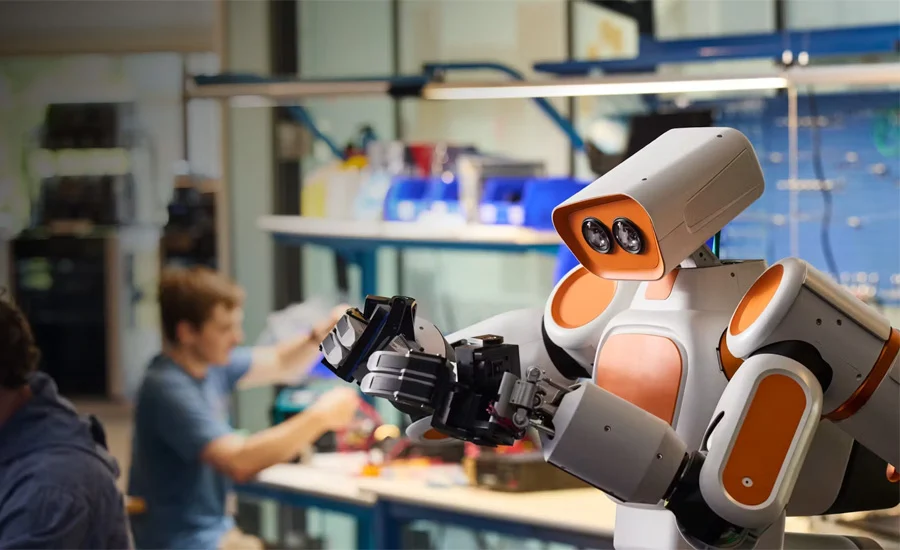
A key aspect of Walden’s innovative approach is its general-purpose humanoid robots. Unlike traditional industrial robots that are typically fixed-arm manipulators designed for highly specific, repetitive tasks, Walden’s humanoids are engineered for adaptability and continuous learning. Since February of the same year, Walden’s robots, characterized by two arms and a wheeled base instead of legs – a design choice likely prioritizing mobility and stability within factory settings over bipedal locomotion – have been actively deployed. Their initial deployment at one of Toyota’s North American assembly plants saw them transition from a pilot project to integral operational roles in less than two months, an unprecedented pace for sophisticated robotic integration. This swift deployment validates the robots’ immediate utility and Walden’s agile development and implementation capabilities.
The Vision Behind Physical AI and Adaptive Robotics
At the helm of Walden Robotics is Dr. Russ Tedrake, co-founder and CEO, a distinguished professor at the Massachusetts Institute of Technology (MIT), and formerly the Senior Vice President of Large Behavior Models at TRI. Dr. Tedrake, a luminary in the field of robotics and AI, articulated the technological leap enabling Walden’s advancements. "Core advances in physical AI have made disruptive change possible," Dr. Tedrake remarked. He further emphasized the importance of a practical, industry-informed approach: "But, providing real value to customers and building a robust and scalable business requires a deep understanding and respect for how manufacturing is done today. The best way to make fast and positive progress is by working closely together with the real experts." This philosophy underscores a commitment to practical utility and collaborative development, ensuring that the technology addresses genuine industrial needs.
Walden’s robots are meticulously designed for collaborative environments, intended to work seamlessly alongside human colleagues. The technological backbone of these robots rests upon foundational AI and robotics research, much of which was pioneered by Dr. Tedrake and other Walden engineers. Key among these innovations are "diffusion policy" and "large behavior models." Diffusion policy refers to a novel machine learning approach that allows robots to learn complex motor skills and decision-making processes more efficiently from data, often through imitation or reinforcement learning. Large behavior models, analogous to large language models in generative AI, enable robots to generalize behaviors across a wide range of tasks and environments, improving their adaptability and problem-solving capabilities without extensive reprogramming for each new scenario. This sophisticated AI architecture empowers the robots to rapidly acquire new tasks and continuously refine their performance through real-world experience, making them truly autonomous and self-improving assets.
The Broader Context: A Global Race for Automation and AI Dominance
The investment in Walden Robotics comes at a time of unprecedented global interest and competition in artificial intelligence and advanced robotics. The market for industrial automation and AI-powered solutions is projected to experience exponential growth over the next decade. According to various market research reports, the global industrial robotics market, valued at over $45 billion in 2022, is expected to surpass $100 billion by 2030, driven by increasing labor costs, demand for higher productivity, and the ongoing push towards Industry 4.0. Humanoid robots, specifically, are emerging as a new frontier, with projections suggesting a significant market share as their capabilities mature and costs decrease.
This burgeoning market is fueled by several factors:
- Labor Shortages: Industries worldwide face persistent labor shortages, particularly in manufacturing and logistics, making automation a necessity.
- Efficiency and Precision: Robots offer unparalleled precision, consistency, and speed, reducing errors and improving product quality.
- Safety: Automating hazardous or repetitive tasks can significantly enhance workplace safety for human employees.
- Technological Advancements: Breakthroughs in AI, computer vision, sensor technology, and mechatronics are making robots more intelligent, versatile, and affordable.
Strategic Rationale of Key Investors
The participation of such prominent companies in Walden’s funding round speaks volumes about the perceived value and future impact of its technology:
-
Toyota Motor Corp.: As a global leader in automotive manufacturing, Toyota’s investment is deeply strategic. The company has long been a pioneer in advanced manufacturing techniques and has its own dedicated research arms like TRI. Investing in Walden allows Toyota to directly integrate cutting-edge physical AI into its production lines, addressing efficiency, quality control, and potential labor challenges. Their emphasis on "keeping people at the center" also suggests a vision of collaborative robotics enhancing human work, rather than outright replacement. This investment reinforces Toyota’s commitment to staying at the forefront of manufacturing innovation.
-
Boeing: The aerospace industry is characterized by extremely complex manufacturing processes, high precision requirements, and stringent safety standards. Boeing’s interest likely stems from the potential for Walden’s robots to automate tasks in assembly, inspection, and logistics within its vast production facilities. Humanoid robots could prove invaluable in handling delicate components, performing repetitive tasks in confined spaces, or assisting with heavy lifting, thereby improving efficiency and worker safety in aircraft production. Boeing’s previous investments in automation and digital manufacturing initiatives highlight their ongoing push to modernize their production capabilities.
-
Samsung: A diversified global conglomerate with extensive interests in electronics manufacturing, semiconductors, and smart home technologies, Samsung’s investment in Walden Robotics aligns with its vision for smart factories and future consumer robotics. For its manufacturing divisions, Walden’s physical AI could optimize production lines, enhance quality control, and streamline logistics. Furthermore, Samsung has been exploring consumer-facing robotics and service robots, and the advancements in general-purpose humanoid AI could lay the groundwork for future product development in those areas.
-
Nvidia: Nvidia’s involvement is a natural fit, given its dominant position in AI computing hardware (GPUs) and software platforms. The sophisticated AI models driving Walden’s robots—such as diffusion policy and large behavior models—require immense computational power, an area where Nvidia excels. By investing in Walden, Nvidia strengthens its ecosystem for robotics development, positioning itself as a foundational technology provider for the next generation of intelligent machines. This collaboration could also lead to optimized hardware and software solutions specifically tailored for physical AI applications, further solidifying Nvidia’s leadership in the AI revolution.
Implications for the Manufacturing Landscape
The successful funding and rapid deployment of Walden’s humanoid robots carry profound implications for the manufacturing sector:
- Increased Automation and Productivity: The ability of robots to learn and adapt quickly means faster integration into existing workflows, leading to immediate productivity gains and reduced downtime for reprogramming.
- Enhanced Flexibility: General-purpose robots can be repurposed for various tasks, offering manufacturers greater flexibility in production lines, especially in dynamic markets with changing product demands.
- Human-Robot Collaboration: The design philosophy of "keeping people at the center" suggests a future where robots work symbiotically with humans, taking on strenuous or monotonous tasks while humans focus on more complex, creative, or supervisory roles. This could lead to a more ergonomic and engaging work environment.
- Democratization of Robotics: As AI-driven robots become more accessible and easier to integrate, they could lower the barrier to entry for automation, allowing small and medium-sized enterprises (SMEs) to adopt advanced technologies that were once exclusive to large corporations.
- Supply Chain Resilience: Automated factories can operate with greater resilience against labor disruptions, natural disasters, or geopolitical events, contributing to more robust global supply chains.
- Economic Impact: While concerns about job displacement often arise with automation, the emergence of advanced robotics also creates new jobs in robot development, maintenance, integration, and training, alongside potentially boosting overall economic productivity and competitiveness.
Challenges and the Road Ahead
Despite the immense promise, the widespread adoption of advanced humanoid robots like those from Walden Robotics also faces challenges. These include:
- Cost: While becoming more affordable, the initial investment in sophisticated humanoid robots and their integration can still be substantial.
- Integration Complexity: Integrating new robotic systems into legacy manufacturing infrastructure requires careful planning and expertise.
- Public Perception and Workforce Adaptation: Addressing concerns about job security and ensuring a smooth transition for the human workforce through retraining and upskilling programs will be crucial.
- Safety Standards: Developing and adhering to robust safety standards for human-robot collaborative environments is paramount.
Walden Robotics’ $300 million funding round is more than just a financial transaction; it represents a significant validation of a new paradigm in robotics and AI. By focusing on "physical AI" that enables robots to learn, adapt, and integrate seamlessly into human-centric work environments, Walden is poised to redefine the future of manufacturing. With the backing of industry giants, the company is well-positioned to lead the charge in bringing intelligent, general-purpose humanoid robots from the realm of research labs into the bustling reality of factories worldwide, promising a future of enhanced productivity, safety, and innovation. The rapid deployment at Toyota’s facilities serves as a compelling testament to the immediate and tangible value these advanced machines can deliver.