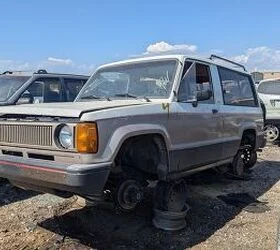
As the automotive landscape of the late 1980s began to shift, the American consumer’s appetite for versatile vehicles capable of both daily commuting and family adventures grew. Trucks, once relegated to workhorse status, were increasingly viewed as practical and stylish choices for everyday life. In this evolving market, Japanese manufacturers were making significant inroads, and Isuzu, a company with a rich history in commercial vehicles, was particularly keen to capture a share of the burgeoning SUV segment. Its Trooper II, a rugged and capable off-roader, emerged as its most successful American sales star during this transformative period. An early first-generation example of this iconic vehicle has recently been discovered in a Denver self-service boneyard, offering a tangible connection to a pivotal era in automotive history.
The discovery was made by an automotive enthusiast and photographer who had initially visited the U-Pull-& Pay facility in Denver with the specific intention of documenting a first-generation Mitsubishi Montero that had appeared in the yard’s online inventory. However, upon arrival, the Montero proved to be in less-than-ideal condition. Fortunately, just a few rows away, a far more compelling find presented itself: an early Isuzu Trooper II, described as one of the nicest examples encountered in a junkyard in recent memory. The condition of the vehicle suggested that its previous owner or owners had treated it with a notable degree of care, allowing it to reach a respectable mileage for an Isuzu product of its vintage.
The Global Journey of the Isuzu Trooper
The Isuzu Trooper, known in its native Japan as the Bighorn, embarked on a diverse international journey, appearing under a variety of names and affiliations. Beyond its primary moniker, it was marketed as the Jackaroo, Monterey, Caribe, Star, and Korando Family in different global markets. This widespread rebranding was facilitated by the extensive reach of General Motors (GM), which held a significant stake in Isuzu and utilized its vehicles across its vast network of brands. Consequently, the Trooper’s lineage can be traced through an impressive array of marques, including Chevrolet, Opel, Subaru, SsangYong, Mekong, Vauxhall, Acura, and Honda, underscoring its modular design and adaptability to various market demands.
Before Isuzu began selling vehicles under its own banner in the United States, its presence was felt through collaborations and rebadged models. Privately imported examples of earlier Isuzu models like the Bellel and Bellett occasionally surfaced, but the first Isuzu product to gain significant traction in the American market was the Chevrolet LUV, a rebadged Isuzu Faster pickup truck. Isuzu’s engines also found their way into American vehicles, notably powering the Chevrolet Chevette and, for a brief period, the Buick Opel by Isuzu.
The direct Isuzu brand presence in the U.S. commenced with the 1981 model year. The initial offerings included the I-Mark, a subcompact car that shared its platform with the Chevrolet Chevette, and the P’up, a mini-pickup truck that was the twin of the Chevrolet LUV. These were soon followed by the sporty Impulse, known as the Piazza in Japan, which debuted for the 1983 model year. The second-generation Gemini, which adopted a front-wheel-drive platform, arrived in the U.S. as the second-generation I-Mark in 1985.
A pivotal moment for Isuzu in the American market arrived in 1986 with the launch of the memorable "Joe Isuzu" advertising campaign, which significantly boosted brand awareness and sales. Concurrently, GM began rebadging Isuzu’s I-Mark models as the Chevrolet Spectrum (1985-1988) and later the Geo Spectrum (1988-1989). While these passenger cars contributed to Isuzu’s growing presence, it was the Trooper that truly resonated with American consumers, arriving at a critical juncture to compete with established SUVs like the Jeep Cherokee and Mitsubishi Montero.
The Trooper’s American Debut and Dominance
Contrary to some online sources that cite 1981 as the first model year for the U.S.-market Trooper, automotive price guides indicate that the first Troopers officially sold in the United States were 1984 models. This launch year coincided with the introduction of the Jeep Cherokee and the Mitsubishi Montero, positioning the Trooper as a direct competitor in a rapidly expanding segment. All first-generation Troopers sold in the U.S. were badged as Trooper IIs, distinguishing them from later generations.
As the 1990s dawned, Isuzu continued to offer passenger cars in the United States. However, the company’s core identity and strategic focus increasingly leaned towards its robust truck and SUV offerings, a direction clearly paved by the success of the Trooper. The final Isuzu-badged cars to be sold in America were the 1993 models: the Isuzu Stylus and the Geo Storm. Following this, Isuzu’s American dealerships predominantly featured trucks and truck-like vehicles, with the Oasis minivan—a rebadged Honda Odyssey—being a notable exception that does not align with Isuzu’s original design philosophy. The American market received a range of Isuzu SUVs and trucks, including the Amigo, Rodeo, VehiCROSS, and Axiom, in addition to the Pickup (the P’up name was retired after 1987) and the enduring Trooper.
The latter half of the 1990s and the early 2000s saw a gradual decline for many Asian automotive manufacturers that were part of the broader General Motors co-prosperity sphere, including Daewoo and Suzuki. Isuzu’s own journey in the U.S. passenger vehicle market concluded with the 2004 Axiom, which was the final Isuzu-designed light passenger vehicle offered domestically. The brand’s narrative in the United States took a somber turn as Isuzu dealers began selling rebadged Chevrolet S-10 pickups as the Isuzu Hombre in the mid-1990s. This was followed by Isuzu-ized versions of GM products, such as the Chevrolet Trailblazer, which became the Isuzu Ascender, and the Chevrolet Colorado twin, the Isuzu I-Series pickup. These badge-engineered models, particularly the I-Series, are often cited as less distinguished entries in the 21st-century pickup truck market, drawing comparisons to the Suzuki Equator.
The second-generation Trooper, introduced in the U.S. for the 1992 model year, saw its final production run for the 2002 model year. This marked the end of an era for Isuzu’s flagship SUV in America, leaving behind a legacy encapsulated by its memorable advertising slogan: "Because the world is big… and cars just aren’t." Despite the discontinuation of its light passenger vehicles, Isuzu continues to thrive in the commercial truck sector in the United States, a testament to its enduring strength in heavy-duty vehicles.
The 1986 Trooper II LS: A Detailed Look
The specific vehicle found in the Denver junkyard is a 1986 Isuzu Trooper II, representing the top trim level of that year: the LS. At its initial release, the MSRP for this LS model, before any optional equipment, was $10,349. In 2026 dollars, this figure equates to approximately $31,533. This pricing was competitive within the burgeoning SUV market of the mid-1980s. For comparison, a four-wheel-drive (4WD) two-door Jeep Cherokee started at $10,849, while the Mitsubishi Montero was priced slightly lower at $9,839. The Ford Bronco II, also a 4WD model, began at $11,501, and the 4WD Chevrolet S-10 Blazer was priced at $10,698.
A significant aspect of these vehicles from the era was their standard engine configurations. Most of these SUVs came equipped with four-cylinder engines as their base powerplants. Notably, the Chevrolet S-10 Blazer could be optioned with the very same Isuzu four-cylinder engine that had previously powered the LUV pickup. For the 1986 Trooper II, Isuzu offered two engine choices: a standard 2.3-liter gasoline inline-four and an optional 2.2-liter diesel inline-four.
The diesel engine was rated at 96 horsepower and 123 lb-ft of torque. The junkyard find, however, appears to be equipped with the gasoline engine. Evidence suggests that the previous owner may have attempted to diagnose an issue by removing the valve cover, indicating a potential mechanical problem that ultimately proved too costly or complex to repair, leading to the vehicle’s retirement.
The presence of factory shop manuals within the truck is a noteworthy detail, suggesting that at least one owner was dedicated to maintaining the vehicle and possessed the skills and willingness to perform their own mechanical work. These manuals, often overlooked by casual observers, can hold significant value on the resale market, particularly on platforms like eBay. Furthermore, the original driver’s manual and warranty booklet were still present in the glovebox, offering a glimpse into the vehicle’s past ownership and service history.
The Trooper II’s base configuration included a five-speed manual transmission. While this offered a more engaging driving experience for enthusiasts, the use of a part-time 4WD system, rather than a more user-friendly full-time all-wheel-drive (AWD) system, may have contributed to a decline in its resale value during its later years. The operation of traditional 4WD systems on dry pavement, often misunderstood or misused by some owners, could lead to accelerated wear and tear.
The final owner of this particular Trooper II appears to have been an avid participant in Ironman triathlons. Such an individual might have found the robust, albeit less refined, Trooper with its manual transmission to be a suitable vehicle for accessing mountainous terrain for training purposes. While not known for its plush ride or exceptional fuel economy, its inherent durability and capability would have served its purpose well. The owner’s likely reluctance to part with such a dependable vehicle underscores its value as a utilitarian tool.
The Isuzu Trooper II was marketed with comprehensive capabilities, often described as a versatile vehicle that could function as a station wagon, a camper, and a truck, embodying the spirit of adventure and utility. Early marketing campaigns emphasized its robust nature and broad applicability, with slogans like "Buy a million Troopers and save $2 billion dollars" hinting at its perceived value and durability. The Japanese pronunciation of its alternative name, "Bighorn," adds a layer of cultural nuance, while publications like Bush Driver Magazine provided positive reviews for its global variant, the Jackaroo.
The discovery of this 1986 Isuzu Trooper II in a Colorado junkyard serves as a poignant reminder of a bygone era in automotive design and consumer preference. It highlights Isuzu’s significant contribution to the rise of the SUV, a vehicle type that has fundamentally reshaped American transportation and family life. The Trooper II, in its various global guises, exemplified a blend of ruggedness, utility, and surprisingly broad appeal, securing its place as a notable chapter in automotive history.