Researchers at MIT Lincoln Laboratory have unveiled a groundbreaking new device, dubbed the Tactical Optical Spherical Sensor for Interrogating Threats, or TOSSIT. This innovative, baseball-sized sensor is designed to remotely detect hazardous vapors and aerosols, offering a crucial early warning system for military service members, first responders, and law enforcement personnel. The development marks a significant advancement in the field of chemical threat detection, addressing a critical gap in current sensor capabilities.
The TOSSIT device is engineered for rapid deployment in potentially dangerous environments. Its spherical design and compact size allow it to be easily tossed, deployed via drone, or launched into areas of concern. Once deployed, the sensor actively samples the surrounding air. Its core detection mechanism relies on a removable dye card, which undergoes a visible color change when exposed to specific chemical agents. An internal camera then captures these color changes, triggering an alert. This visual feedback loop, combined with the sensor’s sophisticated analysis, allows for the identification of chemical threats ranging from potent nerve and blister agents to hazardous substances released during industrial accidents or airborne particles like fentanyl dust.
Addressing an Unmet Need in Chemical Threat Detection
The development of TOSSIT stems from a recognized deficiency in existing portable sensor technology. Many current systems are either too bulky, too expensive, or lack the sensitivity to detect a broad spectrum of airborne threats, particularly solid aerosol particles. "TOSSIT fills an unmet need, providing a low-cost sensing option for vapors and solid aerosol threats — think toxic dust particles — that would otherwise not be detectable by small deployed sensor systems," stated Richard Kingsborough, the principal investigator for the project at MIT Lincoln Laboratory. This capability is particularly vital in scenarios where personnel might be exposed to invisible or difficult-to-detect airborne contaminants.
The implications of such a device are far-reaching. In military operations, TOSSIT could provide invaluable real-time intelligence on the presence of chemical warfare agents, allowing for immediate protective measures and strategic adjustments. For first responders, it offers a vital tool for assessing the safety of environments following industrial accidents, hazardous material spills, or suspected acts of bioterrorism. The ability to quickly identify threats like fentanyl dust is also paramount for law enforcement and emergency medical services, where accidental exposure can have severe consequences.
Technological Innovation and Deployment
The TOSSIT sensor employs a sophisticated yet user-friendly operational model. Upon deployment, the device initiates an air sampling process. The core of its detection capability lies in its specially designed dye cards. These cards are formulated to react chemically with a range of hazardous substances, producing distinct and observable color changes. This visual transformation is then captured by an integrated camera within the TOSSIT unit. Advanced image processing algorithms analyze these color changes, comparing them against a database of known chemical signatures.
Once a potential threat is identified, TOSSIT can issue alerts through multiple channels. These include a dedicated mobile application, providing real-time data and location information to connected personnel, or through integrated alarms within the sensor itself. This multi-faceted alerting system ensures that crucial information reaches those who need it, when they need it, minimizing response times and enhancing safety protocols.
The device’s removable dye card design offers a significant advantage in terms of versatility and maintenance. It allows for the customization of sensor capabilities by swapping out different dye cards tailored to specific threat profiles or operational environments. This modular approach also simplifies the process of recalibrating or updating the sensor’s detection capabilities without requiring a complete system overhaul.
Background and Development Timeline
The genesis of TOSSIT can be traced back to ongoing research at MIT Lincoln Laboratory focused on enhancing the safety and operational effectiveness of personnel in hazardous environments. While specific dates for the initial research phases are not publicly detailed, the announcement of the device’s readiness for transfer to the U.S. military suggests a development cycle spanning several years, involving rigorous design, prototyping, and extensive testing.
The journey from concept to a deployable technology typically involves several key stages:
- Conceptualization and Research (Estimated 2020-2022): Initial research into novel detection methods and sensor miniaturization, focusing on the challenges of detecting diverse chemical threats. This phase likely involved theoretical modeling and laboratory experiments to identify promising dye chemistries and optical detection principles.
- Prototype Development (Estimated 2022-2024): Building functional prototypes of the TOSSIT device, integrating the sensing mechanism, camera, processing unit, and communication systems. This stage would have involved iterative design improvements based on performance testing.
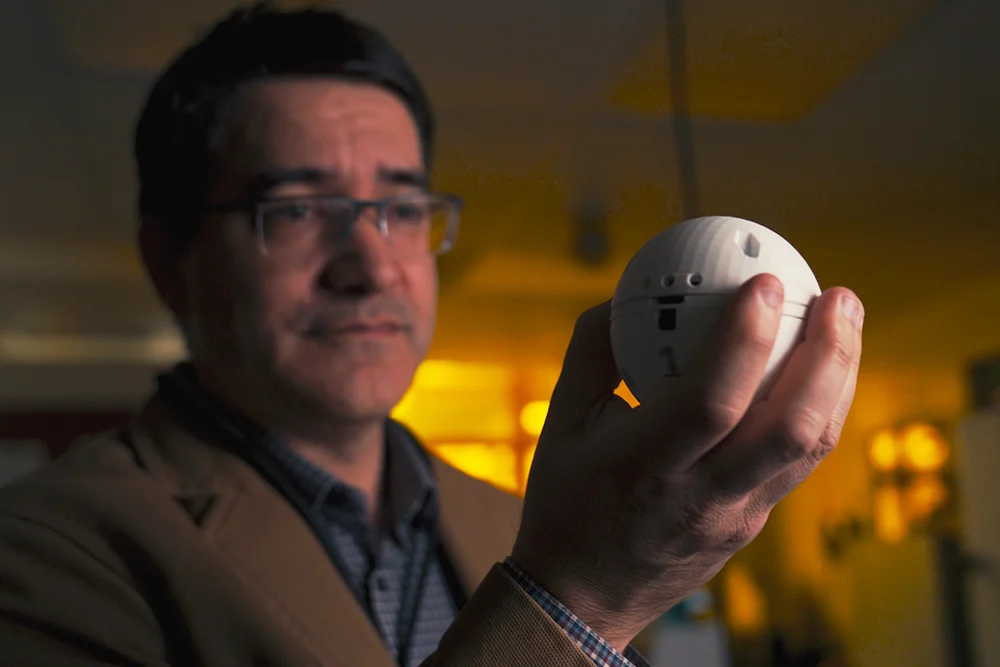
- Laboratory and Field Testing (Estimated 2024-2025): Conducting comprehensive tests in controlled laboratory environments and, crucially, in realistic field conditions. This would involve exposing the TOSSIT to a range of simulated and actual chemical agents to validate its accuracy, sensitivity, and reliability under various environmental factors such as temperature, humidity, and wind. The image displayed in the original announcement, showing researcher Jude Kelley holding the TOSSIT device, is dated July 9, 2026, suggesting that this period marks the culmination of extensive testing and readiness for broader application.
- Technology Transfer and Integration (Ongoing): The current phase, as indicated by the article, involves the transfer of the TOSSIT technology to the U.S. military for integration into existing operational frameworks and further deployment. This process often includes training, logistical planning, and potential modifications based on military-specific requirements.
The transition to the U.S. military signifies a critical milestone, validating the device’s performance and readiness for operational use. This transfer process is typically managed through established defense procurement channels and involves close collaboration between the research institution and the relevant military branches.
Supporting Data and Performance Metrics
While the initial announcement does not provide specific quantitative data, the successful transfer to the U.S. military implies that TOSSIT has met stringent performance benchmarks. Key metrics for such a device would typically include:
- Sensitivity: The minimum concentration of a chemical agent that the sensor can reliably detect. For nerve agents, this could be in the parts per billion (ppb) range.
- Selectivity: The ability of the sensor to distinguish between different chemical agents and avoid false positives from benign substances.
- Response Time: The time it takes for the sensor to detect a chemical threat and issue an alert after initial exposure. For emergency response, this is often measured in seconds.
- Detection Range: The effective operational distance from which the sensor can detect airborne contaminants.
- Battery Life and Operational Duration: The length of time the device can function autonomously after deployment, crucial for extended missions.
- Cost-Effectiveness: The per-unit cost, which is a significant factor for widespread deployment, especially for disposable or semi-disposable sensors. The article explicitly mentions TOSSIT as a "low-cost sensing option," highlighting its economic advantage.
The visual confirmation of the dye card changing color provides a tangible indicator of its detection mechanism. The inclusion of an image featuring researcher Jude Kelley holding the TOSSIT device, described as a "baseball-sized sensor with a removable dye card that changes color in response to chemicals in the air," reinforces the device’s core functionality and user-facing aspects.
Official Responses and Broader Impact
The successful development and impending deployment of TOSSIT are poised to have a significant impact on national security and public safety. While specific official statements from military or government agencies were not included in the initial report, the very act of transferring the technology to the U.S. military serves as a strong endorsement of its capabilities.
From a military perspective, TOSSIT enhances force protection by providing an early warning system against chemical and biological threats. This allows commanders to make informed decisions regarding troop movements, the deployment of protective equipment, and the execution of mission-critical tasks in contested environments. The ability to rapidly assess the safety of an area before or during troop insertion is a strategic advantage.
For civilian first responders, the implications are equally profound. In the event of a chemical spill or an intentional release of hazardous materials, TOSSIT can help first responders quickly determine the extent of contamination and the type of agent involved. This critical information can guide the selection of appropriate personal protective equipment (PPE), inform evacuation strategies, and direct specialized hazmat teams to the most critical areas. The speed and accuracy of detection can directly translate to saving lives and minimizing collateral damage.
The "low-cost" aspect of TOSSIT is a particularly important consideration for widespread adoption. Many advanced chemical detection systems are prohibitively expensive, limiting their availability to specialized units. A more affordable solution like TOSSIT could enable broader distribution across various branches of the military, as well as among local and state law enforcement agencies, fire departments, and emergency medical services. This democratizes access to advanced threat detection capabilities, bolstering overall resilience against chemical incidents.
Future Implications and Potential Enhancements
The current iteration of TOSSIT focuses on visual detection via dye cards. Future developments could potentially incorporate more advanced analytical techniques, such as mass spectrometry or infrared spectroscopy, to provide even more detailed chemical identification and quantification. Integration with advanced artificial intelligence and machine learning algorithms could further refine threat identification, predict dispersal patterns, and provide predictive risk assessments.
Furthermore, the device’s modular design suggests that future versions could be adapted for detecting a wider array of threats, including biological agents or radiological materials. The development of self-powered or energy-harvesting capabilities could also extend the operational lifespan of deployed sensors, reducing the need for frequent battery replacements or manual retrieval.
The success of TOSSIT at MIT Lincoln Laboratory underscores the critical role of research institutions in developing cutting-edge technologies that address pressing national and global security challenges. As the world continues to face evolving threats, devices like TOSSIT represent a vital step forward in safeguarding personnel and communities from the unseen dangers that permeate our environment. The ongoing collaboration between academic research and military application is a testament to the power of innovation in building a safer future.