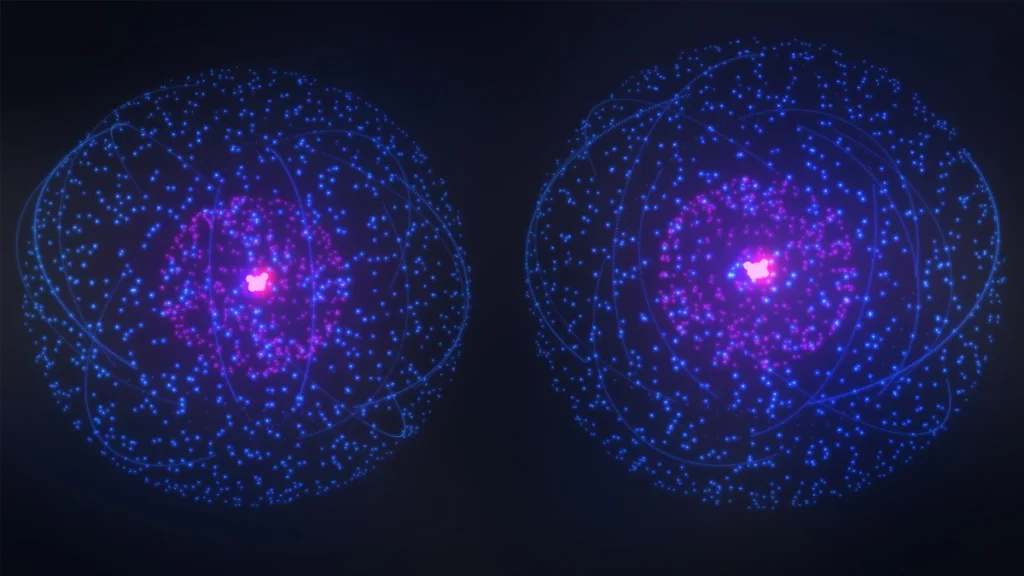
The realm of subatomic particles has just become significantly more enigmatic, as physicists conducting a search for a known, elusive exotic particle have instead stumbled upon compelling evidence for two previously unconfirmed structures. These newfound entities do not readily conform to the established understanding of quarks binding together in simple pairs or triplets, prompting a reevaluation of how matter is fundamentally constructed. The discovery, stemming from experiments at the U.S. Department of Energy’s Thomas Jefferson National Accelerator Facility, marks a significant step in the ongoing quest to unravel the complexities of the strong nuclear force – the fundamental interaction responsible for holding the cores of atoms together.
"We are in a new era here, similar to 70-odd years ago. First, a zoo of hadrons was discovered. Now, we’re facing a zoo of so-called exotic states," stated Frank Nerling, a scientist from Germany’s GSI Helmholtz Centre for Heavy Ion Research and one of the lead researchers involved in this groundbreaking work. His statement underscores the profound shift occurring in particle physics, reminiscent of the mid-20th century when a multitude of new particles led to the development of the quark model. These latest findings are expected to furnish researchers with crucial new clues regarding the strong nuclear force’s intricate mechanisms, particularly its role in assembling some of nature’s most unusual and transient particles.
The Standard Model and the Rise of Exotic Hadrons
To fully appreciate the significance of this discovery, it is essential to contextualize it within the Standard Model of Particle Physics, humanity’s most comprehensive theory describing the fundamental forces and particles that constitute all known matter. The Standard Model posits that matter is composed of elementary particles: quarks and leptons. Quarks, in particular, are the building blocks of composite particles called hadrons. Hadrons are primarily categorized into two types: baryons, which consist of three quarks (like protons and neutrons), and mesons, which are made of a quark and an antiquark. These quarks are held together by the strong nuclear force, mediated by force-carrying particles known as gluons. The theory governing the strong force is Quantum Chromodynamics (QCD), a complex and highly successful framework.
For decades, the traditional quark model, a key component of the Standard Model, has largely explained the vast majority of observed hadrons. However, since the early 2000s, experiments have increasingly unveiled a perplexing collection of short-lived particles that defy this conventional classification. These anomalies are collectively known as XYZ states or, more broadly, exotic hadrons. Unlike conventional mesons or baryons, exotic hadrons are believed to possess more complex internal structures, such as tetraquarks (four quarks), pentaquarks (five quarks), or even glueballs (particles composed solely of gluons) and hybrid mesons (quark-antiquark pairs with an excited gluon). The existence of such particles has been theoretically predicted by QCD, but their experimental confirmation has been challenging, pushing the boundaries of our understanding of the strong force.
A Targeted Search Yields Unexpected Results
The current mystery began with the specific XYZ state known as Y(2175). This particle, a possible "strangeonium" (a meson composed of a strange quark and its antiquark), has a mass of approximately 2.16 GeV (gigaelectronvolts). Its initial detection was reported in 2006 by the BaBar experiment at the U.S. Department of Energy’s SLAC National Accelerator Laboratory. Subsequent experiments at the Beijing Spectrometer (BESIII) in China and the Belle experiment in Japan provided further support for its existence. Crucially, all these earlier observations were derived from high-energy collisions between electrons and positrons. While these findings strongly suggested the particle’s reality, a fundamental question remained: would Y(2175) manifest itself when produced through an entirely different physical process, or was its appearance somehow tied to the specific dynamics of electron-positron annihilation?
To address this critical question, researchers with the GlueX Collaboration at Jefferson Lab embarked on an ambitious experiment. Their objective was to search for Y(2175) using a photon beam, a method fundamentally distinct from electron-positron collisions. The expectation was to either confirm the particle’s presence under new conditions or establish limits on its production via photon interactions. What they discovered, however, was far more intriguing than a simple confirmation. Instead of Y(2175) appearing where anticipated, their analysis revealed compelling evidence for two entirely new structures in the vicinity of the expected mass: Y(2240), with a mass of about 2.24 GeV, and X(1830), with a mass of roughly 1.82 GeV.
"We went searching for a confirmed XYZ candidate with a photon beam but instead found two other structures. It’s new information," explained Malte Albrecht, a staff scientist at Jefferson Lab and another key researcher on the project. This serendipitous discovery underscores the exploratory nature of cutting-edge particle physics research, where carefully designed experiments often lead to unanticipated breakthroughs.
Precision Probing: The GlueX Experiment’s Unique Approach
The GlueX experiment is purpose-built to investigate exotic mesons, particularly those where gluons – the particles mediating the strong nuclear force – are believed to play a direct and prominent role in their structure. To achieve this, the collaboration leverages Jefferson Lab’s Continuous Electron Beam Accelerator Facility (CEBAF), a world-class accelerator renowned for its precisely controlled and high-energy electron beams.
The experimental process is meticulously engineered. CEBAF sends a stream of high-energy electrons towards an ultrathin diamond wafer. As these electrons interact with the diamond lattice, they are converted into a highly energetic photon beam. A unique feature of this photon beam is its polarization, meaning the spins of the photons are aligned, providing an additional dimension of information for probing particle structures. These polarized photons are then directed to slam into protons contained within a liquid hydrogen target. The violent collisions produce showers of secondary particles, which are then meticulously tracked and analyzed by a large, sophisticated spectrometer surrounding the target. By reconstructing the decay products of these ephemeral secondary particles, researchers can infer the properties and masses of the transient particles that briefly existed during the collision.
The sheer scale of data generated by the GlueX experiment is immense. Millions of photons strike the target every second, producing a torrent of information that can fill an average laptop hard drive in mere minutes. "No other experiment has a facility with a photon beam of this intensity at the energy we have available. This truly is a unique setup," Albrecht emphasized, highlighting the unparalleled capabilities of Jefferson Lab in this field. It was by sifting through this colossal dataset, specifically searching for the signature of Y(2175), that the two unexpected structures, Y(2240) and X(1830), gradually emerged at different mass points.
"One of the interesting things about this result is that we didn’t observe Y(2175) at the place we were searching. We found something new using a completely different physics process, and that’s really intriguing. But now that these have been observed, that doesn’t mean we’re done," Albrecht added, hinting at the extensive work that lies ahead.
Statistical Significance and Future Confirmation
In particle physics, the robustness of a discovery is quantified by its statistical significance, typically expressed in terms of "sigma" (σ). The evidence for Y(2240) reached an impressive five-sigma (5σ) significance, which translates to a probability of approximately 99.9994% that the observed signal is not due to a random fluctuation. This level of confidence meets the rigorous gold standard commonly used in particle physics to declare a discovery. The X(1830) signal, while still significant, reached a three-sigma (3σ) confidence level, corresponding to about 99.7%. While indicative, a 3σ signal is generally considered strong evidence but not yet a definitive observation of a new particle; it typically requires further independent confirmation to be established. The difference in significance means that while Y(2240) stands on very firm ground as a new particle candidate, X(1830) will necessitate additional experimental evidence to solidify its nature.
Unraveling the Nature of New Particles
The discovery of Y(2240) and X(1830) is merely the beginning of a complex scientific endeavor. Scientists now face the challenging task of determining the fundamental nature of these new structures. They could represent unusual arrangements of quarks and gluons, potentially fitting the descriptions of tetraquarks, hybrid mesons, or even loosely bound "molecular" states formed by combinations of already known composite particles. The presence of such exotic configurations would provide critical insights into the non-perturbative aspects of QCD, where the strong force behaves in ways that are notoriously difficult to calculate theoretically.
Justin Stevens, a physics professor and a representative from GlueX, shed light on potential avenues of investigation: "Excited gluonic fields are what could be in these mesons where you have more than just the quark-antiquark pair. That’s one of the investigations, to try to understand whether there is a gluonic contribution to the structure we see." This statement directly points towards the possibility of hybrid mesons, where gluons are not just mediating the force but actively contributing to the particle’s quantum numbers and internal structure. The explicit role of gluons in the structure of matter beyond their force-carrying function is a frontier of particle physics.
The new measurements from GlueX offer invaluable data points for theoretical physicists. They provide fresh targets for testing competing explanations of exotic matter, allowing theorists to refine their models and make new predictions. Furthermore, the experiment’s inability to observe Y(2175) through photon collisions, while yielding other discoveries, is itself a crucial piece of information. It places an upper limit on how often Y(2175) can be produced through this particular mechanism, which helps researchers design future experiments more effectively and gain a deeper understanding of how quarks and gluons interact within matter under varying conditions.
Nerling underscored the iterative nature of scientific discovery: "The next step is to figure out which exotic quark configurations nature might have realized here. Theorists may come to further conclusions and identify measurements that could help pin down the real nature of these particular states." This collaborative effort between experimentalists and theorists is fundamental to advancing the field, where new observations inspire theoretical developments, which in turn guide future experimental searches.
Broader Impact and Future Outlook
The work by the GlueX Collaboration is not an isolated event but rather a vital contribution to a broader, global effort to rigorously test the Standard Model of particle physics and ascertain whether its established framework fully accounts for the increasing complexity of particles observed in ever more precise experiments. The discovery of these new exotic candidates, along with numerous others in recent years from facilities like LHCb at CERN, BESIII in China, and Belle II in Japan, is pushing the boundaries of the traditional quark model. It does not necessarily indicate a breakdown of the Standard Model itself, but rather a deeper exploration of its rich and complex predictions regarding the strong force and the spectrum of hadrons.
The "new era" described by Frank Nerling signals an exciting period for hadron spectroscopy. With much more GlueX data still awaiting analysis, researchers anticipate that the "particle zoo" will indeed become even more crowded. This proliferation of new states, while initially perplexing, offers an unprecedented opportunity to map out the landscape of strongly interacting matter in greater detail than ever before. Each new particle or exotic state serves as a unique laboratory for studying the fundamental properties of QCD, providing empirical data to constrain theoretical models and improve our understanding of how quarks and gluons interact at their most basic level. Ultimately, these discoveries bring scientists closer to a complete and nuanced comprehension of the strong nuclear force and the intricate architecture of the universe’s most fundamental constituents. The journey to fully understand these newly observed structures, and the broader implications they hold for particle physics, has just begun.