Electron microscopes, instruments that have revolutionized our understanding of the nanoscale world, are capable of revealing structures far smaller than anything discernible with conventional light. Yet, a groundbreaking initiative by researchers in Austria suggests that even these sophisticated devices may be leaving a wealth of valuable information untapped. A consortium led by TU Wien, in collaboration with the University of Vienna, JKU Linz, and the University of Innsbruck, has developed a novel approach that seeks to harness the inherent quantum information carried by electrons, a capability poised to transform the field of microscopy, particularly for delicate biological specimens.
The conventional operation of an electron microscope primarily involves counting electrons to construct an image. While remarkably effective, this method overlooks the quantum properties intrinsic to each electron. The Austrian teams are proposing and actively constructing a system that connects an electron microscope to a quantum computer. This innovative integration aims to capture and process this hitherto unused quantum information, promising clearer images, reduced electron exposure for sensitive samples, and a paradigm shift in how we observe the atomic and molecular world.
The Foundational Principles of Electron Microscopy and Its Limitations
Electron microscopy emerged in the early 20th century, offering a resolution far exceeding that of light microscopy due to the much shorter de Broglie wavelength of electrons compared to photons. By employing electron beams instead of light, scientists gained the ability to visualize structures down to the atomic scale, unveiling the intricate details of cells, viruses, materials, and nanoparticles. Techniques like Transmission Electron Microscopy (TEM) and Scanning Electron Microscopy (SEM) have become indispensable tools across biology, materials science, and nanotechnology.
Despite their extraordinary capabilities, current electron microscopes face inherent limitations, especially when dealing with biological samples. The very electrons that enable high-resolution imaging can also inflict significant damage on delicate specimens. The intense electron beam can induce chemical changes, conformational alterations, and even complete disintegration of organic molecules, making it challenging to study their native states. This "radiation damage" often necessitates a trade-off between achieving high resolution and preserving sample integrity. For instance, in cryo-electron microscopy (cryo-EM), samples are flash-frozen to mitigate damage, allowing for higher electron doses, but even then, the total electron budget remains a critical constraint. Researchers are constantly battling the signal-to-noise ratio, often requiring a large number of electrons to generate a discernible image, which exacerbates the damage problem.
Unlocking the Quantum Dimension: The New Paradigm
The Austrian researchers propose to circumvent these classical limitations by tapping into the quantum realm. Each electron, beyond being a countable particle, also carries quantum information. In a standard electron microscope, this quantum information, which could provide additional insights into the electron’s interaction with the sample, is typically discarded. The breakthrough lies in the realization that this information can be harnessed through the principles of quantum mechanics.
"Today, we can image tiny details on the atomic scale," explains Philipp Haslinger from the Institute of Atomic and Subatomic Physics at TU Wien. "However, this requires a large number of electrons. And not every sample can be exposed to so many electrons without being damaged. This is often a problem, particularly when imaging biological samples such as individual proteins." This challenge forms the core motivation for their research: to extract more useful information from each electron, thereby reducing the total number required for image formation.
Quantum Entanglement: The Key to Enhanced Information Extraction
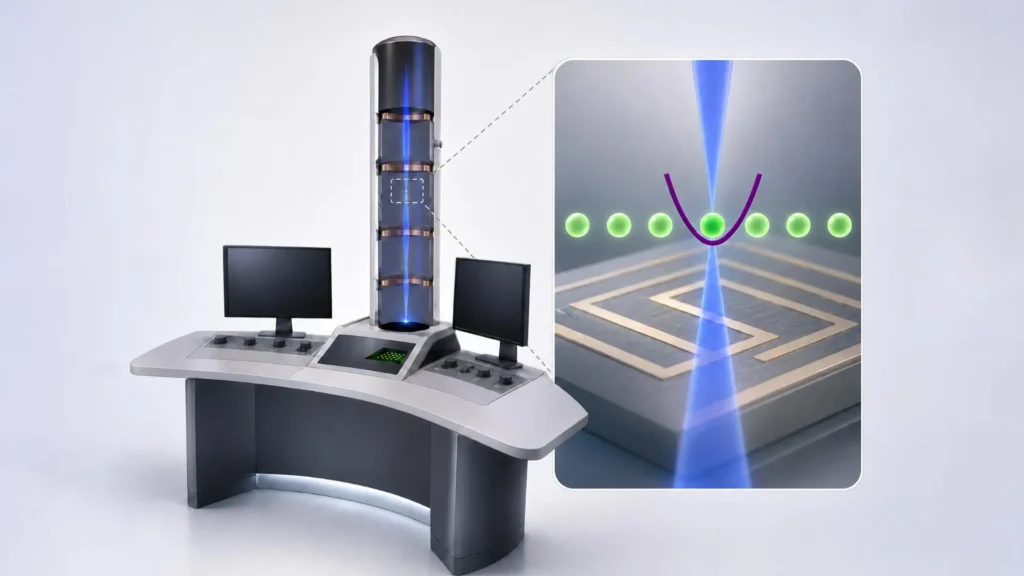
The core of the new approach involves linking the electron microscope to a quantum computer. Specifically, the team proposes a quantum computer built around trapped ions. This interaction is designed to induce quantum entanglement between the electrons traversing the microscope and the ions serving as qubits in the quantum computer.
Elias Pescoller, the first author of the publication and a doctoral student at the Institute for Theoretical Physics and the Institute of Atomic and Subatomic Physics at TU Wien, elaborates on the mechanism: "Our idea is to combine the electrons with a quantum computer. We let them interact with ions that are held in place along the path of the electron beam. This can, for example, create quantum entanglement between the electron and the quantum computer. The electron and the ion then share a joint quantum state."
Quantum entanglement is a phenomenon unique to quantum mechanics, where two or more quantum systems become inextricably linked, such that the state of one instantly influences the state of the others, regardless of the distance separating them. In this setup, an electron passing through the sample and then interacting with a trapped ion effectively transfers information about its interaction with the sample into the quantum state of the ion. This means that instead of merely counting where an electron lands, the system can capture a richer, more nuanced dataset encoded in the quantum state.
The Role of Quantum Computing Algorithms
The true power of this system emerges when multiple electrons interact with the quantum computer sequentially. After one electron entangles with a trapped ion, another electron can pass through and similarly become entangled. The quantum computer then performs carefully designed quantum operations to process and combine the information from these multiple electrons.
Dennis Rätzel from the Institute of Atomic and Subatomic Physics at TU Wien highlights the significance of these operations: "If we perform very specific quantum-computing operations each time, we can optimally combine the information from several electrons so that we obtain a signal of maximum strength even though we use only a relatively small number of electrons."
These sophisticated algorithms, crucial for translating raw quantum interactions into meaningful data, were developed in collaboration with Johannes Kofler’s team at JKU Linz. The algorithms are designed to exploit the quantum correlations generated by entanglement, allowing the system to discern subtle patterns and signals that would be lost in the noise of a classical electron counting system.
Iva Bezinova from the Institute for Theoretical Physics at TU Wien summarizes the transformative potential: "The electrons themselves are used to image small objects, just as in any other electron microscope. But by processing the quantum information carried by these electrons in a quantum computer, we can extract significantly more information from the process. What would previously have been indistinguishable from random noise can thus become a clear signal." This ability to amplify weak signals is paramount for imaging extremely radiation-sensitive materials and for pushing the boundaries of resolution without increasing damage. Elias Pescoller further asserts that "Quantum physics allows us to overcome the statistical limits that constrain conventional electron microscopes."
A Collaborative Austrian Endeavor: From Theory to Prototype
The development of this pioneering quantum electron microscope is a testament to the collaborative spirit and interdisciplinary expertise within the Austrian scientific community. The project brings together leading institutions with specialized knowledge in quantum information, quantum computing, and electron microscopy.
The initial phase involved extensive mathematical proof and theoretical modeling to demonstrate the viability and potential advantages of the new method. With the theoretical groundwork established, the consortium has now moved into the experimental phase. At TU Wien’s University Service Center for Transmission Electron Microscopy (USTEM), researchers are actively preparing for the integration of an ion-based quantum computer into an electron microscope. The quantum computer component itself was developed by Philipp Schindler’s team at the University of Innsbruck, showcasing the specialized contributions from each partner institution.
Thomas Juffmann from the University of Vienna emphasizes the synergy: "It is really exciting that, within the quantA Cluster of Excellence, we can combine the expertise in quantum information, quantum computing and electron microscopy available at the different universities in Austria. This allows us to launch a unique project." This collaborative framework, uniting theoretical physicists, experimental quantum physicists, and materials scientists, is critical for tackling the complex engineering and scientific challenges involved in building such a hybrid instrument.
Broader Implications and Future Outlook
If the system functions as anticipated, its implications for scientific research could be profound and far-reaching.
Revolutionizing Structural Biology: The most immediate and significant impact is expected in structural biology. The ability to image biological macromolecules like proteins, nucleic acids, and cellular components with higher resolution and reduced electron dose could unlock unprecedented insights into their native structures and dynamic functions. This could accelerate drug discovery by providing clearer targets, deepen our understanding of disease mechanisms, and shed light on fundamental biological processes that are currently obscured by electron beam damage. Imagine precisely visualizing delicate protein complexes in their functional states, or observing molecular machines in action without fear of destroying them.
Advancing Materials Science and Nanotechnology: Beyond biology, materials scientists could benefit immensely. The study of radiation-sensitive materials, such as organic semiconductors, polymers, and certain catalysts, could be performed with greater fidelity. Researchers could explore new nanomaterials and quantum dots with enhanced precision, leading to innovations in electronics, energy storage, and quantum technologies themselves.
Pushing the Boundaries of Resolution: By overcoming classical statistical limits, the quantum electron microscope could potentially push the achievable resolution even further, revealing details that are currently beyond the reach of even the most advanced conventional instruments. This could open entirely new avenues of discovery at the very edge of the atomic scale.
A New Class of Scientific Instruments: This project represents a pioneering step towards a new class of hybrid scientific instruments that integrate quantum technologies directly into classical measurement devices. It sets a precedent for how quantum computing could enhance traditional experimental techniques, moving beyond theoretical applications to tangible, practical improvements in scientific discovery.
Challenges and the Road Ahead
While the mathematical proof offers a compelling vision, the experimental realization presents substantial engineering and scientific hurdles. Integrating a sophisticated ion-based quantum computer with the vacuum and electron beam environment of an electron microscope is a formidable task. Maintaining the delicate quantum coherence required for entanglement while electrons interact with the sample and then with the ions will demand extreme precision and stability. The algorithms must be robust and efficient, capable of processing quantum information in real-time.
Furthermore, the cost and complexity of such hybrid systems could initially limit their widespread adoption. However, as quantum computing technology matures and becomes more accessible, and as the benefits become undeniable, these instruments could eventually become standard tools in cutting-edge research facilities.
The current focus is on demonstrating the experimental benefits of the prototype. Success in this phase will pave the way for further development, optimization, and ultimately, the deployment of quantum-enhanced electron microscopes that promise to reveal the universe in unprecedented detail, without compromising the integrity of its most delicate components.
Major funding for this ambitious consortium, which is coordinated by the University of Vienna, comes from the Austrian Science Fund (FWF) through the Cluster of Excellence quantA and from the Gordon and Betty Moore Foundation, underscoring the international recognition of this groundbreaking research. The journey from theoretical possibility to a working, transformative instrument is underway, promising a quantum leap for scientific imaging.