More than 50 years ago, visionary physicist Sir Roger Penrose ignited the scientific imagination with a profound proposition: under specific, extreme conditions, it might be feasible to extract energy from the formidable rotational energy of a rapidly spinning black hole. His groundbreaking concept described a scenario where a particle venturing into the black hole’s ergosphere – a peculiar region where the very fabric of spacetime is inexorably dragged along by the object’s immense rotation – could fragment into two distinct parts. One of these fragments would inevitably succumb to the black hole’s gravitational pull, spiraling inward, while the other would escape, astonishingly carrying away more energy than the original particle possessed. This theoretical marvel, known as the Penrose process, laid a crucial foundation for understanding energy dynamics in the universe’s most enigmatic objects.
A decade later, in 1971, another brilliant physicist, Yakov Zel’dovich, expanded upon Penrose’s audacious idea, shifting the focus from particles to waves. Zel’dovich predicted that waves interacting with an object rotating at a sufficiently high speed could similarly gain energy, becoming significantly amplified through a phenomenon now recognized as superradiance. This theoretical framework suggested that not only could matter extract energy, but also electromagnetic or gravitational waves could be "boosted" by a spinning celestial body. However, the extreme rotational speeds and gravitational forces required for these processes made them seem perpetually beyond the reach of terrestrial experimentation, confined solely to the realm of theoretical physics and astronomical observation.
Now, after decades of conceptual development and computational modeling, a significant experimental breakthrough has been achieved by researchers at the Advanced Science Research Center (ASRC) at the CUNY Graduate Center. Publishing their findings in the prestigious journal Nature, the team has successfully demonstrated an experimental approach directly inspired by these long-standing theories. Crucially, they showed that wave amplification, mirroring the essential physics of the Penrose-Zel’dovich process, can be realized using an innovative device that simulates extreme rotation without any physical spinning. This pioneering work not only validates foundational astrophysical theories but also unlocks a new frontier for exploring extreme physics and developing advanced technologies.
The Penrose-Zel’dovich Legacy: A Theoretical Odyssey
To fully appreciate the magnitude of the CUNY ASRC’s achievement, it is essential to delve deeper into the theoretical underpinnings that have fascinated physicists for over half a century. Black holes, as predicted by Einstein’s theory of general relativity, are regions of spacetime where gravity is so intense that nothing, not even light, can escape. They are typically characterized by their mass, charge, and angular momentum (spin). Spinning black holes, known as Kerr black holes, possess a unique structure that includes the ergosphere.
The ergosphere is not the event horizon, the point of no return. Instead, it is an outer boundary where spacetime itself is dragged around by the black hole’s rotation. Inside the ergosphere, it is impossible for any object or light to remain stationary relative to a distant observer; everything is compelled to co-rotate with the black hole. However, unlike the event horizon, it is theoretically possible to escape the ergosphere. Penrose’s genius lay in recognizing this nuance. He proposed that if a particle entering the ergosphere were to split, one fragment could acquire negative energy relative to an outside observer. This "negative energy" state is only possible within the ergosphere and is what allows the other fragment to escape with more energy than the original particle, effectively drawing rotational energy from the black hole itself. While the theoretical maximum efficiency for extracting energy from a maximally spinning Kerr black hole could be as high as 20.7% of its total mass, the practical challenges of such a particle-splitting mechanism in the vicinity of a black hole are immense, requiring precise conditions and interactions.
Zel’dovich extended this concept to waves, introducing the idea of superradiance. He theorized that if a wave encounters a rotating absorber (or, by analogy, a rotating black hole), and the object’s rotational speed exceeds the wave’s phase velocity, the wave can be amplified. Instead of being absorbed, the wave gains energy from the rotating object, similar to how a spinning drum might amplify sound waves under specific conditions. This phenomenon is not limited to black holes; it can occur with any rotating object, provided the rotational speed and wave properties are suitably matched. Zel’dovich even speculated about a "black hole bomb" – a theoretical scenario where a superradiant black hole placed within a reflective cavity could lead to an exponential amplification of waves, creating an explosive energy release. While such a scenario remains purely theoretical, it underscored the powerful implications of superradiant amplification.
For decades, the experimental verification of these profound theories remained elusive. The colossal gravitational forces of black holes and the unattainable mechanical rotational speeds required for terrestrial analogues presented insurmountable barriers. Physicists were left to ponder these ideas solely through mathematical models and astrophysical observations.
Synthetic Rotation: A Paradigm Shift in Experimental Physics
The CUNY ASRC team’s breakthrough lies in their innovative circumvention of these long-standing experimental limitations. Instead of attempting to mechanically rotate an object at speeds that defy conventional engineering – speeds that would tear apart any known material – the researchers developed a sophisticated radio frequency device that creates the illusion of ultrafast rotation. This method, termed "synthetic rotation," eliminates the need for physical motion entirely.
The device itself is a carefully engineered system whose electromagnetic properties are rapidly and precisely changed across both space and time. By manipulating the local refractive index and other characteristics of the medium in a dynamic, synchronized sequence, the researchers effectively create a traveling pattern that electromagnetic waves perceive as a rapidly spinning environment. This sophisticated approach allows for the simulation of effective rotational speeds far beyond what any conventional mechanical system could ever hope to achieve, pushing the boundaries of experimental physics into previously inaccessible regimes.
"Our approach facilitates a new method of wave-matter interaction in which waves with selected rotational properties extract energy from synthetic time-engineered rotation, producing a form of broadband selective amplification," explained Andrea Alù, the principal investigator, who is a Distinguished Professor and Einstein Professor of Physics at the CUNY Graduate Center and founding director of the CUNY ASRC’s Photonics Initiative. His statement underscores the novelty of their method, which opens up entirely new avenues for controlling and harnessing wave energy.
The Mechanics of the Experiment: A Ring of Resonators
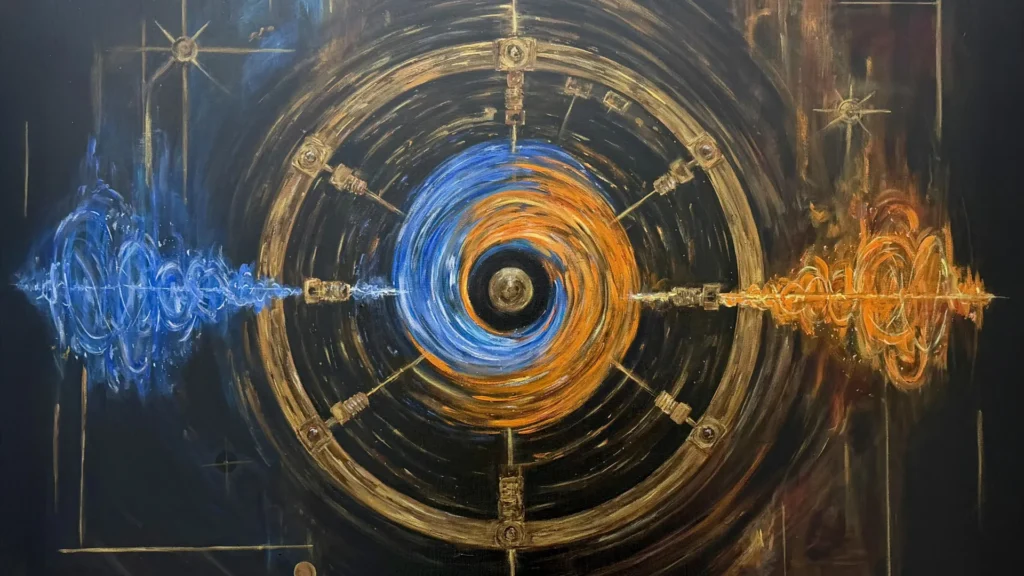
To investigate whether electromagnetic waves could behave as if they were encountering an object rotating at ultrafast speed and draw energy from this synthetic motion, the team constructed a ring of electronic resonators. These resonators are essentially components designed to oscillate at specific frequencies. The genius of the experiment lay in how these resonators’ properties were not static but were rapidly adjusted in a carefully synchronized sequence.
Although the physical hardware of the ring remained completely stationary, these precisely timed changes in the resonators’ properties generated a dynamic, traveling pattern around the ring. This induced a non-reciprocal response in the system, meaning that waves propagating in one direction experienced different conditions than waves propagating in the opposite direction, a hallmark of rotation. Consequently, electromagnetic waves interacting with this system effectively experienced it as though it were spinning at extraordinary, even "superluminal" (faster than light), speeds.
Co-lead author Hady Moussa, a former PhD student with the CUNY ASRC Photonics Initiative, elaborated on the mechanism: "Waves with the appropriate rotational characteristics extracted energy from the system and became amplified, reproducing the essential physics of the Penrose-Zel’dovich process." He further noted, "Our approach relies on engineered metamaterials that are designed to control how waves propagate." Metamaterials are artificial structures engineered to possess properties not typically found in natural materials. By designing these structures at scales smaller than the wavelength of the interacting waves, scientists can precisely control how light or other electromagnetic waves interact with the material, offering unprecedented control over wave propagation. In this experiment, the dynamic manipulation of these metamaterial-like properties within the electronic resonator ring was key to simulating the rotational environment.
The successful demonstration marks a pivotal moment, transitioning a long-standing theoretical concept from abstract equations to a tangible laboratory phenomenon. Lead author Hadiseh Nasari, a post-doctoral researcher with the CUNY ASRC’s Photonics Initiative, emphasized this transformation: "This successful experiment moves ideas about extreme rotational dynamics from theory to practice and creates a versatile experimental platform for exploring a broad range of phenomena at the intersection of astrophysics, wave physics, and quantum science." She highlighted the profound implications, extending from fundamental science to practical applications in communications, optics, and photonics.
Broader Impact and Future Horizons
The implications of this breakthrough extend far beyond merely validating half-century-old theories. The ability to simulate extreme rotation synthetically opens up a controlled laboratory platform for exploring physical regimes that would otherwise be impossible to study directly. This capability has profound ramifications across multiple scientific disciplines and technological sectors.
In Fundamental Science:
- Astrophysics: For the first time, researchers have a terrestrial platform to directly investigate phenomena related to black holes, such as the Penrose process, superradiance, and frame-dragging, without requiring actual black holes. This could lead to a deeper understanding of the physics governing these extreme cosmic objects, potentially shedding light on their formation, evolution, and interaction with their environment. It offers a new avenue to test theories of general relativity under extreme conditions that are otherwise inaccessible.
- Wave Physics: The research provides a novel framework for studying wave-matter interactions in non-equilibrium, dynamically changing systems. It allows for the exploration of how waves behave in environments where the effective properties of the medium are rapidly modulated in space and time, leading to new insights into wave amplification, energy transfer, and signal manipulation.
- Quantum Science: The principles demonstrated could potentially be extended to photonic and quantum systems. This opens up possibilities for investigating quantum analogues of black hole phenomena, studying quantum superradiance, or developing new methods for controlling quantum states. It could pave the way for understanding how quantum information behaves in highly dynamic and non-reciprocal environments.
In Technological Applications:
- Wireless Communications: The ability to achieve broadband selective amplification of waves has transformative potential for wireless communication systems. It could lead to the development of highly efficient amplifiers for weak signals, enabling longer-range and more reliable communication. It might also facilitate new forms of directional antennas and advanced signal processing techniques, enhancing data transmission rates and reducing interference in crowded spectrums.
- Optics and Photonics: This research could inspire the creation of novel light sources, detectors, and modulators. Imagine optical isolators that prevent unwanted reflections or highly efficient optical amplifiers that require minimal energy input. The ability to control light at unprecedented levels could revolutionize optical computing, quantum optics, and high-speed data transfer within optical networks.
- Quantum Technologies: While still nascent, the application of these principles to quantum systems could lead to advancements in quantum sensing, quantum computing, and quantum communication. The precise manipulation of wave properties in dynamic environments could offer new tools for preparing and manipulating fragile quantum states, crucial for the development of next-generation quantum devices.
The researchers acknowledge that significant additional work will be necessary before these groundbreaking ideas can be translated into practical, deployable devices. The challenge lies in scaling the technology, refining the engineering, and addressing the complexities of integrating these synthetic rotation systems into existing or future communication and optical platforms. However, the fundamental principles have been established, and the pathway for future innovation is now clearly illuminated.
This pivotal research, which bridges the gap between abstract theoretical physics and tangible experimental verification, was made possible through the generous support of several key funding bodies: the U.S. Department of Defense, the U.S. National Science Foundation, and the Simons Foundation. Their investment in fundamental science has yielded a breakthrough that promises to reshape our understanding of the universe and propel technological progress across multiple frontiers, from the depths of black hole physics to the intricacies of everyday communication. The CUNY ASRC’s achievement stands as a testament to the enduring power of scientific curiosity and the innovative spirit that continues to unlock the universe’s most profound secrets.