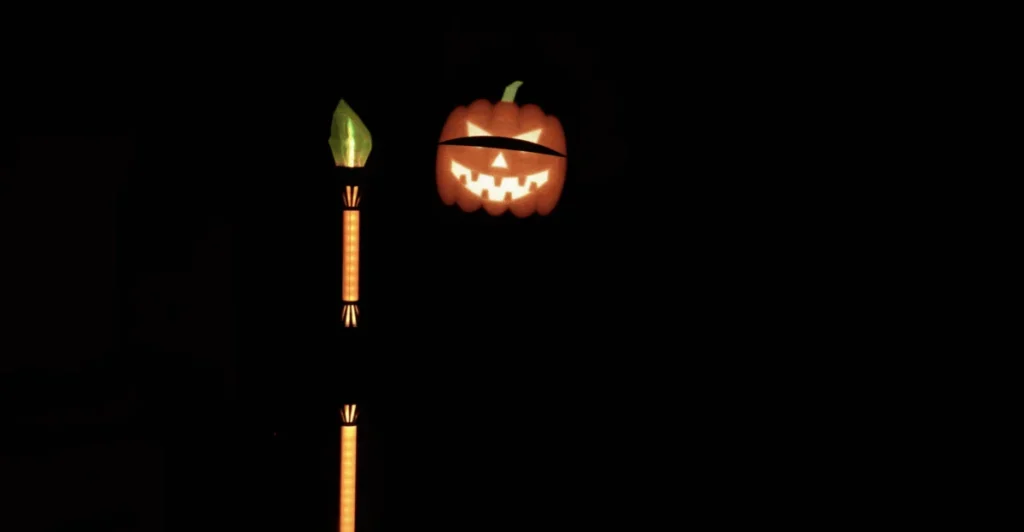
The landscape of holiday costuming has undergone a significant technological shift as makers increasingly integrate sophisticated electronics into wearable art, a trend exemplified by Sebastian Staacks’ latest creation. Known for his technical blog "There Oughta Be," Staacks has developed what he describes as a "hood full of pixels," a high-tech mask capable of morphing into any digital visage through the use of high-density LED matrices. Originally conceived for a Halloween celebration, the project represents a convergence of embedded systems programming, 3D structural engineering, and theatrical design. The mask is not merely a static display but a dynamic canvas, allowing the wearer to transition between characters instantaneously, controlled by a synchronized peripheral staff that acts as the system’s primary interface.
Technical Foundations: The Raspberry Pi Pico 2 W Integration
At the heart of the shapeshifting mask lies the Raspberry Pi Pico 2 W, a microcontroller chosen for its balance of processing power and compact form factor. The Pico 2 W, featuring the RP2350 chip, provides the necessary dual-core performance to drive high-resolution LED arrays while maintaining low power consumption. This specific hardware choice is critical because driving a high-density LED matrix requires constant, high-speed data refreshing to avoid flickering, especially when the wearer is in motion.
The display consists of two 128×64 LED matrices, providing a total resolution that allows for surprisingly detailed facial features. These matrices utilize the HUB75 interface, a standard protocol for large-scale LED signage that requires precise timing to control the red, green, and blue (RGB) diodes. By leveraging the Pico 2 W’s Programmable I/O (PIO) state machines, Staacks was able to offload the timing-heavy tasks from the main CPU, ensuring that the animations remain fluid even as the device handles other inputs.
The hardware is powered by a standard USB power bank, though the power requirements are substantial for a wearable device. At full brightness, the LED arrays can draw upwards of 3 Amperes of current. This necessitates robust wiring and a power delivery system capable of handling significant loads without overheating or experiencing voltage drops that could reset the microcontroller.
Engineering and Structural Assembly
Creating a wearable display of this magnitude presents unique mechanical challenges, particularly regarding weight distribution and user comfort. Staacks utilized a combination of 3D-printed brackets, magnets, and zip ties to secure the heavy LED panels to a standard protective face shield. The use of 3D printing allowed for custom-contoured mounts that distribute the weight across the forehead and cheekbones rather than the bridge of the nose.
Magnets play a crucial role in the mask’s modularity. By using high-strength neodymium magnets, the electronic components can be easily detached from the fabric hood for maintenance or battery swaps. This design choice also serves a safety function; in the event of a technical failure or the need for a quick removal, the mask can be detached without fumbling with complex harnesses.

Visibility remains one of the primary hurdles in full-face LED costuming. To allow the wearer to navigate safely, Staacks incorporated a narrow horizontal slit between the two LED panels. While this offers a limited field of vision, it is a necessary compromise to maintain the "infinite face" illusion on the exterior. The entire assembly is shrouded in a black, light-absorbent hood, which serves to hide the structural elements and ensure that the glowing pixels appear to float in the darkness, creating a striking visual contrast.
The Control Staff: An Integrated User Interface
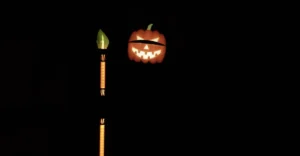
The "Hood Full of Pixels" is accompanied by a secondary piece of hardware that elevates the project from a simple costume to an interactive performance piece: a glowing staff. This staff is not merely a prop but serves as the control hub for the entire ensemble. Like the mask, the staff is powered by its own Raspberry Pi Pico 2 W and a dedicated USB power bank.
Integrated within the staff is an accelerometer, which detects the orientation and movement of the device. This allows Staacks to change the mask’s display through physical gestures. For example, a sharp tilt or a specific rotation of the staff can trigger a signal—sent via a wireless protocol—to the mask to switch from a ghostly skull to a futuristic robotic face.
The staff also features manual controls and is synced with a Bluetooth speaker mounted on the wearer’s belt. This synchronization allows for a holistic audio-visual experience; when the mask changes its appearance, the staff can change its glow color, and the speaker can emit a corresponding sound effect or voice modulator change. This level of integration mimics the sophisticated "show control" systems used in professional theme parks and theatrical productions.
Chronology of the Build
The development of the LED mask followed a rigorous engineering timeline, beginning with the conceptualization phase several months prior to Halloween.
- Phase I: Component Testing (August): The initial phase involved testing the HUB75 LED matrices with the then-new Raspberry Pi Pico 2 W. Staacks had to ensure the PIO code could handle the refresh rate required for the 128×64 density.
- Phase II: Structural Prototyping (September): Using CAD software, Staacks designed the initial 3D-printed mounts. This phase involved multiple iterations to find the balance between structural rigidity and the weight limits of a wearable mask.
- Phase III: Software and Animation Development (Late September): The software was written to handle bitmap storage and real-time animation. Each "face" had to be optimized for the specific resolution of the matrices to ensure clarity.
- Phase IV: Staff Integration (October): The staff was built and programmed to communicate with the mask. This required fine-tuning the accelerometer sensitivity to prevent accidental face changes during normal walking.
- Phase V: Final Assembly and Stress Testing (Late October): The components were integrated into the hood and staff. Stress tests were conducted to monitor battery life and heat dissipation, ensuring the 3A draw did not cause the panels to become uncomfortably hot against the face.
Safety Considerations and Ergonomic Challenges
Operating high-power electronics in close proximity to the human face introduces several safety concerns that Staacks addressed throughout the build. The most prominent issue is the 3A current draw. While 5V (the standard USB voltage) is generally safe regarding electric shock, the heat generated by the LEDs and the potential for a short circuit in a flexible, wearable environment require careful insulation.
The narrow viewing slit also poses a challenge for long-term wear. In environments with varying light levels, such as a crowded party or an outdoor event, the contrast between the bright LEDs and the dark interior of the hood can lead to eye fatigue. Staacks noted that while the effect is "amazing" in the dark, the practicalities of navigation require the wearer to be highly conscious of their surroundings.

Furthermore, the weight of the LED panels and the internal battery bank (if not hip-mounted) can lead to neck strain. By using a standard face shield as the base, the project leverages a design already intended for ergonomic headwear, providing a more stable platform than a simple elastic strap.
Broader Implications in the Maker Community
The "Hood Full of Pixels" project is indicative of the "Intermediate Maker" tier—a demographic of hobbyists who possess skills in coding, 3D design, and electronics assembly. By publishing the part numbers and assembly details on his blog, Staacks has provided a blueprint for others to explore the boundaries of digital costuming.
This project highlights the democratization of advanced hardware. A decade ago, a mask with this level of resolution and interactivity would have required expensive industrial components. Today, with microcontrollers like the Raspberry Pi Pico 2 W costing less than $10 and mass-produced LED matrices becoming widely available, high-end "cyberpunk" aesthetics are within reach of the dedicated hobbyist.
Moreover, the project suggests a future where costuming becomes an iterative, software-defined medium. Instead of building a new costume every year, a maker could simply update their "Hood Full of Pixels" with new animations, sensors, or AI-driven facial tracking. This shift from physical crafts to digital-physical hybrids is a hallmark of the modern maker movement, blending traditional craftsmanship with the cutting edge of silicon technology.
Conclusion
Sebastian Staacks’ shapeshifting LED mask stands as a testament to the creative potential of modern embedded systems. By successfully navigating the complexities of high-speed data protocols, power management, and ergonomic design, he has created a piece of wearable technology that is as functional as it is visually stunning. As the maker community continues to push the limits of what is possible with low-cost electronics, projects like "A Hood Full of Pixels" serve as both an inspiration and a technical benchmark for the future of interactive art and holiday tradition.