An international team of astronomers, co-led by an Institute for Advanced Study (IAS) scholar, has identified what appears to be a universal rule governing one of the most dramatic behaviors of black holes: the production of powerful relativistic jets. This groundbreaking discovery, published in the prestigious journal Nature Astronomy, suggests that black holes, regardless of their immense size variations, launch these colossal outflows of plasma at a remarkably similar critical stage in their feeding cycle. This finding has profound implications for our understanding of black hole physics, galaxy evolution, and the very fabric of the cosmos.
The research, spearheaded by Andrew Mummery, a Martin A. and Helen Chooljian Member in the School of Natural Sciences at the Institute for Advanced Study (IAS) for the period 2025-2030, and Adelle Goodwin, a Forrest Research Foundation Fellow at Curtin University’s International Centre of Radio Astronomy Research (ICRAR) in Western Australia, synthesizes years of meticulous observations across the electromagnetic spectrum. Their collaborative effort drew upon data from a global network of observatories, including sophisticated instruments in America, Australia, India, and South Africa, as well as cutting-edge space-based telescopes. This multidisciplinary approach allowed for an unprecedented holistic view of black hole activity.
Witnessing the Violent Demise of Stars
The focal point of this extensive study was tidal disruption events (TDEs). These cataclysmic phenomena occur when a star ventures too close to the overwhelming gravitational grip of a supermassive black hole. The immense tidal forces exerted by the black hole then inexorably rip the star apart, a process often described as "spaghettification." These events offer astronomers a rare and invaluable opportunity to observe in near real-time how a black hole’s behavior changes in response to a sudden and substantial influx of matter.
"We were driven by a profound desire to unravel this immense cosmic puzzle," stated Dr. Mummery. "The question that plagued us was: why do some supermassive black holes immediately unleash powerful radio jets the moment they shred a star, while others remain quiescent for extended periods, only to ignite their jets months or even years later? This variability has been a persistent enigma."
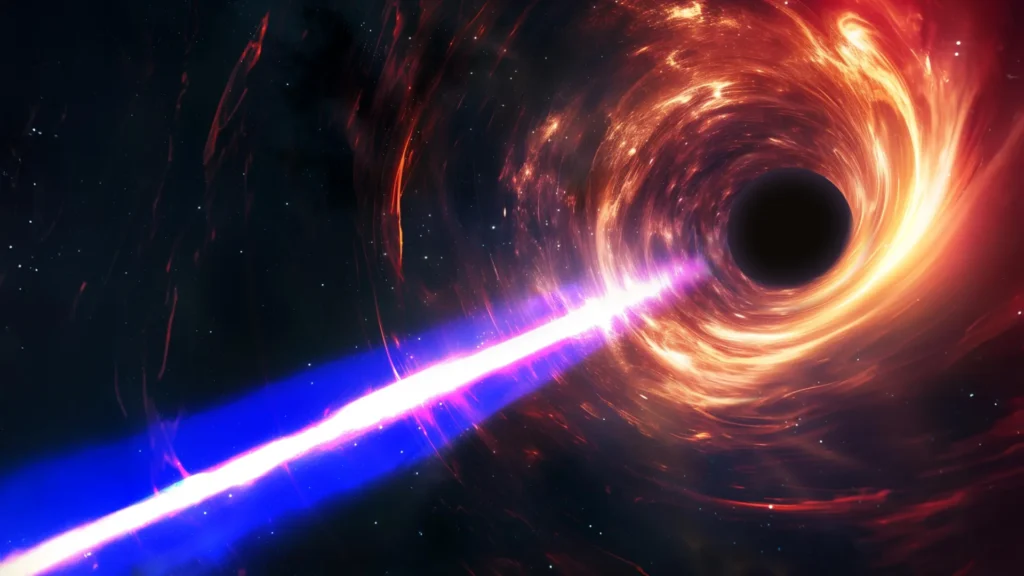
Black holes, though often metaphorically depicted as insatiable cosmic vacuum cleaners, possess a far more chaotic and complex feeding mechanism. "When a black hole tears apart a star, it does not neatly ingest all the stellar material," explained Dr. Goodwin. Instead, a significant portion of the star’s remnants is violently ejected into the surrounding space through powerful outflows, often referred to as relativistic jets. These colossal cosmic expulsions, capable of carrying matter at speeds approaching that of light, can traverse vast cosmic distances. Their influence extends far beyond the immediate vicinity of the black hole, playing a crucial role in shaping the evolution of the galaxies in which they reside.
A Swift Window into Supermassive Black Hole Dynamics
For decades, astronomers have operated under the strong theoretical suspicion that the fundamental physical principles governing black holes remain consistent, irrespective of their staggering differences in mass. However, empirically verifying this hypothesis has presented considerable challenges. The processes surrounding supermassive black holes typically unfold over timescales spanning thousands, if not millions, of years, making direct observation and analysis exceedingly difficult.
Tidal disruption events have emerged as a vital workaround to this temporal limitation. When a star is violently disrupted, the subsequent feeding episode around a supermassive black hole can evolve and manifest its activity over a period of just a few years. This compressed timescale provides scientists with a significantly accelerated observational window into processes that would otherwise be virtually impossible to track in real time.
The pivotal insight that underpins this new research emerged in an informal yet scientifically fertile setting. During an astrophysics conference held in Madrid, Spain, Dr. Mummery and Dr. Goodwin were engaged in a discussion at a local bar. It was during this casual conversation that they had a remarkable realization: a specific physical rule, previously known to govern jet production in smaller, stellar-mass black holes, might also be universally applicable to their much larger supermassive counterparts. This serendipitous connection sparked the drive for the rigorous investigation that followed.
Unveiling Two Distinct Phases of Black Hole Jet Eruption
To rigorously test their hypothesis, the research team meticulously examined twenty well-documented tidal disruption events. Their analysis incorporated observations across a broad spectrum of electromagnetic wavelengths, including optical light, ultraviolet radiation, X-rays, and radio waves. This multi-wavelength approach was critical for capturing the full picture of the material dynamics and energy output associated with these events.
Following a thorough sifting of the available data, the researchers narrowed their focus to ten high-quality TDEs. These selected events provided reliable data that allowed for the precise determination of the black hole’s accretion rate – the rate at which it was consuming stellar material – and the precise timing of the subsequent radio jet outflows.
The comprehensive analysis revealed a compelling pattern: black hole jets appear to form during two distinct temporal phases following the initial disruption of a star.
The first phase of jet formation occurs relatively early in the TDE process, coinciding with a period when the black hole is actively consuming stellar material at an extremely high rate. This initial burst of activity is thought to be directly linked to the rapid influx of gas and dust spiraling into the black hole.
The second, and perhaps more surprising, phase of jet formation emerges much later, typically hundreds to thousands of days after the star was initially torn apart. This delayed eruption suggests a more complex underlying mechanism than a simple direct response to immediate accretion.
Crucially, at this later stage, the black hole’s feeding rate is observed to have significantly diminished, falling to approximately two percent of the Eddington limit. The Eddington limit represents a theoretical maximum rate at which a black hole can accrete matter. Beyond this limit, the outward pressure exerted by the intense radiation emitted by the infalling material would theoretically overcome the inward pull of gravity, halting further accretion.
The Significance of the Two Percent Threshold
The identification of this specific "two percent threshold" is particularly significant. This same critical accretion rate is already well-established as a trigger for jet formation in much smaller, stellar-mass black holes located within our own Milky Way galaxy. The fact that this identical threshold is observed to initiate jet formation in supermassive black holes, which are millions of times more massive, provides powerful evidence for a universal principle at play. It strongly suggests that this particular aspect of black hole physics operates in fundamentally the same manner across an immense range of black hole masses, from those comparable to our Sun to the colossal behemoths at galactic centers.
This universal critical accretion rate implies that the underlying physics governing the launch of relativistic jets is not dictated by the absolute mass of the black hole but rather by the rate at which it is accreting matter relative to its size and gravitational influence. This is a fundamental shift in our understanding, moving from a mass-centric view to a rate-dependent one for jet production.
Predicting Cosmic Eruptions and Enhancing Observational Efficiency
The implications of this discovery extend beyond pure theoretical advancement; they also hold significant practical value for observational astronomy. By identifying the conditions that lead to delayed jet formation, researchers can refine their strategies for observing these fleeting but powerful cosmic events.
"If astronomers can accurately predict when a black hole is likely to produce a delayed jet, they can schedule their observations much more efficiently," explained Dr. Mummery. "This increases their chances of capturing these short-lived phenomena as they unfold, rather than missing them due to a lack of foresight."
This predictive capability can lead to more judicious use of highly sought-after telescope time. It can reduce the number of unproductive observations made when little or no black hole activity is expected, thereby optimizing the allocation of precious observational resources.
Furthermore, the ability to anticipate these powerful eruptions is poised to become increasingly vital for the operation of next-generation astronomical facilities. Major upcoming projects, such as the ambitious Square Kilometre Array (SKA) radio telescope project, which is slated to commence scientific data collection in 2028, will be capable of detecting and characterizing these events with unprecedented sensitivity. Having a predictive framework will enable the SKA and similar advanced observatories to maximize their scientific return by targeting observations when they are most likely to yield groundbreaking discoveries.
Broader Implications for Galactic Evolution
The continuous ejection of material through relativistic jets has a profound impact on the evolution of galaxies. These powerful outflows can inject enormous amounts of energy and momentum into the interstellar medium, the gas and dust that permeates galaxies. This energy input can regulate star formation by heating and dispersing gas clouds, or it can even expel gas from galaxies altogether, thus quenching star formation and shaping the morphology and growth of galactic structures over cosmic timescales.
Understanding the universal mechanisms that drive jet production is therefore intrinsically linked to understanding how galaxies form and evolve. The findings of Mummery and Goodwin provide a crucial piece of this complex cosmic puzzle.
Future Directions and Unanswered Questions
While this study represents a significant leap forward, it also opens new avenues for future research. Astronomers are now keen to explore the precise physical mechanisms that lead to the delayed jet formation. Is it related to the evolution of the accretion disk around the black hole, the properties of the ejected stellar debris, or perhaps the interplay between the black hole’s spin and its magnetic field? Further detailed observations of TDEs, coupled with advanced theoretical modeling, will be essential to fully elucidate these processes.
The universality of the observed critical accretion rate also prompts further questions about the diversity of black hole environments. How does the surrounding galactic environment, such as the density of gas and the presence of magnetic fields, influence the accretion process and subsequent jet production?
"We are optimistic that our work will serve as a catalyst for even more profound discoveries about the universe," concluded Dr. Mummery. The identification of a universal rule governing black hole jet formation marks a pivotal moment in astrophysics, offering a clearer path towards understanding these enigmatic cosmic engines and their far-reaching influence on the cosmos.