The Acmer SM 60W MOPA Split Laser represents a significant shift in the accessibility of industrial-grade marking technology, moving high-speed fiber laser capabilities from exclusive factory floors into the workshops of professional makers and small-scale manufacturers. Priced at approximately $6,299 for the 60W MOPA configuration, this machine is positioned as a "budget" industrial solution, offering a specialized set of features designed for high-volume metal marking and precision etching. However, its arrival in the market highlights a growing tension between professional-grade power and the safety and usability standards expected by the broader consumer and "prosumer" audience.
Technical Specifications and Machine Architecture
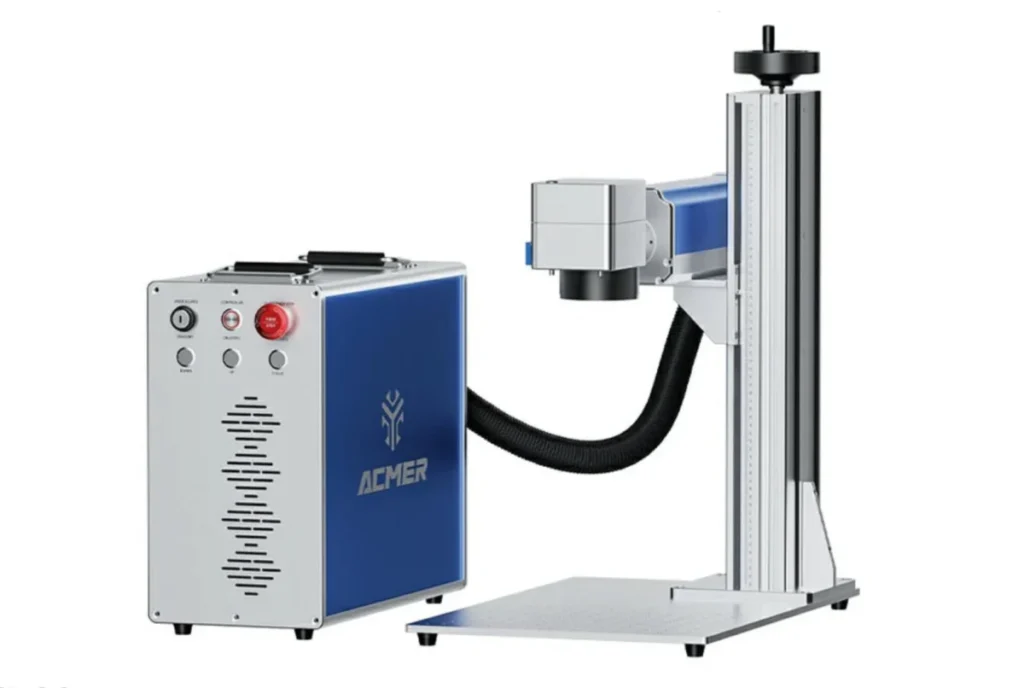
The Acmer SM series is built on a split-unit architecture, a design choice that separates the power supply and control electronics from the laser source and galvo-head assembly. This configuration is standard in industrial environments where flexibility is required to mark large or awkwardly shaped components that would not fit inside a traditional enclosed cabinet.
The machine is available in four distinct power tiers: 30W and 50W fiber variants, alongside 60W and 100W MOPA (Master Oscillator Power Amplifier) versions. The MOPA technology is the primary differentiator for the higher-end models, as it allows for the adjustment of pulse duration. While standard fiber lasers have a fixed pulse width, MOPA lasers can fine-tune the frequency and pulse length, enabling the user to achieve a spectrum of colors on stainless steel and titanium, as well as cleaner marks on certain plastics.
The core of the system utilizes a Sino-Galvo scanner, a widely recognized component in the industry known for its reliability and speed. The system boasts a maximum marking speed of 10,000mm/s. This speed is achieved through a galvanometric system, where stationary mirrors vibrate at high frequencies to direct the laser beam, rather than the slower gantry-style movement found in CO2 or diode lasers. Out of the box, the machine provides a marking area of 150mm x 150mm, though this can be expanded to 300mm x 300mm with the purchase of optional lenses.
Assembly and Industrial Build Quality
The Acmer SM arrives in a heavy industrial crate, emphasizing its status as a piece of heavy machinery rather than a desktop appliance. The total weight necessitates a two-person lift, and the construction materials reflect this "heavy-duty" philosophy. The base and vertical stand are composed of thick, machined aluminum, providing the rigidity required to maintain focus at high speeds.

A notable design characteristic is the permanently attached fiber optic cable connecting the main power box to the laser head. This umbilical cord carries the laser source and electrical signals; its permanent attachment means users must plan their workspace carefully before assembly to avoid damaging the sensitive fiber line. Assembly is relatively straightforward, involving the mounting of the vertical column to the base and the connection of peripheral cables, including a foot pedal designed for high-frequency "batch" operations.
The machine’s cooling system is designed for "extended operation," with the manufacturer claiming it can run for up to 24 hours continuously. This feature is particularly relevant for small businesses looking to integrate the laser into a production line for part numbering, QR code etching, or branding on metal components.
Software Integration and User Interface
In its current iteration, the Acmer SM ships with BsIAppSimple software, a Windows-only application that manages the machine’s drivers and marking parameters. While the hardware is compatible with industry standards like LightBurn and EZCAD2, the out-of-the-box experience relies on the proprietary BsIAppSimple interface.
Testing of the software revealed a steep learning curve and several localization issues. Users have reported that the interface is not immediately intuitive, with key functions such as the "fill" command (hatching) labeled simply as "H." Furthermore, the software’s handling of imported Scalable Vector Graphics (SVGs) can be inconsistent, occasionally resulting in scrambled paths or geometry. For professional environments, the consensus suggests migrating to LightBurn for a more stable and feature-rich design workflow, though this requires an additional license and setup time.
The machine’s physical interface also follows an industrial logic that may confuse uninitiated users. The power switches are labeled sequentially (ON1, ON2, ON3) to dictate the start-up order of the controller, laser source, and scanner. Misinterpreting these labels or the orientation of the key-lock safety switch can lead to operational delays during initial setup.
Performance Analysis: Speed, Precision, and Color Marking
The primary appeal of the Acmer SM 60W MOPA is its raw performance. In marking tests, the machine demonstrated the ability to execute complex vector etches almost instantaneously. Unlike gantry-style lasers that may take minutes to engrave a logo, the SM’s galvo system completes similar tasks in seconds. The lines produced are exceptionally crisp, with no visible deviation or "ghosting" even at high speeds.

The MOPA engine’s ability to produce colors on metal is a significant draw for artists and high-end product designers. By manipulating five distinct parameters—power, frequency, speed, pulse width, and line spacing—the laser can create different oxide layers on the surface of stainless steel, resulting in various colors. However, this process is highly sensitive; achieving specific "pastel" or vibrant hues requires extensive testing and calibration. The colors produced are often muted and depend heavily on the specific grade of metal being marked.
The inclusion of an autofocus system is a notable efficiency gain. By utilizing a motorized Z-axis, the machine can quickly find the optimal focal distance for the material, reducing the manual labor involved in switching between parts of different thicknesses.
Safety Concerns and Environmental Requirements
Perhaps the most critical aspect of the Acmer SM is its lack of integrated safety features. As an "open" laser system, it is classified as a Class 4 laser device. This means the beam is powerful enough to cause permanent eye damage or skin burns from direct or reflected light.
Acmer provides safety glasses with the unit, but these have faced scrutiny. In industrial settings, safety eyewear must be clearly marked with the Optical Density (OD) rating and the specific wavelength range it protects against. The provided glasses often lack these clear certifications, leading experts to recommend that users immediately invest in certified OD7+ safety eyewear from reputable manufacturers.
Furthermore, the machine lacks an enclosure and integrated fume extraction. Fiber lasers, particularly when marking metals or plastics, produce fine particulate matter and potentially toxic gasses. Operating the Acmer SM in a home or poorly ventilated office environment without a custom-built enclosure and a high-grade fume filtration system poses significant health risks. While the machine includes a port for a protective cover safety shutoff, the cover itself must be sourced or built by the user.
Market Context and Industrial Implications
The release of the Acmer SM series comes at a time when the "Maker Movement" is transitioning into small-scale manufacturing. Previously, a 60W MOPA laser with these specifications would have cost upwards of $15,000 to $20,000 and would have been sold through industrial distributors with mandatory safety training.

The "budget" pricing of $6,299 democratizes this technology but places the burden of safety and compliance entirely on the end-user. For a professional machine shop already equipped with ventilation and safety protocols, the Acmer SM represents an excellent value proposition, providing high-speed marking capabilities at a fraction of the traditional cost.
However, for the hobbyist or the small "Etsy-style" business operating out of a residential garage, the machine requires a significant secondary investment in safety infrastructure. The warning against using the laser on flammable materials like wood or paper further defines its niche; this is a tool for the metalworking and hard-plastic industries.
Conclusion: A Powerful Tool with Significant Responsibility
The Acmer SM 60W MOPA Split Laser is a highly capable, industrial-grade marking machine that delivers on its promises of speed and precision. Its MOPA source provides a level of versatility that standard fiber lasers cannot match, particularly for those looking to explore color marking on metals.
However, the machine’s "industrial" nature is a double-edged sword. Its lack of user-friendly software, confusing labeling, and—most importantly—the absence of built-in safety enclosures and fume management systems make it a specialized tool for experienced operators. It is not a "plug-and-play" consumer product. Prospective buyers must view the $6,299 price tag as a starting point, acknowledging that a complete, safe, and professional setup will require additional expenditures on software licenses, certified safety gear, and environmental controls. In the right hands and the right environment, the Acmer SM is a powerhouse capable of significantly increasing production throughput and marking quality.