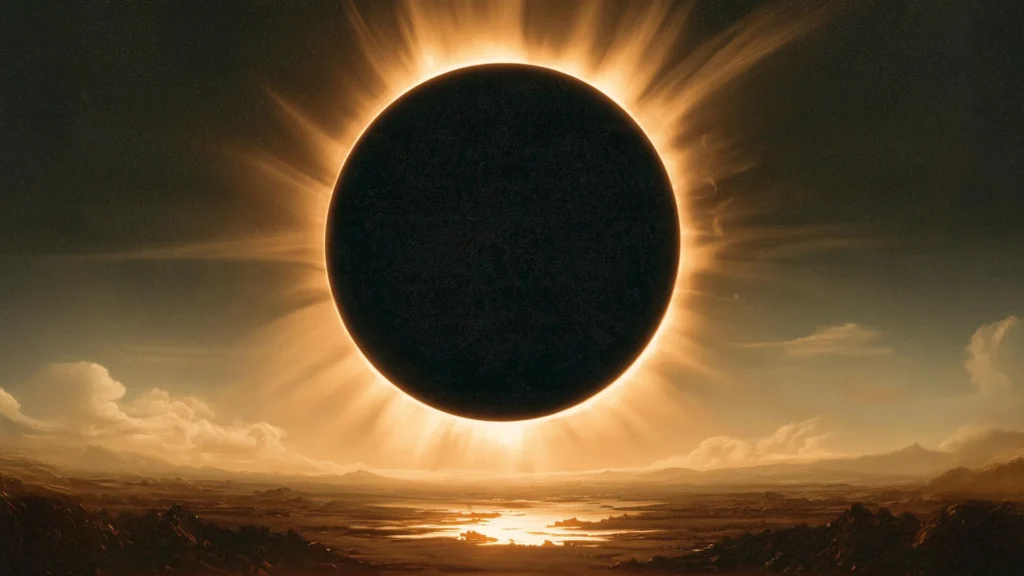
An international team of researchers has meticulously re-examined one of history’s most ancient, precisely dated records of a total solar eclipse, unlocking profound new insights into the subtle yet significant changes in Earth’s rotation over millennia. This groundbreaking study, which masterfully blends historical geography with cutting-edge astronomical calculations, has allowed scientists to reconstruct an eclipse that transpired on July 17, 709 BCE, and determine with unprecedented accuracy how it would have been observed from Qufu, the historic capital of China’s ancient Lu Duchy.
Beyond detailing the celestial spectacle, the scientists have also delved into an early textual account that offers a tantalizing glimpse of the solar corona – the Sun’s ethereal outer atmosphere, invisible to the naked eye except during the brief, awe-inspiring moments of totality. The analysis of its potential shape suggests that the Sun was emerging from an extended period of uncharacteristic quietude and transitioning back towards a more active phase.
Published in the esteemed journal Astrophysical Journal Letters, these findings offer a more precise and robust dataset for understanding Earth’s rotational speed in antiquity. Furthermore, they provide crucial, independent corroboration for previous reconstructions of solar activity, which were largely based on radiocarbon measurements derived from ancient organic materials.
An Ancient Chinese Eclipse Record Holds a Crucial Clue
The date of July 17, 709 BCE, marks a significant moment when observers at the court of the Lu Duchy were treated to the extraordinary sight of a total solar eclipse. This momentous event was subsequently preserved within the pages of the "Spring and Autumn Annals," a venerable historical chronicle that was compiled approximately two to three centuries after the eclipse itself. The original entry succinctly states: "the Sun was totally eclipsed."
Adding another layer of intrigue to this ancient observation is a later account found within the "Hanshu" (Book of Han). This text, compiled roughly seven centuries after the eclipse, incorporates a passage that may well be the earliest written description of the solar corona. This addendum describes the eclipsed Sun as "completely yellow above and below."
"What makes this record special isn’t just its age, but also a later addendum in the ‘Hanshu’ (Book of Han) based on a quote written seven centuries after the eclipse," explained lead author Hisashi Hayakawa, an assistant professor at Nagoya University’s Institute for Space-Earth Environmental Research and Institute for Advanced Research. "It describes the eclipsed Sun as ‘completely yellow above and below.’ This addendum has been traditionally associated with a record of a solar corona. If this is truly the case, it represents one of the earliest surviving written descriptions of the solar corona." Dr. Hayakawa, who holds doctorates in both solar physics and Oriental history, highlighted the unique dual expertise required to fully appreciate and decipher such historical and scientific data.
The Discrepancy and the Eight-Kilometer Correction
Initially, the historical account presented a perplexing paradox when juxtaposed with modern astronomical calculations. When the research team applied existing estimates of Earth’s ancient rotation to model the eclipse’s path, their computations indicated that a total eclipse should not have been visible from Qufu, the historically accepted location of the Lu court. This discrepancy pointed to a subtle yet critical error in the assumed geographic coordinates of ancient Qufu.
Through a meticulous process of examining archaeological excavation reports and consulting historical geographic evidence, the researchers identified that earlier calculations had mispositioned ancient Qufu by approximately eight kilometers. This seemingly small geographical error had significant ramifications for the accuracy of astronomical reconstructions.
"This correction allowed us to accurately measure the Earth’s rotation during the total eclipse, calculate the orientation of the Sun’s rotation axis, and simulate the corona’s appearance," stated Hayakawa. With this positional correction, the team could accurately model the eclipse and extract invaluable data about Earth’s rotation and the Sun’s appearance during this ancient event.
Why Ancient China Preserved Such Detailed Astronomical Records
The enduring survival of such a detailed astronomical observation underscores the profound importance of celestial monitoring within ancient Chinese society. For centuries, successive dynasties employed dedicated astronomical specialists to meticulously track and document celestial events. This practice was deeply intertwined with a system of omenology, where unusual phenomena in the sky were often interpreted as divine pronouncements or portents.
This sophisticated system of omenology was inextricably linked to political legitimacy and governance. Eclipses, auroras, and other extraordinary celestial occurrences were sometimes viewed as cosmic warnings, signaling that an emperor had strayed from righteous conduct or that the mandate of heaven was in jeopardy. Consequently, court astronomers were tasked with the critical duty of accurately documenting these events, not only for scientific understanding but also for their political and societal implications. The diligent records maintained across numerous dynasties have thus become some of the world’s most invaluable historical archives for the study of ancient astronomical phenomena, including eclipses.
It is important, however, for researchers to distinguish between the original observation of the eclipse and the later description of the solar corona. The 709 BCE event is widely recognized as the earliest unambiguous written record of a total solar eclipse that can be reliably dated. While it may also be associated with one of the oldest surviving descriptions of the solar corona, this interpretation remains subject to scholarly caution, as the relevant passage appears in a text compiled centuries after the actual event. Despite this caveat, the confirmed timing of the eclipse provides a solid foundation for investigating Earth’s historical rotation, and the potential corona description offers a valuable point of comparison with other studies of ancient solar activity.
How a 2,700-Year-Old Eclipse Reveals Earth’s Faster Rotation
Earth’s rotation is not a constant, unwavering phenomenon. Over vast geological timescales, the planet’s spin has gradually decelerated, a process largely attributed to the tidal friction generated by the Moon’s gravitational pull. This means that approximately 2,700 years ago, Earth was rotating at a slightly faster pace than it does today.
By utilizing the corrected geographic coordinates of ancient Qufu, the research team was able to derive more precise constraints on Earth’s rotational behavior during the period spanning the eighth to sixth centuries BCE. Their calculations placed delta T (ΔT) – a key metric used to quantify variations in Earth’s rotation relative to a uniform time scale – within a range of 20,264 to 21,204 seconds for the 709 BCE eclipse.
"This new dataset fixes coordinate errors in previous Earth rotation studies," stated coauthor Mitsuru Sátoma of the National Astronomical Observatory of Japan. "Additionally, it improves the accuracy of dating and reconstructing historical astronomical events." These precise measurements are crucial for refining our understanding of how the length of Earth’s day has evolved over thousands of years. Moreover, they hold the potential to enhance the accuracy of predicting the timing and visibility of other ancient astronomical events.
Supporting Data: Earth’s Rotational Slowdown
- Tidal Friction: The primary driver of Earth’s rotational slowdown is tidal friction, caused by the gravitational interaction between Earth, the Moon, and the Sun. The bulging of Earth’s oceans and solid body due to these gravitational forces creates tides. As Earth rotates beneath these bulges, friction is generated, gradually transferring angular momentum from Earth to the Moon, causing Earth’s rotation to slow and the Moon to recede.
- Geological Processes: While tidal friction is the dominant long-term factor, other geological processes, such as changes in the distribution of mass within Earth (e.g., mantle convection, ice sheet melting and formation), can also influence Earth’s rotation on shorter timescales.
- Historical Delta T Values: Historical records of eclipses, like the one from 709 BCE, are vital for constraining delta T. These values provide a quantitative measure of Earth’s rotational history. For example, studies of eclipses in the Roman period have yielded delta T values that differ from modern predictions, indicating the gradual slowdown. The 709 BCE eclipse data fits within this broader trend, offering a more precise anchor point for earlier epochs.
Evidence That the Sun Was Awakening From a Long Quiet Period
Beyond illuminating Earth’s rotational history, the 709 BCE eclipse may also provide compelling evidence of a significant transition in the Sun’s activity. Scientists have previously reconstructed ancient solar cycles by analyzing radiocarbon isotopes preserved within tree rings. The possible description of the solar corona from 709 BCE offers an independent avenue for examining and validating these reconstructions.
"This unique historical addendum for the possible solar coronal structure is critical for providing a spot reference on solar activity reconstructions from tree rings and ice cores, as well as providing independent validation of solar activity models," explained coauthor Mathew Owens, a professor of space physics at the University of Reading.
Trees absorb carbon dioxide from the atmosphere during photosynthesis, including trace amounts of radioactive carbon isotopes, such as radiocarbon (Carbon-14). This radiocarbon becomes incorporated into the tree’s annual growth rings, creating a natural, chronological archive of atmospheric conditions over thousands of years.
Radiocarbon production in the atmosphere is influenced by cosmic rays. When the Sun is more active, its magnetic field is stronger and more effective at deflecting incoming cosmic rays, thus reducing the rate at which radiocarbon is produced. Conversely, during periods of lower solar activity, more cosmic rays reach Earth’s atmosphere, leading to increased radiocarbon production. By meticulously measuring the varying concentrations of radiocarbon across successive tree rings, scientists can reconstruct the ebb and flow of solar activity long before the advent of modern observational instruments.
The Sun typically follows an 11-year cycle of activity, characterized by fluctuations in the number of sunspots and the intensity of its magnetic field. However, the Sun can also enter prolonged periods of significantly reduced activity, known as "grand minima." During these intervals, sunspot occurrences become exceptionally rare, and the regular 11-year cycle is markedly diminished.
One such prolonged period of reduced solar activity, known as the "Neo-Assyrian Grand Minimum" or sometimes the "Homer Grand Minimum," is estimated to have lasted from approximately 808 BCE to 717 BCE. The eclipse observed in 709 BCE occurred relatively shortly after the conclusion of this extended quiet phase.
The researchers propose that the described appearance of the solar corona is consistent with a Sun that was re-engaging with its regular activity cycles. The suggested structure of the corona points towards substantial magnetic activity, indicating that the Sun may have been approaching the peak of its approximately 11-year cycle at the time of the eclipse. This interpretation aligns harmoniously with earlier solar activity reconstructions derived from radiocarbon analysis of tree rings. However, the inherent uncertainty surrounding the historical description of the corona means it cannot be considered definitive proof, but rather a valuable corroborating piece of evidence.
Implications for Solar Cycle Understanding
- Grand Minima: The "Neo-Assyrian Grand Minimum" (c. 808-717 BCE) is one of several documented grand minima in solar activity. These periods are characterized by a significant reduction in sunspot numbers and solar flares. Examples include the Spörer Minimum (c. 1460-1550) and the Maunder Minimum (c. 1645-1715), which have been linked to colder periods in Earth’s climate history.
- Solar Cycle Recovery: The 709 BCE eclipse data provides a potential observational anchor for the end of this grand minimum. If the corona’s description is accurate, it suggests a robust recovery of solar magnetic activity, marking a return to more typical solar behavior.
- Cross-Disciplinary Validation: The study highlights the power of interdisciplinary research. Combining astronomical observation, historical records, archaeological evidence, and paleoclimatology (through radiocarbon dating) allows scientists to build a more comprehensive and reliable picture of past solar and Earth system behavior.
Ancient Astronomers Are Still Helping Scientists Understand the Universe
This remarkable study serves as a powerful testament to the enduring legacy of ancient observations and their continued relevance in advancing modern scientific understanding. By synthesizing historical documents, archaeological findings, geographical research, and sophisticated computational models, scientists can now recover invaluable data that would otherwise be impossible to obtain through direct measurement.
In this particular instance, a correction of merely eight kilometers in the ancient location of Qufu transformed a centuries-old eclipse record into a more precise source of information about Earth’s rotation. It has also opened a potential window into the Sun’s distant past, offering insights into its activity cycles when direct observation was impossible.
"Some of our ancestors were very skilled observers," noted coauthor Dr. Meng Jin of the Lockheed Martin Solar and Astrophysics Laboratory. "When we combine their careful records with modern computational methods and historical evidence, we can potentially find new information about our planet and our star from thousands of years ago." This collaborative effort between the past and the present underscores the timeless quest for knowledge and the interconnectedness of human curiosity across millennia.