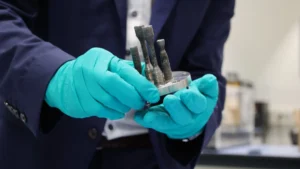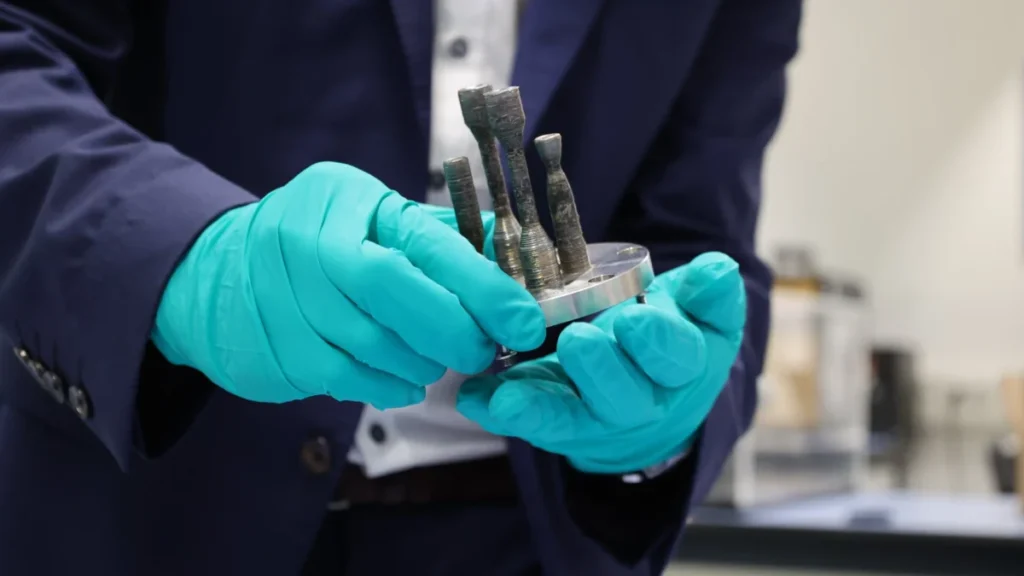
The fifth metal sample, a significant milestone in the European Space Agency’s (ESA) endeavors to advance in-space manufacturing, has successfully returned to Earth, carrying with it the very first thrusters ever created beyond our planet. This groundbreaking component, fabricated using ESA’s Metal 3D Printer aboard the International Space Station’s (ISS) Columbus module, was retrieved by ESA astronaut Sophie Adenot in July, marking a pivotal moment in the quest for crew autonomy and reduced reliance on Earth-based supply chains.
The successful return of this sample is the culmination of a rapid development cycle that began with the launch of the Metal 3D Printer to the ISS in January 2024. Within a mere few months, the printer achieved its maiden success, producing its first complete metal part, an accomplishment that represented the inaugural instance of a metal component being manufactured in the unique environment of space. This initial success was not merely symbolic; it provided invaluable data for ESA’s material scientists at the European Space Research and Technology Centre (ESTEC) in the Netherlands. They meticulously examined and tested this first-ever space-printed metal part, focusing on understanding how the absence of gravity, or microgravity, influenced the intricate printing process.
These crucial initial findings were then instrumental in refining the printing procedures for the subsequent, more complex elements of the fifth sample. The two smaller parts of this latest sample, designed by the German Aerospace Center (DLR), are specifically engineered to function as miniature thrusters – essential components for satellite propulsion. This deliberate choice underscores the tangible applications and practical utility of in-space manufacturing, moving beyond theoretical demonstrations to the creation of functional, flight-ready hardware.
A Closer Look at the In-Orbit Thruster Development
Florian Merz, a research associate and test engineer at DLR, elaborated on the strategic design of these novel thrusters. "We have designed two versions of the thruster," Merz stated, highlighting a dual-pronged approach to validation. "One manufactured as closely as possible to the desired shape, and one with thicker walls that allow for post-processing to refine the thruster’s inner diameter." This meticulous approach ensures a comprehensive assessment of the manufacturing process and its impact on performance.
The next critical phase in the validation process will involve rigorous testing at DLR’s specialized vacuum test bench in Lampoldshausen, Germany. Here, the space-manufactured thrusters will undergo "hot-fire tests" under conditions meticulously calibrated to replicate representative operating scenarios in space. This is a crucial step to demonstrate not only the functionality of the thrusters but also their ability to meet the stringent precision requirements for propulsion systems and to withstand the extreme temperatures and pressures inherent in space operations.
Sonja Steinbach, DLR’s project manager for this initiative, emphasized the comparative nature of their research. "By comparing the space-manufactured thrusters with equivalent components produced on Earth, we can investigate how microgravity influences the manufacturing process and how these effects translate into the performance of the finished components," Steinbach explained. This comparative analysis is vital for understanding the nuances of in-space additive manufacturing and for identifying areas for further optimization. "The results will help us further optimise metal 3D printing for future in-space manufacturing," she added, underscoring the long-term vision of this project.
A Timeline of In-Space Metal Printing Milestones
The journey to the fifth metal sample and its groundbreaking thruster payload represents a structured progression of technological development and scientific inquiry:
- January 2024: ESA launches its Metal 3D Printer to the International Space Station (ISS). This marked the beginning of a new era for in-space manufacturing capabilities.
- Early 2024: The printer successfully produces its very first complete metal sample, becoming the first metal part ever fabricated in space. This initial success served as a proof-of-concept and a platform for initial data collection.
- Following Initial Success: ESA’s material scientists at ESTEC begin their in-depth analysis of the first space-printed sample, investigating the effects of microgravity on the printing process.
- Refinement of Printing Procedures: Based on the findings from the initial sample, the printing procedures are optimized for subsequent, more complex parts.
- Design of Thruster Components: The German Aerospace Center (DLR) designs two versions of miniature thrusters, intended to be the key functional components of the fifth sample.
- July 2024: ESA astronaut Sophie Adenot retrieves the fifth metal sample from the ISS. This sample includes the DLR-designed thrusters, representing the first propulsion components manufactured in orbit.
- Post-Retrieval Analysis and Testing: The returned sample, including the thrusters, is undergoing further analysis and will be subjected to rigorous testing on Earth.
Background and Context: The Drive for In-Space Manufacturing
The development of in-space manufacturing capabilities, particularly additive manufacturing or 3D printing, is a strategic imperative for space agencies worldwide. The inherent challenges of launching mass and volume from Earth impose significant cost and logistical constraints on space missions. By enabling the production of tools, spare parts, and even complex components like thrusters directly in orbit, in-space manufacturing promises to revolutionize space exploration and utilization.
ESA’s Metal 3D Printer project is a cornerstone of this broader vision. The ability to print with metals opens up possibilities for creating robust and high-performance components that are essential for the longevity and success of space missions. This technology has the potential to:
- Reduce Mission Costs: By eliminating the need to transport heavy spare parts from Earth, missions can be made more cost-effective.
- Enhance Crew Autonomy: Astronauts can address unexpected equipment failures or evolving mission needs by fabricating necessary parts on demand, reducing reliance on Earth-based support.
- Enable New Mission Architectures: The ability to build and repair infrastructure in space could pave the way for ambitious projects such as orbital assembly of large structures, lunar bases, and interplanetary missions.
- Advance Scientific Research: The unique conditions of space offer an unparalleled laboratory for studying material science and the fundamental processes of manufacturing.
The ISS, serving as a crucial testbed for these advanced technologies, provides a real-world environment to validate the performance of in-orbit manufactured components under extreme conditions. The successful printing of the first thrusters signifies a leap forward in demonstrating the practical application of this technology for critical spacecraft systems.
Supporting Data and Technological Underpinnings
While specific quantitative data on the printing process and material properties of the fifth sample are still under analysis, the foundational principles of metal 3D printing involve the layer-by-layer deposition of metallic powder, fused by a high-energy source such as a laser or electron beam. The success of this process in microgravity is contingent upon overcoming challenges related to:
- Material Containment: Preventing the metallic powder from dispersing in the absence of gravity.
- Thermal Management: Controlling heat distribution and dissipation in a vacuum environment.
- Precision and Accuracy: Achieving the required dimensional tolerances for complex geometries.
- Material Properties: Ensuring the printed parts exhibit the desired mechanical strength, durability, and thermal resistance.
The fact that ESA’s printer has produced a functional component like a thruster, which operates under high thermal and pressure loads, suggests that these challenges are being effectively addressed. The use of metal powders, likely alloys such as stainless steel or titanium, is common in aerospace applications due to their high strength-to-weight ratios and resistance to extreme temperatures.
Official Responses and Future Outlook
The sentiment from the ESA and DLR teams reflects a blend of scientific rigor and palpable excitement. Rob Postema, ESA’s technical officer for the project, articulated this enduring enthusiasm: "Even though we have already received four samples from the ISS at ESTEC, the thrill of opening these very special packages remains the same." This sentiment underscores the continuous innovation and discovery inherent in space exploration.
The successful return and subsequent testing of the space-printed thrusters will provide crucial data that will inform the next generation of in-space manufacturing technologies. This research is not merely academic; it is a vital step towards enabling more sustainable, resilient, and ambitious human and robotic activities in space. The ability to manufacture critical components, like propulsion systems, in orbit marks a significant stride towards a future where humanity’s presence in space is not limited by the constraints of Earth-based logistics. The lessons learned from this fifth sample will undoubtedly contribute to a future where astronauts can repair their spacecraft, build habitats, and extend their reach further into the cosmos, all powered by the ingenuity of in-space manufacturing. The potential implications for future space missions, from extended lunar stays to the exploration of Mars, are profound, as the reliance on Earth-based supply chains diminishes, paving the way for greater self-sufficiency and operational flexibility beyond our home planet.