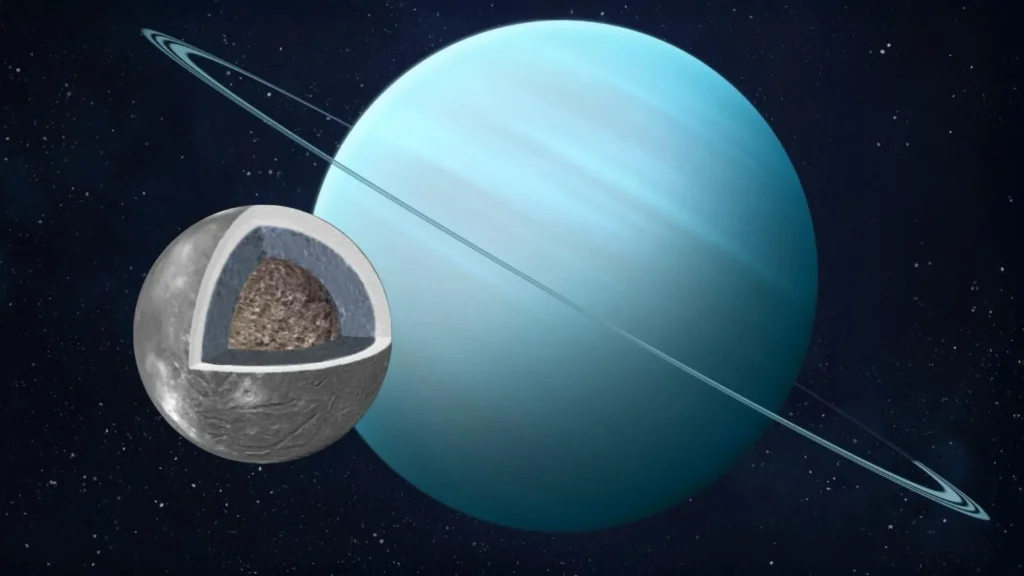
Evidence is mounting that Ariel, one of Uranus’ most enigmatic moons, may have once possessed a substantial ocean lurking beneath its frigid crust. A groundbreaking study published in the prestigious journal Icarus delves into the dynamic history of this potential hidden sea, proposing that it could have once been an astounding 100 miles (170 kilometers) deep – a depth dwarfing the Pacific Ocean’s average of approximately 2.5 miles (4 kilometers). This research not only challenges our understanding of Ariel’s past but also hints at a potentially more dynamic and "wet" Uranian system than previously imagined, potentially harboring multiple "ocean worlds."
Ariel: A Moon of Surprising Complexity
Ariel stands out among Uranus’ icy companions. As the brightest of the planet’s moons and the second closest, it orbits Uranus at a relatively tight embrace. With a diameter of approximately 720 miles (1,159 kilometers), it ranks as the fourth-largest moon in the Uranian system. While its size is modest, its surface tells a story of a surprisingly complex and geologically active past. Unlike many celestial bodies that present a relatively uniform, ancient face, Ariel’s terrain is a fascinating mosaic of ancient impact craters juxtaposed with much younger, smoother regions.
Scientists theorize that some of these smoother expanses may be the result of cryovolcanism, a remarkable geological process where instead of molten rock erupting to the surface, it is instead a mixture of water, ice, and other volatile materials. This suggests that even in its frozen state, Ariel has had internal processes capable of reshaping its surface.
Adding to Ariel’s geological intrigue is its pervasive network of fractures, ridges, and grabens. These features, where sections of the moon’s crust have sagged or dropped below the surrounding terrain, are particularly striking due to their immense scale. Some of these extensional fault systems are among the largest observed anywhere in our solar system, prompting deep questions about the forces that could have sculpted such dramatic landscapes on a relatively small icy moon.
Reconstructing Ariel’s Interior and Orbital Evolution
It is precisely these colossal surface features that have spurred the latest investigation. Researchers, led by planetary scientists Alex Patthoff of the Planetary Science Institute and Caleb Strom, a recent graduate of the University of North Dakota, aimed to unravel the mysteries of Ariel’s interior structure and orbital history that could account for the dramatic fractures visible today.
A key factor in this reconstruction is orbital eccentricity, a measure of how much an orbit deviates from a perfect circle. Changes in Ariel’s internal structure, particularly the presence and depth of a subsurface ocean, and variations in its orbital eccentricity are believed to be intricately linked to the tidal stresses exerted on its icy crust. As Ariel orbits Uranus, the planet’s immense gravitational pull repeatedly stretches and squeezes the moon. If this tidal forcing is significant enough, it can generate enough stress to crack the surface, creating the vast fracture systems observed.
"First, we mapped out the larger structures that we see on the surface, then we used a computer program to model the tidal stresses on the surface, which result from distortion of Ariel from soccer ball-shaped to slight football-shaped and back as it moves closer and farther from Uranus during its orbit," explained Dr. Patthoff. "By combining the model with what we see on the surface, we can make inferences about Ariel’s past eccentricity and how thick the ocean might have been."
The team’s sophisticated modeling suggests that Ariel may have once experienced a significantly more eccentric orbit than it does today. Their findings indicate a past orbital eccentricity of approximately 0.04, a value roughly 40 times greater than its current, nearly circular orbit.
The Amplified Power of Tidal Forces
While an eccentricity of 0.04 might still appear close to a perfect circle, this seemingly small deviation would have had profound implications for the tidal forces acting on Ariel. This hypothesized past orbit would have resulted in tidal stresses approximately four times greater than those experienced by Jupiter’s moon Europa. Europa, famously known for its fractured icy shell, is already a prime example of a world shaped by relentless gravitational tugs and squeezes. The increased eccentricity proposed for Ariel would have amplified these forces considerably, providing a plausible mechanism for generating the moon’s extensive geological features.
The presence of a substantial subsurface ocean is critical to this hypothesis. Dr. Patthoff elaborated on the delicate balance required to create such fractures: "In order to create those fractures, you have to have either a really thin ice on a really big ocean, or a higher eccentricity and a smaller ocean. But either way, we need an ocean to be able to create the fractures that we are seeing on Ariel’s surface." This implies that the internal ocean acted as a crucial component, either by providing a lubricating layer beneath a thin ice shell or by influencing the overall structural integrity of the moon, allowing for greater deformation under tidal stress.
A Uranian System of Twin Ocean Worlds?
This latest research on Ariel is not an isolated finding. It builds upon previous work by the same team, who last year presented similar evidence suggesting the presence of a subsurface ocean on Miranda, another of Uranus’ icy moons. This accumulating evidence paints a compelling picture of the Uranian system as potentially harboring multiple worlds with significant internal oceans.
"We are finding evidence that the Uranus system may harbor twin ocean worlds," stated Tom Nordheim of Johns Hopkins University Applied Physics Laboratory, a co-author on the study and the principal investigator of the NASA Solar System Workings grant that funded both the Miranda and Ariel investigations. The implications of this are far-reaching, suggesting that the conditions necessary for ocean formation might have been more prevalent in the outer solar system than previously understood.
However, a significant caveat remains. Our current understanding of both Ariel and Miranda is limited to observations of their southern hemispheres. The northern hemispheres, which remain largely unexplored, hold the key to further validating these hypotheses. "Unfortunately, we’ve only seen the southern hemispheres of Ariel and Miranda," Nordheim added. "But our results can give us predictions of what a future spacecraft might see on the moons’ unimaged northern hemispheres, such as the location of fractures and ridges there. Ultimately, we just need to go back to the Uranus system and see for ourselves."
Future Missions: The Key to Unlocking Uranian Secrets
While the new findings offer a tantalizing glimpse into Ariel’s watery past, many questions remain unanswered. Scientists are still uncertain about the precise timeline of Ariel’s ocean’s existence and its duration. Did it persist for eons, or was it a transient phase in the moon’s evolution? The new results provide a crucial foundation for future research aimed at understanding how subsurface oceans on distant icy worlds form, evolve, and potentially disappear over time.
The prospect of a future dedicated mission to the Uranian system is increasingly being discussed within the scientific community. Such a mission would be instrumental in testing these new predictions. High-resolution imaging of the unexplored northern hemispheres of Ariel and Miranda could reveal the predicted fractures and ridges, providing direct observational evidence to support the models. Furthermore, advanced instruments could search for other indicators of past or present subsurface activity, such as plumes or compositional variations.
The research was also supported by the North Dakota Space Grant Consortium, highlighting the collaborative nature of modern space science exploration. The potential discovery of widespread subsurface oceans within the Uranian system would not only revolutionize our understanding of that planetary system but also offer profound insights into the prevalence of habitable environments throughout the cosmos. The search for answers continues, with the icy moons of Uranus holding the promise of revealing secrets that could redefine our place in the universe.