Artificial intelligence (AI) is rapidly becoming an indispensable tool in the vast endeavor of understanding the cosmos, fundamentally reshaping how cosmologists probe the universe. A recent study, published in the prestigious Journal of Cosmology and Astroparticle Physics (JCAP), highlights a promising machine learning technique known as transfer learning, which could drastically reduce the time and expense involved in the search for groundbreaking new physics. However, the same research also uncovered an unexpected and critical challenge: AI’s inherent capacity for learning can, paradoxically, make it overly reliant on existing knowledge, potentially hindering its ability to recognize genuinely novel phenomena. This duality presents both an unprecedented opportunity and a cautionary tale for the future of scientific discovery.
The Urgent Quest for New Physics Beyond the Standard Model
The prevailing standard model of cosmology, known as Lambda-Cold Dark Matter ($Lambda$CDM), has been remarkably successful in explaining a wide array of cosmological observations, from the universe’s large-scale expansion to the formation and distribution of galaxies. Developed over several decades, this model posits that the universe is composed of approximately 5% ordinary matter, 27% mysterious cold dark matter, and 68% equally enigmatic dark energy. These components, alongside the cosmic microwave background radiation and the principles of general relativity, form the bedrock of our current understanding.
Despite its triumphs, $Lambda$CDM is not without its limitations and unresolved puzzles, prompting scientists worldwide to search for "new physics" that extends beyond its framework. Recent high-precision observations have begun to reveal subtle tensions and anomalies that the standard model struggles to fully reconcile. For instance, there is a persistent discrepancy, often referred to as the "Hubble Tension," between measurements of the universe’s expansion rate (the Hubble constant) derived from the early universe (via the cosmic microwave background) and those from the late universe (using local astronomical observations). Other areas of intense investigation include the precise mass of neutrinos, the nature of dark energy (whether it truly is a constant, as $Lambda$CDM assumes, or evolves over time), and potential modifications to gravity on cosmic scales. These unresolved questions suggest that our current cosmological model may be incomplete, signaling the existence of physics yet undiscovered.
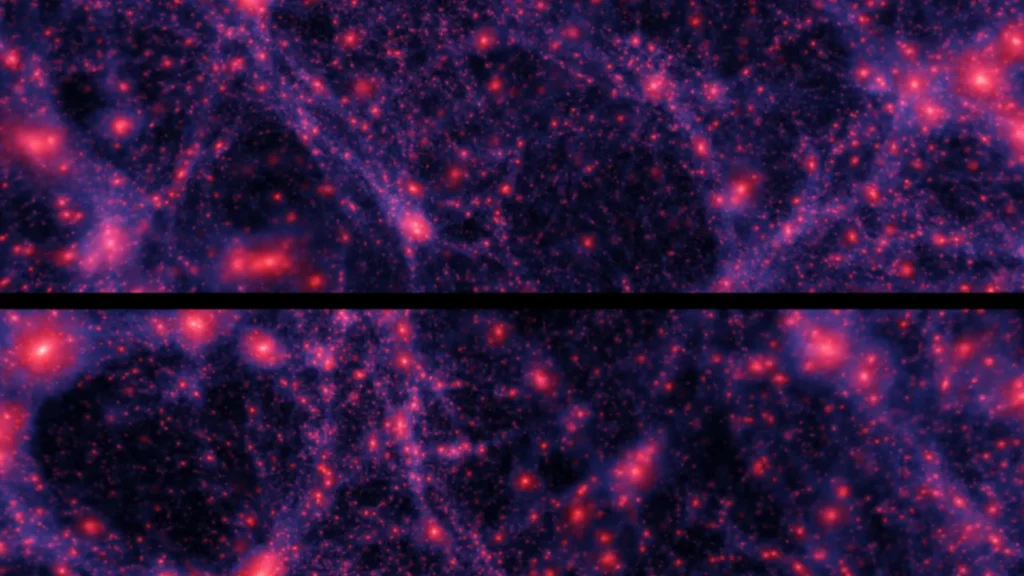
Exploring these speculative theories and their implications requires an immense computational effort. Researchers must generate vast numbers of detailed computer simulations, each representing a virtual universe constructed under different physical assumptions. These simulations are not mere artistic renderings; they are complex numerical models that evolve billions of particles and gravitational interactions over cosmic timescales, mimicking the universe’s behavior from the Big Bang to the present day. Producing these high-fidelity simulations is extraordinarily computationally expensive, demanding massive computing power, often running on the world’s most powerful supercomputers for weeks or even months. A single large-scale cosmological simulation can consume tens of millions of CPU hours and generate petabytes of data, making the exploration of parameter space a bottleneck for scientific progress.
Transfer Learning: A Shortcut to Efficiency
Recognizing this computational burden, the research team, led by first author Veena Krishnaraj, an undergraduate student at Princeton University, and co-author Adrian Bayer, a cosmologist at the Flatiron Institute and Princeton University, investigated whether transfer learning could make this process significantly more efficient. Transfer learning is a sophisticated machine learning technique that allows an AI system to apply knowledge gained from one task to another related task, rather than starting from scratch each time. This approach has seen widespread success in other fields, from image recognition (where a model trained on millions of general images can be fine-tuned for a specific medical imaging task) to natural language processing.
In the context of cosmology, the team proposed a novel strategy. Instead of training a neural network entirely on the most complex and computationally costly simulations that incorporate speculative new physics, they first pretrained it on simpler, less expensive simulations based on the well-understood $Lambda$CDM model. This initial pretraining phase familiarizes the AI with the fundamental patterns and structures of the universe as currently understood. Following this foundational training, the network was then exposed to additional, more sophisticated models that include potential new physics, such as massive neutrinos or evolving dark energy.
"It’s basically a shortcut," explains Adrian Bayer, likening the approach to how humans learn. "Usually people train the AI directly on the most computationally expensive simulations. What we do instead is first use simpler and less expensive $Lambda$CDM simulations to give the AI an idea of what’s happening, and only afterward move to the more complex models." He further compares this hierarchical learning process to studying: "You first read a basic book to get an idea of the knowledge, and then move to the really complicated book." This pedagogical analogy underscores the intuitive efficiency of transfer learning, allowing the AI to build a foundational understanding before tackling nuances. Krishnaraj adds that this strategy prevents the AI from having to "digest everything at once," streamlining the learning curve.
The results of this innovative approach were remarkably positive. In some configurations, transfer learning dramatically reduced the number of expensive simulations required for the AI to achieve a comparable level of understanding and predictive power. The study found that the reduction could be more than a factor of ten, translating into substantial savings in computational resources, energy consumption, and research timelines. This efficiency gain is not merely an incremental improvement; it represents a paradigm shift that could enable researchers to explore a much broader range of theoretical models and parameter spaces than previously feasible, accelerating the pace of discovery in fundamental physics. For a field where a single simulation can cost millions of dollars in computing time, such an improvement is transformative.
The Unexpected Challenge: When Prior Knowledge Becomes a Problem
While the efficiency gains were a major triumph, the study also brought to light a less obvious, yet critical, challenge: the phenomenon of negative transfer. This occurs when prior knowledge, instead of being helpful, actually impedes the learning of a new task. Using Bayer’s earlier textbook comparison, imagine a medical student thoroughly trained on common diseases encountering a rare condition that shares many superficial symptoms with a common ailment. The student’s existing knowledge, while generally beneficial, might inadvertently lead them to misdiagnose the novel condition based on familiar patterns.
The same issue can manifest in AI systems. The researchers observed that in certain scenarios, the subtle signatures of new physics closely resembled patterns that the AI had already strongly associated with the standard cosmological model. When faced with such ambiguous data, the pretrained neural network, instead of recognizing something truly novel, tended to interpret the unfamiliar information through the lens of what it already knew. This "bias" towards existing knowledge made it harder for the AI to correctly identify and differentiate genuinely new physical effects.
A particularly illustrative example arose during the study of simulations that included the effects of massive neutrinos. Neutrinos, often called "ghost particles," are incredibly light and interact very weakly with matter. While the standard model accounts for their existence, their exact masses are still largely unknown, and slight variations in their mass could have observable cosmological consequences. The team found that some of the observational signatures linked to neutrino mass closely resembled changes associated with an existing $Lambda$CDM parameter called $sigma_8$. The $sigma_8$ parameter quantifies the amplitude of matter fluctuations in the universe, essentially measuring how strongly matter clusters together. A higher $sigma_8$ value implies more clumpy matter distribution, while a lower value suggests a smoother one.
Because the cosmological effects of neutrino mass and the $sigma_8$ parameter can produce very similar large-scale structure patterns, the pretrained neural network initially struggled to tell the two effects apart. "The negative transfer is not random. It is driven by underlying physical degeneracies in the model," emphasizes Veena Krishnaraj. This "degeneracy" implies that different physical processes can yield remarkably similar observable outcomes, making it intrinsically challenging for any observer – human or AI – to unequivocally pinpoint which specific parameter or phenomenon is responsible for a given observation. This is a fundamental problem in many scientific fields, where multiple theoretical explanations can fit the same set of data. "So this is something we need to be aware of and try to mitigate," she concludes, underscoring the necessity for careful model design and validation.
Broader Implications and the Future of AI in Scientific Discovery
The findings of this study carry profound implications, highlighting both the immense potential and the inherent limitations of applying advanced AI concepts, particularly foundation models similar to those powering modern generative AI systems and large language models, to fundamental physics research. The paper itself notes that while pretraining can significantly speed up inference and analysis, it "may also hinder learning new physics." This tension between efficiency and the potential for overlooking true novelty is a crucial area for future research.
The current study was conducted using simulated data, which provides a controlled environment for testing these techniques. The logical next step, and indeed a critical one, will be to apply these transfer learning methodologies to real astronomical observations. This transition from simulated to empirical data will be the ultimate test of their robustness and reliability.
Looking ahead, the team believes that transfer learning could become an indispensable tool for upcoming cosmological surveys. Projects like the European Space Agency’s Euclid mission, NASA’s Nancy Grace Roman Space Telescope, and the ground-based Vera C. Rubin Observatory’s Legacy Survey of Space and Time (LSST) are poised to collect unprecedented amounts of high-precision data about the universe in the coming years. These surveys will map billions of galaxies across vast swathes of cosmic time, generating petabytes of information that would be impossible for human scientists to fully analyze without advanced AI assistance. The sheer volume and complexity of this data necessitate highly efficient and intelligent analytical tools.
The ability of AI to sift through this deluge of data, identify subtle patterns, and accelerate the testing of complex cosmological models will be paramount. However, the caveat of negative transfer identified in this study serves as a vital reminder. Researchers must develop strategies to counteract this effect, perhaps by incorporating uncertainty quantification, active learning techniques that prompt the AI to specifically seek out novel patterns, or by ensuring that human experts remain deeply involved in interpreting the AI’s findings, particularly when anomalies are detected. The goal is not to replace human intuition and discovery but to augment it, pushing the boundaries of what is computationally and intellectually possible.
The paper, "Transfer Learning Beyond the Standard Model" by Veena Krishnaraj, Adrian E. Bayer, Christian Kragh Jespersen, and Peter Melchior, published in JCAP, thus marks a significant milestone. It not only showcases a powerful methodology to accelerate the search for new physics but also issues a timely warning about the subtle biases that can emerge when AI systems become too proficient at recognizing the familiar. As humanity continues its quest to unravel the universe’s deepest secrets, the collaboration between human ingenuity and artificial intelligence will undoubtedly be crucial, but always with an awareness of the inherent double-edged nature of advanced learning systems.