The landscape of modern cosmology is undergoing a seismic shift as data from the James Webb Space Telescope (JWST) continues to challenge long-held assumptions about the formation of the first structures in the cosmos. In a groundbreaking study published by a team led by researchers at the Massachusetts Institute of Technology (MIT), astronomers have identified a singular celestial object that may provide the "missing link" in our understanding of how supermassive black holes and the first galaxies evolved. The object, designated MoM-BH*-1, is described as a "black hole star"—a gargantuan entity featuring a central black hole 100,000 times the mass of the sun, enveloped in a hydrogen gas cloud so vast it rivals the size of our entire solar system.
Lead author Rohan Naidu, a NASA Hubble Fellow and Pappalardo Fellow at MIT’s Kavli Institute for Astrophysics and Space Research (MKI), notes that the scientific community’s understanding of this object is evolving with unprecedented speed. The discovery was made during the "Mirage or Miracle" (MoM) survey, an initiative designed to investigate the nature of the most distant and earliest galaxies in the observable universe. By utilizing the advanced infrared capabilities of the JWST, the team peered back to a time when the universe was only a few hundred million years old, uncovering a phenomenon that defies conventional stellar categorization.
The Enigma of the Little Red Dots
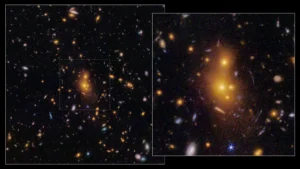
Since the JWST began its science operations in 2022, astronomers have been puzzled by the ubiquitous presence of "little red dots" in deep-space imagery. These objects, which appear in the distant, high-redshift universe, are characterized by their distinct crimson hue and compact appearance. While they are prevalent in the early stages of cosmic history, they are virtually non-existent in the modern, local universe. The nature of these dots has sparked intense debate among astrophysicists, with theories ranging from extremely dusty star-forming galaxies to obscured active galactic nuclei (AGN).
The identification of MoM-BH-1 as a black hole star offers a potential resolution to this debate. Naidu and his colleagues suggest that many of these mysterious red dots may, in fact, be similar black hole stars. However, MoM-BH-1 stands out because of its extraordinary luminosity. While most little red dots are embedded within the light of their host galaxies, MoM-BH*-1 is so bright that it effectively outshines its surrounding environment, allowing scientists to observe the "pure" light of the black hole star itself. This clarity has provided an unprecedented opportunity to analyze the spectral signatures of an object that existed during the universe’s infancy.
Scientific Methodology: The Mirage or Miracle Survey
The MoM survey was initially conceived to address the "early galaxy problem"—the observation of unexpectedly bright and mature galaxies existing at times when the universe was thought to be too young to have produced them. Astronomers faced a choice: either the standard model of cosmology required a radical overhaul to account for these "miracles," or these objects were "mirages" created by unusual physical processes.
During their search for the most distant galaxies, the MIT-led team noticed a specific source that was both exceptionally red and remarkably bright. Robert Simcoe, the MKI Director and Bruno B. Rossi Professor of Experimental Physics, explains that in astronomy, a red appearance usually suggests the presence of cosmic dust. Much like how smoke from terrestrial wildfires can turn the sky a deep orange or red by scattering shorter wavelengths of light, interstellar dust can "redden" the light of stars and galaxies.
However, the light from MoM-BH-1 did not conform to the expected patterns of dust-reddened objects. Instead, the team observed a "Balmer break," a spectral feature where light intensity drops off sharply at specific wavelengths. This phenomenon is typically associated with the dense hydrogen atmospheres of stars that are hundreds of millions of years old, such as the star Vega. The Balmer break observed in MoM-BH-1 was the deepest ever recorded in any celestial object, a finding that ruled out ordinary stars as the primary source of the light.
Simulations and the Black Hole Star Hypothesis
To decipher the nature of the red dot, the research team conducted extensive computer simulations, testing various astrophysical scenarios. They sought to determine if a source could appear that red using only hydrogen, without the presence of dust. The simulations revealed that an extremely dense "screen" or cocoon of hydrogen could produce the observed color and the Balmer break.
The primary challenge remained the object’s sheer brightness. MoM-BH*-1 is approximately 100 billion times brighter than a standard star. Energy production on this scale cannot be achieved through nuclear fusion, the process that powers the sun and other conventional stars. The only mechanism known to science capable of generating such immense power within a compact region is the accretion of matter onto a black hole.
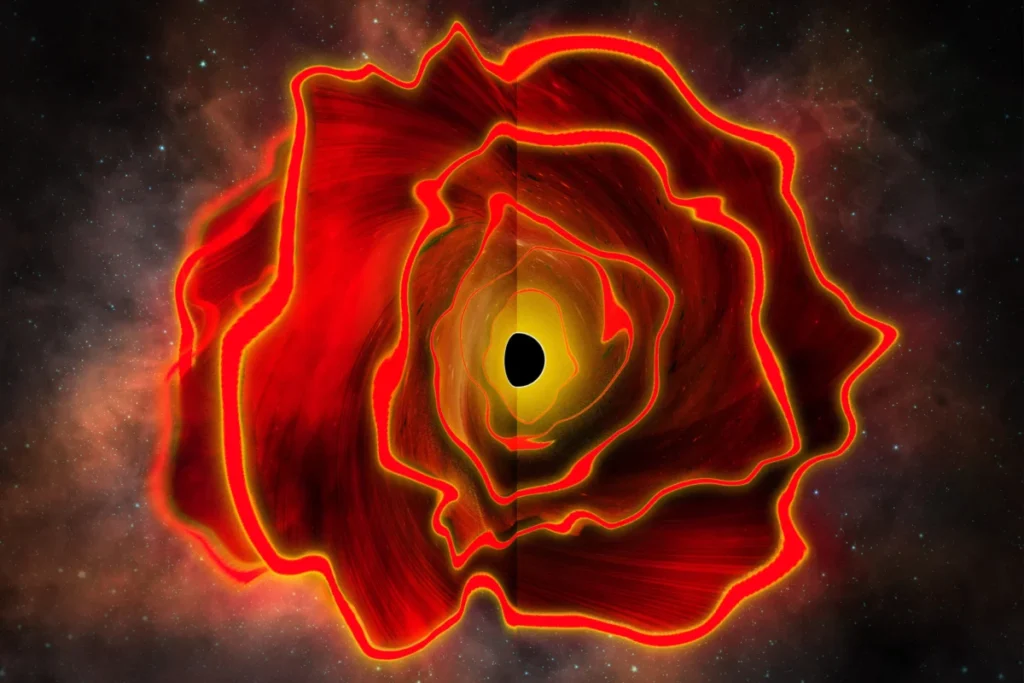
By incorporating an active, accreting black hole into their hydrogen-cocoon model, the researchers found a match for the JWST data. The resulting picture is that of a "black hole star": a massive central engine (the black hole) surrounded by a solar-system-sized envelope of hydrogen gas. This envelope acts as a stellar atmosphere on a spectacular scale, absorbing the high-energy radiation from the black hole and re-emitting it as the bright red light captured by the telescope.
Chronology of Discovery and Historical Context
The discovery of MoM-BH*-1 is the culmination of decades of theoretical work regarding the "seeding" of supermassive black holes. For years, cosmologists have struggled to explain how black holes with masses millions or billions of times that of the sun could exist so soon after the Big Bang. Two primary theories have dominated the field: the "light seed" theory, which suggests black holes grew from the remnants of the first generation of stars, and the "heavy seed" theory, which proposes that massive clouds of gas collapsed directly into black holes without forming stars first.
The black hole star observed by the MIT team provides strong evidence for the "heavy seed" or "Direct Collapse Black Hole" (DCBH) pathway. MoM-BH*-1, with its 100,000 solar masses, represents an intermediate stage of growth that had previously been purely theoretical.
- July 2022: JWST releases its first deep-field images, revealing an unexpected abundance of "little red dots."
- 2023: The "Mirage or Miracle" survey begins, targeting these red dots to determine if they are early galaxies or something else.
- Late 2023: Researchers identify MoM-BH*-1 as a unique candidate due to its extreme brightness and lack of metallic signatures (containing only hydrogen and helium).
- 2024: Advanced simulations at MIT confirm that the object’s spectral properties are best explained by a black hole enshrouded in a hydrogen cocoon.
Implications for Modern Astrophysics
The implications of this discovery extend far beyond the identification of a single object. If MoM-BH*-1 is indeed the prototype for the "little red dots" seen throughout the early universe, it suggests that the early cosmos was far more active in producing massive black holes than previously thought.
Furthermore, the lack of metals—elements heavier than hydrogen and helium—in the spectrum of MoM-BH*-1 indicates that it formed from "pristine" gas that had not yet been processed by previous generations of stars. This places the object firmly within the era of the first light in the universe, providing a window into the conditions that existed during the Epoch of Reionization.
The research also highlights the transformative power of the JWST. Prior to its launch, the infrared signatures of these objects were largely inaccessible to ground-based and space-based observatories like Hubble. The ability to resolve the Balmer break at such high redshifts is a feat that has moved the study of the early universe from theoretical modeling to empirical observation.
Collaboration and Official Recognition
The study involved a broad collaboration of experts, including MIT co-authors Robert Simcoe and Wendy Sun, along with researchers from multiple international institutions. The work received support from the MIT Department of Physics, NASA, and the Space Telescope Science Institute (STScI), which operates the JWST.
While the "black hole star" model currently offers the most robust explanation for the observed data, the team acknowledges that the field is moving quickly. Future observations using JWST’s spectroscopy tools will be aimed at finding more objects like MoM-BH*-1 to determine if they represent a common phase of galactic evolution or a rare cosmic anomaly.
In the broader context of the "Mirage or Miracle" debate, this finding suggests a middle ground. While some of the bright objects in the early universe are indeed "miracles"—galaxies that formed faster than expected—others are "mirages" in the sense that they are not traditional galaxies at all, but rather these exotic black hole stars that mimic the appearance of massive stellar populations.
As astronomers continue to sift through the vast amounts of data provided by the James Webb Space Telescope, MoM-BH*-1 stands as a testament to the complexity of the early universe. It challenges our definitions of what constitutes a "star" and a "galaxy," forcing a refinement of the narratives regarding cosmic origins. The "little red dots" that once seemed like background noise in deep-space images have now become the focal point of a new era in astronomical discovery.